St. Wenceslaus I, Duke of Bohemia
Facts
Patron: of Bohemia, Czech state, Prague
Birth: 907
Death: 935
Author and Publisher - Catholic Online
Printable Catholic Saints PDFs
Shop St. Wenceslaus I, Duke of Bohemia
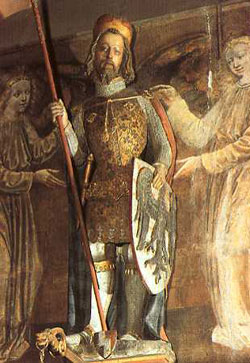
Patron saint of Bohemia, parts of Czech Republic, and duke of Bohemia from 924-929. Also called Wenceslas, he was born near Prague and raised by his grandmother, St. Ludmilla, until her murder by his mother, the pagan Drahomira.
Wenceslaus's mother assumed the regency over Bohemia about 920 after her husband's death, but her rule was so arbitrary and cruel in Wenceslaus' name that he was compelled on behalf of his subjects to overthrow her and assume power for himself in 924 or 925.
A devout Christian, he proved a gifted ruler and a genuine friend of the Church.
German missionaries were encouraged, churches were built, and Wenceslaus perhaps took a personal vow of poverty. Unfortunately, domestic events proved fatal, for in 929 the German king Heinrich I the Fowler (r. 919-936) invaded Bohemia and forced Wenceslaus to make an act of submission.
This defeat, combined with his pro-Christian policies, led a group of non-Christian nobles to conspire against him. On September 28, 935, a group of knights under the leadership of Wenceslaus' brother, Boreslav, assassinated the saint on the doorstep of a church.
Virtually from the moment of his death, Wenceslaus was considered a martyr and venerated as a saint.
Miracles were reported at his tomb, and his remains were translated to the church of St. Vitus in Prague which became a major pilgrimage site.
The feast has been celebrated at least since 985 in Bohemia, and he is best known from the Christmas carol "Good King Wenceslaus."
Come Grow With Us
Sign up and walk the Catholic journey with millions around the world.
Receive inspiring emails on saints, daily readings, and free faith-building resources—no cost, ever.
Millions Depend on These FREE Catholic Resources.
But We Can't Keep Them Free Without You.
- 7 Morning Prayers
- Mysteries of the Rosary
- Litany of the Bl. Virgin Mary
- Popular Saints
- Popular Prayers
- Female Saints
- Saint Feast Days by Month
- Stations of the Cross
- St. Francis of Assisi
- St. Michael the Archangel
- The Apostles' Creed
- Unfailing Prayer to St. Anthony
- Pray the Rosary








Copyright 2026 Catholic Online. All materials contained on this site, whether written, audible or visual are the exclusive property of Catholic Online and are protected under U.S. and International copyright laws, © Copyright 2026 Catholic Online. Any unauthorized use, without prior written consent of Catholic Online is strictly forbidden and prohibited.
Catholic Online is a Project of Your Catholic Voice Foundation, a Not-for-Profit Corporation. Your Catholic Voice Foundation has been granted a recognition of tax exemption under Section 501(c)(3) of the Internal Revenue Code. Federal Tax Identification Number: 81-0596847. Your gift is tax-deductible as allowed by law.