Jean-Antoine Nollet
FREE Catholic Classes
Physicist, b. at Pimpré, Oise, France, 19 November, 1700; d. at Paris, 25 April, 1770. His peasant parents sent him to study at Clermont and Beauvais. He went later to Paris to prepare for the priesthood. In 1728 he received the deaconship and applied immediately for permission to preach. Soon love of science became uppermost and together with Dufay and Réaumur he devoted himself to the study of physics and especially to research work in electricity. Abbé Nollet was the first to recognize the importance of sharp points on the conductors in the discharge of electricity. This was later applied practically in the construction of the lightning-rod. He also studied the conduction of electricity in tubes, in smoke, vapours, steam, the influence of electric charges on evaporation, vegetation, and animal life. His discovery of the osmosis of water through a bladder into alcohol was the starting-point of that branch of physics.
In 1734 Nollet went to London and was admitted into the Royal Society. In 1735 he started in Paris, at his own expense, a course in experimental physics which he continued until 1760. In 1738 Cardinal Fleury created a public chair of experimental physics for Nollet. In 1739 he entered the Academy of Sciences, becoming associate member in 1742, and pensionary in 1758. In April, 1739 the King of Sardinia called him to Turin to instruct the Duke of Savoy, and to furnish the instruments needed for the new chair of physics at the university. After lecturing a short time at Bordeaux, he was called to Versailles to instruct the dauphin in experimental science. He was appointed professor of experimental physics at the Royal College of Navarre, in 1753. In 1761 he taught at the school of artillery at Mézières. Nollet was also a member of the Institute of Bologna and of the Academy of Sciences of Erfurt. He was calm and simple in manner, and his letters and papers showed that he had been devoted and generous to his family and his native village. Nollet contributed to the "Recueil de l'Académie des Sciences" (1740-67) and the "Philosophical Transactions of the Royal Society"; his larger works include among others: — "Programme d'un cours de physique expérimentale" (Paris, 1738); "Leçons de physique expérimentale" (Paris, 1743); "Recherches sur les causes particulières des phénomenes électriques" (Paris, 1749); "L'art des expériences" (Paris, 1770).

We ask you, humbly: don't scroll away.
Hi readers, it seems you use Catholic Online a lot; that's great! It's a little awkward to ask, but we need your help. If you have already donated, we sincerely thank you. We're not salespeople, but we depend on donations averaging $14.76 and fewer than 1% of readers give. If you donate just $5.00, the price of your coffee, Catholic Online School could keep thriving. Thank you.Help Now >
 Hi readers, it seems you use Catholic Online a lot; that's great! It's a little awkward to ask, but we need your help. If you have already donated, we sincerely thank you. We're not salespeople, but we depend on donations averaging $14.76 and fewer than 1% of readers give. If you donate just $5.00, the price of your coffee, Catholic Online School could keep thriving. Thank you. Help Now >
Join the Movement
When you sign up below, you don't just join an email list - you're joining an entire movement for Free world class Catholic education.


-

-
Mysteries of the Rosary
-
St. Faustina Kowalska
-
Litany of the Blessed Virgin Mary
-
Saint of the Day for Wednesday, Oct 4th, 2023
-
Popular Saints
-
St. Francis of Assisi
-
Bible
-
Female / Women Saints
-
7 Morning Prayers you need to get your day started with God
-
Litany of the Blessed Virgin Mary


Sacrifices of Faith: The Pro-Life Legacies of St. Gianna and Jessica Hanna
-
How to love God by caring for our bodies
-
Pope Francis calls for negotiations to End Russia-Ukraine War
-
Pope Francis Contemplates Return to U.S. for United Nations Assembly Address
-
Pope Francis Calls on Faithful to Embrace Faith, Hope, and Charity in New Teaching Series


Daily Catholic
- Daily Readings for Monday, April 29, 2024
- St. Catherine of Siena: Saint of the Day for Monday, April 29, 2024
- Prayer for the Dead # 3: Prayer of the Day for Monday, April 29, 2024
- Daily Readings for Sunday, April 28, 2024
- St. Peter Chanel: Saint of the Day for Sunday, April 28, 2024
- Prayer before a Crucifix: Prayer of the Day for Sunday, April 28, 2024
 Daily Readings for Monday, April 29, 2024
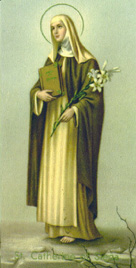 St. Catherine of Siena: Saint of the Day for Monday, April 29, 2024
 Prayer for the Dead # 3: Prayer of the Day for Monday, April 29, 2024


Copyright 2024 Catholic Online. All materials contained on this site, whether written, audible or visual are the exclusive property of Catholic Online and are protected under U.S. and International copyright laws, © Copyright 2024 Catholic Online. Any unauthorized use, without prior written consent of Catholic Online is strictly forbidden and prohibited.
Catholic Online is a Project of Your Catholic Voice Foundation, a Not-for-Profit Corporation. Your Catholic Voice Foundation has been granted a recognition of tax exemption under Section 501(c)(3) of the Internal Revenue Code. Federal Tax Identification Number: 81-0596847. Your gift is tax-deductible as allowed by law.