We ask you, humbly: don't scroll away.
Hi readers, it seems you use Catholic Online a lot; that's great! It's a little awkward to ask, but we need your help. If you have already donated, we sincerely thank you. We're not salespeople, but we depend on donations averaging $14.76 and fewer than 1% of readers give. If you donate just $5.00, the price of your coffee, Catholic Online School could keep thriving. Thank you.Help Now >
St. Melania (the Younger)
FREE Catholic Classes
Born at Rome, about 383; died in Jerusalem, 31 December, 439. She was a member of the famous family of Valerii. Her parents were Publicola and Albina, her paternal grandmother of the same name is known as Melania, Senior. Little is known of the saint's childhood, but after the time of her marriage, which occurred in her thirteenth year, we have more definite information. Through obedience to her parents she married one of her relatives, Pinianus a patrician. During her married life of seven years she had two children who died young. After their death Melania's inclination toward a celibate life reasserting itself, she secured her husband's consent and entered upon the path of evangelic perfection, parting little by little with all her wealth. Pinianus, who now assumed a brotherly position toward her, was her companion in all her efforts toward sanctity. Because of the Visigothic invasions of Italy, she left Rome in 408, and for two years lived near Messina in Sicily. Here, their life of a monastic character was shared by some former slaves. In 410 she went to Africa where she and Pinianus lived with her mother for seven years, during which time she grew well acquainted with St. Augustine and his friend Alypius. She devoted herself to works of charity and piety, especially in her zeal for souls, to the foundation of a nunnery of which she became superior, and of a cloister of which Pinianus took charge. In 417, Melania, her mother, and Pinianus went to Palestine by way of Alexandria. For a year they lived in a hospice for pilgrims in Jerusalem, where she met St. Jerome. She again made generous donations, upon the receipt of money from the sale of her estates in Spain. About this time she travelled in Egypt, where she visited the principal places of monastic and eremetical life, and upon her return to Jerusalem she lived for twelve years, in a hermitage near the Mount of Olives. Before the death of her mother (431), a new series of monastic foundations had begun. She started with a convent for women on the Mount of Olives, of which she assumed the maintenance while refusing to be made its superior. After her husband's death she built a cloister for men, then a chapel, and later, a more pretentious church. During this last period (Nov., 436), she went to Constantinople where she aided in the conversion of her pagan uncle, Volusian, ambassador at the Court of Theodosius II, and in the conflict with Nestorianism. An interesting episode in her later life is the journey of the Empress Eudocia, wife of Theodosius, to Jerusalem in 438. Soon after the empress's return Melania died.
 Hi readers, it seems you use Catholic Online a lot; that's great! It's a little awkward to ask, but we need your help. If you have already donated, we sincerely thank you. We're not salespeople, but we depend on donations averaging $14.76 and fewer than 1% of readers give. If you donate just $5.00, the price of your coffee, Catholic Online School could keep thriving. Thank you. Help Now >
The Greek Church began to venerate her shortly after her death, but she was almost unknown in the Western Church for many years. She has received greater attention since the publication of her life by Cardinal Rampolla (Rome, 1905). In 1908, Pius X granted her office to the congregation of clergy at Somascha. This may be considered as the beginning of a zealous ecclesiastical cult, to which the saint's life and works have entitled her. Melania's life has been shrouded in obscurity nearly up to the present time ; many people having wholly or partially confounded her with her grandmother Antonia Melania. The accurate knowledge of her life we owe to the discovery of two manuscripts ; the first, in Latin, was found by Cardinal Rampolla in the Escorial in 1884, the second, a Greek biography, is in the Barberini library. Cardinal Rampolla published both these important discoveries at the Vatican printing-office.


Join the Movement
When you sign up below, you don't just join an email list - you're joining an entire movement for Free world class Catholic education.


-

-
Mysteries of the Rosary
-
St. Faustina Kowalska
-
Litany of the Blessed Virgin Mary
-
Saint of the Day for Wednesday, Oct 4th, 2023
-
Popular Saints
-
St. Francis of Assisi
-
Bible
-
Female / Women Saints
-
7 Morning Prayers you need to get your day started with God
-
Litany of the Blessed Virgin Mary


Sacrifices of Faith: The Pro-Life Legacies of St. Gianna and Jessica Hanna
-
How to love God by caring for our bodies
-
Pope Francis calls for negotiations to End Russia-Ukraine War
-
Pope Francis Contemplates Return to U.S. for United Nations Assembly Address
-
Pope Francis Calls on Faithful to Embrace Faith, Hope, and Charity in New Teaching Series


Daily Catholic
- Daily Readings for Monday, April 29, 2024
- St. Catherine of Siena: Saint of the Day for Monday, April 29, 2024
- Prayer for the Dead # 3: Prayer of the Day for Monday, April 29, 2024
- Daily Readings for Sunday, April 28, 2024
- St. Peter Chanel: Saint of the Day for Sunday, April 28, 2024
- Prayer before a Crucifix: Prayer of the Day for Sunday, April 28, 2024
 Daily Readings for Monday, April 29, 2024
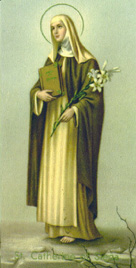 St. Catherine of Siena: Saint of the Day for Monday, April 29, 2024
 Prayer for the Dead # 3: Prayer of the Day for Monday, April 29, 2024


Copyright 2024 Catholic Online. All materials contained on this site, whether written, audible or visual are the exclusive property of Catholic Online and are protected under U.S. and International copyright laws, © Copyright 2024 Catholic Online. Any unauthorized use, without prior written consent of Catholic Online is strictly forbidden and prohibited.
Catholic Online is a Project of Your Catholic Voice Foundation, a Not-for-Profit Corporation. Your Catholic Voice Foundation has been granted a recognition of tax exemption under Section 501(c)(3) of the Internal Revenue Code. Federal Tax Identification Number: 81-0596847. Your gift is tax-deductible as allowed by law.