 Hi readers, it seems you use Catholic Online a lot; that's great! It's a little awkward to ask, but we need your help. If you have already donated, we sincerely thank you. We're not salespeople, but we depend on donations averaging $14.76 and fewer than 1% of readers give. If you donate just $5.00, the price of your coffee, Catholic Online School could keep thriving. Thank you. Help Now >
Edward Maginn
FREE Catholic Classes
Coadjutor Bishop of Derry, b. at Fintona, Ireland, 16 Dec., 1802; d. at Derry, 17 January, 1849, the son of Patrick Maginn, a farmer, and his wife, Mary Slevin, whose families gave many distinguished priests to the Irish Church in the eighteenth century. He was educated by his uncle, parish priest of Monaghan, and later by Thomas MacColgan, at Buncrana, Donegal, and entered the Irish College, Paris, in 1818. He was ordained in 1825 at Derry, and was soon appointed curate of Moville, where he remained till 1829, labouring with great fruit and winning renown as a preacher. He opposed energetically the efforts made by the Episcopalian body to proselytize his flock, and took a prominent part in a public controversy held at Derry concerning Catholic doctrines, a report of which was published later in book form (Dublin, 1828). In 1829 he became parish priest of Fahan, and applied himself to the suppression of agrarian secret societies, while appealing to the Government to protect the peasantry against the abuse of power by the local non-Catholic magistrates. He was one of the most zealous advocates of Catholic Emancipation, supported O'Connell in the Repeal movement, and endeavoured to heal the breach between the young Irelanders and the Liberator. Though recognizing the glaring defects of the "national school " system he accepted it, and by his protests prevented the withdrawal of the schools from clerical control. He repudiated the Queen's Colleges, helped to bring about their condemnation at Rome, and enthusiastically advocated the establishment of a Catholic university, which, however, he did not live to see. On 18 Jan., 1846, he was consecrated titular Bishop of Orthosia and coadjutor to Dr. MacLaughlin of Derry. Seized with typhus fever on 14 Jan., 1849, he expired three days later in St. Columb's College and was buried at Buncrana, Donegal. Dr. Maginn was an important factor in the rehabilitation of the Church in Ulster after Emancipation; he devoted himself, moreover, to the temporal welfare of the peasants, and his letters on land and the Poor Law administration, together with his evidence before the Devon Commission (Report published at Dublin, 1847), contain valuable information on the social condition of Ireland in the first half of the nineteenth century. The gross incompetency and partiality of the government officials during the famine of 1847-49 inspired him with an abhorrence of English misrule. Not the least useful of his writings was a series of letters in reply to Lord Stanley, who in the House of Lords, 23 Nov., 1847, had accused the Irish clergy of using the confessional to encourage lawlessness and crime ("Refutation of Lord Stanley's Calumnies against the Catholic Clergy of Ireland ", reprint, Dublin, 1850).
Hi readers, it seems you use Catholic Online a lot; that's great! It's a little awkward to ask, but we need your help. If you have already donated, we sincerely thank you. We're not salespeople, but we depend on donations averaging $14.76 and fewer than 1% of readers give. If you donate just $5.00, the price of your coffee, Catholic Online School could keep thriving. Thank you. Help Now >

We ask you, humbly: don't scroll away.
Hi readers, it seems you use Catholic Online a lot; that's great! It's a little awkward to ask, but we need your help. If you have already donated, we sincerely thank you. We're not salespeople, but we depend on donations averaging $14.76 and fewer than 1% of readers give. If you donate just $5.00, the price of your coffee, Catholic Online School could keep thriving. Thank you.Help Now >
Join the Movement
When you sign up below, you don't just join an email list - you're joining an entire movement for Free world class Catholic education.


-

-
Mysteries of the Rosary
-
St. Faustina Kowalska
-
Litany of the Blessed Virgin Mary
-
Saint of the Day for Wednesday, Oct 4th, 2023
-
Popular Saints
-
St. Francis of Assisi
-
Bible
-
Female / Women Saints
-
7 Morning Prayers you need to get your day started with God
-
Litany of the Blessed Virgin Mary


Sacrifices of Faith: The Pro-Life Legacies of St. Gianna and Jessica Hanna
-
How to love God by caring for our bodies
-
Pope Francis calls for negotiations to End Russia-Ukraine War
-
Pope Francis Contemplates Return to U.S. for United Nations Assembly Address
-
Pope Francis Calls on Faithful to Embrace Faith, Hope, and Charity in New Teaching Series


Daily Catholic
- Daily Readings for Monday, April 29, 2024
- St. Catherine of Siena: Saint of the Day for Monday, April 29, 2024
- Prayer for the Dead # 3: Prayer of the Day for Monday, April 29, 2024
- Daily Readings for Sunday, April 28, 2024
- St. Peter Chanel: Saint of the Day for Sunday, April 28, 2024
- Prayer before a Crucifix: Prayer of the Day for Sunday, April 28, 2024
 Daily Readings for Monday, April 29, 2024
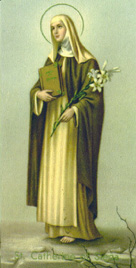 St. Catherine of Siena: Saint of the Day for Monday, April 29, 2024
 Prayer for the Dead # 3: Prayer of the Day for Monday, April 29, 2024


Copyright 2024 Catholic Online. All materials contained on this site, whether written, audible or visual are the exclusive property of Catholic Online and are protected under U.S. and International copyright laws, © Copyright 2024 Catholic Online. Any unauthorized use, without prior written consent of Catholic Online is strictly forbidden and prohibited.
Catholic Online is a Project of Your Catholic Voice Foundation, a Not-for-Profit Corporation. Your Catholic Voice Foundation has been granted a recognition of tax exemption under Section 501(c)(3) of the Internal Revenue Code. Federal Tax Identification Number: 81-0596847. Your gift is tax-deductible as allowed by law.