We ask you, humbly: don't scroll away.
Hi readers, it seems you use Catholic Online a lot; that's great! It's a little awkward to ask, but we need your help. If you have already donated, we sincerely thank you. We're not salespeople, but we depend on donations averaging $14.76 and fewer than 1% of readers give. If you donate just $5.00, the price of your coffee, Catholic Online School could keep thriving. Thank you.Help Now >
St. Eustathius
FREE Catholic Classes
Bishop of Antioch, b. at Side in Pamphylia, c. 270; d. in exile at Trajanopolis in Thrace , most probably in 360, according to some already in 336 or 337. He was at first Bishop of Berœa in Syria, whence he was transferred to Antioch c. 323. At the Council of Nicæa (325), he was one of the most prominent opponents of Arianism and from 325-330 he was engaged in an almost continuous literary warfare against the Arians. By his fearless denunciation of Arianism and his refusal to engage any Arian priests in his diocese, he incurred the hatred of the Arians, who, headed by Eusebius of Cæsarea and his namesake of Nicomedia, held a synod at Antioch (331) at which Eustathius was accused, by suborned witnesses, of Sabellianism, incontinency, cruelty, and other crimes. He was deposed by the synod and banished to Trajanopolis in Thrace by order of the Emperor Constantine, who gave credence to the scandalous tales spread about Eustathius. The people of Antioch, who loved and revered their holy and learned patriarch, became indignant at the injustice done to him and were ready to take up arms in his defence. But Eustathius kept them in check, exhorted them to remain true to the orthodox faith and humbly left for his place of exile, accompanied by a large body of his clergy. The adherents of Eustathius at Antioch formed a separate community by the name of Eustathians and refused to acknowledge the bishops set over them by the Arians. When, after the death of Eustathius, St. Meletius became Bishop of Antioch in 360 by the united vote of the Arians and the orthodox, the Eustathians would not recognize him, even after his election was approved by the Synod of Alexandria in 362. Their intransigent attitude gave rise to two factions among the orthodox, the so-called Meletian Schism, which lasted till the second decade of the fifth century (Cavallera, Le schisme d'Antioche, Paris, 1905).

Most of the numerous dogmatic and exegetical treatises of Eustathius have been lost. His principal extant work is "De Engastrimytho", in which he maintains against Origen that the apparition of Samuel ( 1 Samuel 28 ) was not a reality but a mere phantasm called up in the brain of Saul by the witch of Endor. In the same work he severely criticizes Origen for his allegorical interpretation of the Bible . A new edition of it, together with the respective homily of Origen, was made by A. Jahn in Gebhardt and Harnack's "Texte und Untersuchungen zur Gesch. der altchristl. Literatur" (Leipzig, 1886), II, fasc. iv. Cavallera recently discovered a Christological homily : "S. Eustathii ep. Antioch. in Lazarum, Mariam et Martham homilia christologica", which he edited together with a commentary on the literary fragments of Eustathius (Paris, 1905). Fragments of lost writings are found in Migne (P. G., XVIII, 675-698), Pitra and Martin (Analecta Sacra, II, Proleg., 37-40; IV, 210-213 and 441-443). "Commentarius in Hexaemeron" ( Migne, P. G.,XVIII, 707-794) and "Allocution ad Imp. Constantinum in Conc. Nicæno" ( Migne, P. G., XVIII, 673-676) are spurious. His feast is celebrated in the Latin Church on 16 July, in the Greek on 21 Feb. His relics were brought to Antioch.
We ask you, humbly: don't scroll away.
Hi readers, it seems you use Catholic Online a lot; that's great! It's a little awkward to ask, but we need your help. If you have already donated, we sincerely thank you. We're not salespeople, but we depend on donations averaging $14.76 and fewer than 1% of readers give. If you donate just $5.00, the price of your coffee, Catholic Online School could keep thriving. Thank you.Help Now >

Join the Movement
When you sign up below, you don't just join an email list - you're joining an entire movement for Free world class Catholic education.


-

-
Mysteries of the Rosary
-
St. Faustina Kowalska
-
Litany of the Blessed Virgin Mary
-
Saint of the Day for Wednesday, Oct 4th, 2023
-
Popular Saints
-
St. Francis of Assisi
-
Bible
-
Female / Women Saints
-
7 Morning Prayers you need to get your day started with God
-
Litany of the Blessed Virgin Mary


Sacrifices of Faith: The Pro-Life Legacies of St. Gianna and Jessica Hanna
-
How to love God by caring for our bodies
-
Pope Francis calls for negotiations to End Russia-Ukraine War
-
Pope Francis Contemplates Return to U.S. for United Nations Assembly Address
-
Pope Francis Calls on Faithful to Embrace Faith, Hope, and Charity in New Teaching Series


Daily Catholic
- Daily Readings for Saturday, April 27, 2024
- St. Zita: Saint of the Day for Saturday, April 27, 2024
- Prayer for the Dead # 2: Prayer of the Day for Saturday, April 27, 2024
- Daily Readings for Friday, April 26, 2024
- St. Cletus: Saint of the Day for Friday, April 26, 2024
- Prayer before the Closing of the Day: Prayer of the Day for Friday, April 26, 2024
 Daily Readings for Saturday, April 27, 2024
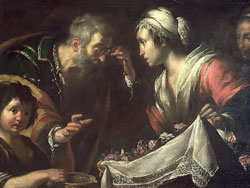 St. Zita: Saint of the Day for Saturday, April 27, 2024
 Prayer for the Dead # 2: Prayer of the Day for Saturday, April 27, 2024
 Hi readers, it seems you use Catholic Online a lot; that's great! It's a little awkward to ask, but we need your help. If you have already donated, we sincerely thank you. We're not salespeople, but we depend on donations averaging $14.76 and fewer than 1% of readers give. If you donate just $5.00, the price of your coffee, Catholic Online School could keep thriving. Thank you. Help Now >

Copyright 2024 Catholic Online. All materials contained on this site, whether written, audible or visual are the exclusive property of Catholic Online and are protected under U.S. and International copyright laws, © Copyright 2024 Catholic Online. Any unauthorized use, without prior written consent of Catholic Online is strictly forbidden and prohibited.
Catholic Online is a Project of Your Catholic Voice Foundation, a Not-for-Profit Corporation. Your Catholic Voice Foundation has been granted a recognition of tax exemption under Section 501(c)(3) of the Internal Revenue Code. Federal Tax Identification Number: 81-0596847. Your gift is tax-deductible as allowed by law.