 Hi readers, it seems you use Catholic Online a lot; that's great! It's a little awkward to ask, but we need your help. If you have already donated, we sincerely thank you. We're not salespeople, but we depend on donations averaging $14.76 and fewer than 1% of readers give. If you donate just $5.00, the price of your coffee, Catholic Online School could keep thriving. Thank you. Help Now >
Dora
FREE Catholic Classes
A titular see of Palestina Prima. The name ( Dôr ) in Semitic languages means "dwelling", "abode". On the coming of the Hebrews, the King of Dora or Dor entered into the confederation against Josue and was defeated with the confederates ( Joshua 11:2 ; 12:23 ). The town was first allotted to the tribe of Aser ( Joshua 17:11 ), then given to Manasses ( Judges 1:27 ; 1 Chronicles 7:29 ), who failed to expel the inhabitants and imposed on them a tribute; the Israelites may have captured only the upper city ( Nafat Dôr ), called Napheddor or Phenneddor by the Septuagint, and regiones or provincia Dor by the Vulgate. The Egyptian King Rameses III set up a Phœnecian colony at Dora; according to Stephan of Byzantium the Phœnecians settled there because the coast abounded in the shells that produced the famous Tyrian purple dye. Dora was united by David to the Kingdom of Israel and governed under Solomon by Benabinadab, one of the twelve prefects ( 1 Kings 4:11 ). Later it underwent successively the rule of the Persians, the Greeks, and the Lagides. In 217 B.C. it was unsuccessfully besieged by Antiochus the Great; at a later date it was taken by the kings of Syria. In 139 B.C. the usurper Tryphon, who had taken refuge at Dora, was besieged by Antiochus (VII) Sidetes with a fleet, 120,000 foot, and 8000 horse ( 1 Maccabees 15:13 ). The city then fell into the hands of a private individual called Zoilus, at whose death it was added by Alexander Jammæus to his Kingdom of Judea. When Pompey conquered Syria, he granted Dora an autonomous constitution; from this time dates its peculiar era, 64-63 B.C. , known chiefly through numerous coins. As Dora had suffered much from the Jews, Gabinius rebuilt it (56 B.C. ). In 42 of the Christian Era its inhabitants were still disputing with the Jews, whom they seem to have specially hated. In the time of Pliny the town was in a state of utter decay; St. Jerome speaks of "the ruins of that city (Dora) which had been formerly so powerful". He may have exaggerated its decay, or the city may have risen from its ruins.

As early as the fifth century it was the residence of a bishop, Sidus, and suffragan to Cæsarea; there is record also of Barachius in 518, John in 536, Stephen, the friend of St. Sophronius, Patriarch of Jerusalem and the great opponent of Monothelism. In the Middle Ages Dora was called Pirgul, a corruption of Greek p&úrgos, "tower", according to Foucher of Chartres (Gesta Dei per Francos, ed. Bongars, 396); it was also known as Merla (Rey, Les colonies franques de Syrie, Paris, 1883, 422). There are records of five Latin bishops during the fourteenth and fifteenth centuries (Eubel, I, 235; II, 161). Another is mentioned in "Revue bénédictine" (1904), p. 62. Its modern Arabic name is Tantourah. Dora is a village of about 1500 inhabitants, on the seashore between Caifa and Cæsarea, nearer the latter. The harbour is frequented by small boats; the old port, situated more to the north, was enclosed by two headlands lengthened by two piers. To the east are vast quarries and the ancient necropolis. The ruins of the ancient city cover a space about four-fifths of a mile long by one-third broad. Many Jewish colonists have recently settled in the vicinity.
We ask you, humbly: don't scroll away.
Hi readers, it seems you use Catholic Online a lot; that's great! It's a little awkward to ask, but we need your help. If you have already donated, we sincerely thank you. We're not salespeople, but we depend on donations averaging $14.76 and fewer than 1% of readers give. If you donate just $5.00, the price of your coffee, Catholic Online School could keep thriving. Thank you.Help Now >

Join the Movement
When you sign up below, you don't just join an email list - you're joining an entire movement for Free world class Catholic education.


-

-
Mysteries of the Rosary
-
St. Faustina Kowalska
-
Litany of the Blessed Virgin Mary
-
Saint of the Day for Wednesday, Oct 4th, 2023
-
Popular Saints
-
St. Francis of Assisi
-
Bible
-
Female / Women Saints
-
7 Morning Prayers you need to get your day started with God
-
Litany of the Blessed Virgin Mary


Sacrifices of Faith: The Pro-Life Legacies of St. Gianna and Jessica Hanna
-
How to love God by caring for our bodies
-
Pope Francis calls for negotiations to End Russia-Ukraine War
-
Pope Francis Contemplates Return to U.S. for United Nations Assembly Address
-
Pope Francis Calls on Faithful to Embrace Faith, Hope, and Charity in New Teaching Series


Daily Catholic
- Daily Readings for Monday, April 29, 2024
- St. Catherine of Siena: Saint of the Day for Monday, April 29, 2024
- Prayer for the Dead # 3: Prayer of the Day for Monday, April 29, 2024
- Daily Readings for Sunday, April 28, 2024
- St. Peter Chanel: Saint of the Day for Sunday, April 28, 2024
- Prayer before a Crucifix: Prayer of the Day for Sunday, April 28, 2024
 Daily Readings for Monday, April 29, 2024
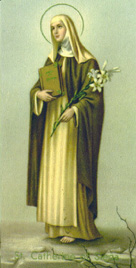 St. Catherine of Siena: Saint of the Day for Monday, April 29, 2024
 Prayer for the Dead # 3: Prayer of the Day for Monday, April 29, 2024


Copyright 2024 Catholic Online. All materials contained on this site, whether written, audible or visual are the exclusive property of Catholic Online and are protected under U.S. and International copyright laws, © Copyright 2024 Catholic Online. Any unauthorized use, without prior written consent of Catholic Online is strictly forbidden and prohibited.
Catholic Online is a Project of Your Catholic Voice Foundation, a Not-for-Profit Corporation. Your Catholic Voice Foundation has been granted a recognition of tax exemption under Section 501(c)(3) of the Internal Revenue Code. Federal Tax Identification Number: 81-0596847. Your gift is tax-deductible as allowed by law.