Sigebert of Gembloux
FREE Catholic Classes
Benedictine historian, b. near Gembloux which is now in the Province of Namur, Belgium, about 1035; d. at the same place, 5 November, 1112. He was apparently not a German, but seems to have been of Latin descent. He received his education at the Abbey of Gembloux and at an early age became a monk in this abbey ; after this he taught for a long time at the Abbey of St. Vincent at Metz. About 1070 he returned to Gembloux, where he was universally admired and venerated, and had charge there of the abbey school until his death. While at Metz he wrote the biographies of Bishop Theodoric I of Metz (964-85), of King Sigebert III, founder of the monastery of St. Martin at Metz, and also a long poem on the martyrdom of St. Lucia, whose relics were venerated at the Abbey of St. Vincent. After his return to Gembloux he also wrote similar works for this abbey, namely: a long poem on the martyrdom of the Theban Legion, as Gembloux had relics of its reputed leader Exuperius; a biography of the founder of the abbey, Wicbert (d. 962); a history of the abbots of Gembloux, and revisions of the biographies of St. Maclovius and the two early bishops of Liège, Theodard and Lambert.

Later he became a violent imperial partisan in the great struggle between the empire and the papacy. Of the three treatises which he contributed to the contest, one is lost; this was an answer to the letter of Gregory VII, written in 1081 to Bishop Hermann of Metz, in which Gregory asserted that the popes have the right to excommunicate kings and to release subjects from the oath of loyalty. In the second treatise Sigebert defended the masses of married priests, the hearing of which had been forbidden by the pope in 1074. When Paschal II in 1103 ordered the Count of Flanders to punish the citizens of Liège for their adherence to the emperor and to take up arms against him, Sigebert attacked the proceeding of the pope as unchristian and contrary to the Scriptures. His most celebrated work, "Chronicon sive Chronographia", is a chronicle of the world; it must be confessed that in this work he has not written history; he desired probably merely to give a chronological survey, consequently there is only a bare list of events even for the era in which he lived, though the last years, including 1105-11, are treated more in detail. The chronicle gained a very high reputation, was circulated in numberless copies, and was the basis of many later works of history. Notwithstanding various oversights and mistakes the industry and wide reading of Sigebert deserve honorable mention. He also made a catalogue of one hundred and seventy-one ecclesiastical writers and their works from Gennadius to his own time, "De scriptoribus ecclesiasticis". In this list he mentions his own work.
We ask you, humbly: don't scroll away.
Hi readers, it seems you use Catholic Online a lot; that's great! It's a little awkward to ask, but we need your help. If you have already donated, we sincerely thank you. We're not salespeople, but we depend on donations averaging $14.76 and fewer than 1% of readers give. If you donate just $5.00, the price of your coffee, Catholic Online School could keep thriving. Thank you.Help Now >
Join the Movement
When you sign up below, you don't just join an email list - you're joining an entire movement for Free world class Catholic education.


-

-
Mysteries of the Rosary
-
St. Faustina Kowalska
-
Litany of the Blessed Virgin Mary
-
Saint of the Day for Wednesday, Oct 4th, 2023
-
Popular Saints
-
St. Francis of Assisi
-
Bible
-
Female / Women Saints
-
7 Morning Prayers you need to get your day started with God
-
Litany of the Blessed Virgin Mary


Sacrifices of Faith: The Pro-Life Legacies of St. Gianna and Jessica Hanna
-
How to love God by caring for our bodies
-
Pope Francis calls for negotiations to End Russia-Ukraine War
-
Pope Francis Contemplates Return to U.S. for United Nations Assembly Address
-
Pope Francis Calls on Faithful to Embrace Faith, Hope, and Charity in New Teaching Series


Daily Catholic
- Daily Readings for Monday, April 29, 2024
- St. Catherine of Siena: Saint of the Day for Monday, April 29, 2024
- Prayer for the Dead # 3: Prayer of the Day for Monday, April 29, 2024
- Daily Readings for Sunday, April 28, 2024
- St. Peter Chanel: Saint of the Day for Sunday, April 28, 2024
- Prayer before a Crucifix: Prayer of the Day for Sunday, April 28, 2024
 Daily Readings for Monday, April 29, 2024
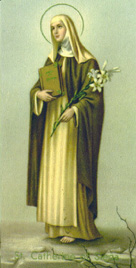 St. Catherine of Siena: Saint of the Day for Monday, April 29, 2024
 Prayer for the Dead # 3: Prayer of the Day for Monday, April 29, 2024
We ask you, humbly: don't scroll away.
Hi readers, it seems you use Catholic Online a lot; that's great! It's a little awkward to ask, but we need your help. If you have already donated, we sincerely thank you. We're not salespeople, but we depend on donations averaging $14.76 and fewer than 1% of readers give. If you donate just $5.00, the price of your coffee, Catholic Online School could keep thriving. Thank you.Help Now >

Copyright 2024 Catholic Online. All materials contained on this site, whether written, audible or visual are the exclusive property of Catholic Online and are protected under U.S. and International copyright laws, © Copyright 2024 Catholic Online. Any unauthorized use, without prior written consent of Catholic Online is strictly forbidden and prohibited.
Catholic Online is a Project of Your Catholic Voice Foundation, a Not-for-Profit Corporation. Your Catholic Voice Foundation has been granted a recognition of tax exemption under Section 501(c)(3) of the Internal Revenue Code. Federal Tax Identification Number: 81-0596847. Your gift is tax-deductible as allowed by law.
