We ask you, humbly: don't scroll away.
Hi readers, it seems you use Catholic Online a lot; that's great! It's a little awkward to ask, but we need your help. If you have already donated, we sincerely thank you. We're not salespeople, but we depend on donations averaging $14.76 and fewer than 1% of readers give. If you donate just $5.00, the price of your coffee, Catholic Online School could keep thriving. Thank you.Help Now >
Sadducees
FREE Catholic Classes
A politico-religious sect of the Jews during the late post-Exile and New-Testament period. The old derivation of the name from tsaddiqim , i.e. the righteous; with assumed reference to the adherence of the Sadducees to the letter of the Law as opposed to the pharasaic attention to the superadded "traditions of the elders", is now generally discredited mainly on philological grounds and the term is associated with the proper name "Sadoc", Sadducee being equivalent to Sadokite. They became the dominant priestly party during the Greek and Roman period of Jewish history, and the name, whether bestowed seriously or in irony, originated doubtless in their pretensions to the descendants of Sadoc, the high-priest prominent in the times of David and Solomon ( 1 Kings 1:8, 26, 32 ; 2:35 ; 1 Chronicles 29:22 ; cf. Ezekiel 40:46 ; 42:19 ; etc.). As a prominent political party they first appear in the reign of John Hyrcanus (135-105 B.C.). They espoused the hellenizing tendencies of the Asmonean princes in which they were strongly opposed by the Pharisees, or Separatists, a party evolved from the earlier Assideans, and which abhorred all forms of Greek culture as detrimental to the religious interests of the Jewish nation. Under Aristobulus I and Alexander Jannæus, the immediate successor of John Hyrcanus, the power of the Sadducees was supreme, and though the opposing faction of the Pharisees came into favour during the regency of Alexandra Salome (780-69 B.C.), the Sadducees regained their ascendancy under Aristobulus II (69-63 B.C.) whom they supported in his conflicts with Hyrcanus II, Antipater, and the Romans. When Pompey captured Jerusalem (63 B.C.) he executed many of their leaders, as did also Herod the Idumean on his accession to power (37 B.C.). The Sadducees retained however, their traditional priestly functions and also a varying preponderance in the Sanhedrin, but even in this respect their influence was much diminished through the policy of Herod and later of the Roman procurators of Judea, who, arbitrarily and mainly for political reasons, appointed and removed the high-priests at will.

During this period and down to the destruction of Jerusalem the Sadducees were naturally unpopular with the masses because of their marked tendency to side closely with the ruling power, while the patriotic and exclusive Pharisees became more and more the leaders of the people. Among the religious difference between the two parties may be mentioned the denial on the part of the Sadducees of the resurrection, the immortality of the soul and the existence of angels ( Matthew 22:23 ; Mark 12:18 ; Acts 23:8 ). They rejected likewise the oral traditions which the Pharisees maintained and emphasized as a Divinely ordained supplement to the written law. While the tenacity and exclusiveness and other characteristics of the Pharisees have been indelibly impressed on all subsequent generations of Judaism, the influence of the indifferent and materialistic Sadducees vanished completely as soon as the Jews ceased to be a nation.
We ask you, humbly: don't scroll away.
Hi readers, it seems you use Catholic Online a lot; that's great! It's a little awkward to ask, but we need your help. If you have already donated, we sincerely thank you. We're not salespeople, but we depend on donations averaging $14.76 and fewer than 1% of readers give. If you donate just $5.00, the price of your coffee, Catholic Online School could keep thriving. Thank you.Help Now >

Join the Movement
When you sign up below, you don't just join an email list - you're joining an entire movement for Free world class Catholic education.


-

-
Mysteries of the Rosary
-
St. Faustina Kowalska
-
Litany of the Blessed Virgin Mary
-
Saint of the Day for Wednesday, Oct 4th, 2023
-
Popular Saints
-
St. Francis of Assisi
-
Bible
-
Female / Women Saints
-
7 Morning Prayers you need to get your day started with God
-
Litany of the Blessed Virgin Mary


Sacrifices of Faith: The Pro-Life Legacies of St. Gianna and Jessica Hanna
-
How to love God by caring for our bodies
-
Pope Francis calls for negotiations to End Russia-Ukraine War
-
Pope Francis Contemplates Return to U.S. for United Nations Assembly Address
-
Pope Francis Calls on Faithful to Embrace Faith, Hope, and Charity in New Teaching Series


Daily Catholic
- Daily Readings for Monday, April 29, 2024
- St. Catherine of Siena: Saint of the Day for Monday, April 29, 2024
- Prayer for the Dead # 3: Prayer of the Day for Monday, April 29, 2024
- Daily Readings for Sunday, April 28, 2024
- St. Peter Chanel: Saint of the Day for Sunday, April 28, 2024
- Prayer before a Crucifix: Prayer of the Day for Sunday, April 28, 2024
 Daily Readings for Monday, April 29, 2024
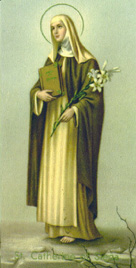 St. Catherine of Siena: Saint of the Day for Monday, April 29, 2024
 Prayer for the Dead # 3: Prayer of the Day for Monday, April 29, 2024



Copyright 2024 Catholic Online. All materials contained on this site, whether written, audible or visual are the exclusive property of Catholic Online and are protected under U.S. and International copyright laws, © Copyright 2024 Catholic Online. Any unauthorized use, without prior written consent of Catholic Online is strictly forbidden and prohibited.
Catholic Online is a Project of Your Catholic Voice Foundation, a Not-for-Profit Corporation. Your Catholic Voice Foundation has been granted a recognition of tax exemption under Section 501(c)(3) of the Internal Revenue Code. Federal Tax Identification Number: 81-0596847. Your gift is tax-deductible as allowed by law.
