 Dear readers, Catholic Online was de-platformed by Shopify for our pro-life beliefs. They shut down our Catholic Online, Catholic Online School, Prayer Candles, and Catholic Online Learning Resources essential faith tools serving over 2.2 million students and millions of families worldwide. Our founders, now in their 70's, just gave their entire life savings to protect this mission. But fewer than 2% of readers donate. If everyone gave just $5, the cost of a coffee, we could rebuild stronger and keep Catholic education free for all. Stand with us in faith. Thank you. DONATE TODAY >
St. Vincent Saragossa
Facts
Patron: of São Vicente, Lisbon; Vicenza, Italy, vinegar-makers, wine-makers.
Death: 304
Author and Publisher - Catholic Online
Printable Catholic Saints PDFs
Shop St. Vincent Saragossa
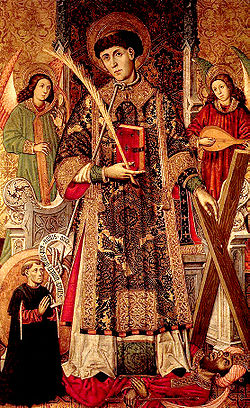
St. Vincent, the protomartyr of Spain, was a deacon of the 3rd century. Together with his Bishop, Valerius of Saragossa, he was apprehended during a persecution of Dacian the governor of Spain. Valerius was banished but Vincent was subjected to fierce tortures before ultimately dying from his wounds. According to details of his death (which seem to have been considerably developed later on), his flesh was pierced with iron hooks, he was bound upon a red-hot gridiron and roasted, and he was cast into a prison and laid on a floor strewn with broken pottery. But through it all his constancy remained unmoved (leading to his jailer's conversion) and he survived until his friends were allowed to see him and prepare a bed for on which he died. The saint's fame spread rapidly throughout Gaul and Africa - we have several sermons of St. Augustine given on his feast day. His feast day is January 22.

Come Grow With Us
Sign up and walk the Catholic journey with millions around the world.
Receive inspiring emails on saints, daily readings, and free faith-building resources—no cost, ever.
Thank You for Being Part of Our Catholic Family.
Watch Sister Sara's Special Message
- 7 Morning Prayers
- Mysteries of the Rosary
- Litany of the Bl. Virgin Mary
- Popular Saints
- Popular Prayers
- Female Saints
- Saint Feast Days by Month
- Stations of the Cross
- St. Francis of Assisi
- St. Michael the Archangel
- The Apostles' Creed
- Unfailing Prayer to St. Anthony
- Pray the Rosary









Copyright 2026 Catholic Online. All materials contained on this site, whether written, audible or visual are the exclusive property of Catholic Online and are protected under U.S. and International copyright laws, © Copyright 2026 Catholic Online. Any unauthorized use, without prior written consent of Catholic Online is strictly forbidden and prohibited.
Catholic Online is a Project of Your Catholic Voice Foundation, a Not-for-Profit Corporation. Your Catholic Voice Foundation has been granted a recognition of tax exemption under Section 501(c)(3) of the Internal Revenue Code. Federal Tax Identification Number: 81-0596847. Your gift is tax-deductible as allowed by law.
