
Benedict XVI's Planned Lecture at La Sapienza
FREE Catholic Classes
"The Truth Makes Us Good and Goodness Is True"
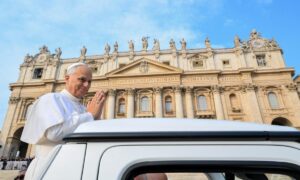
VATICAN CITY, JAN. 20, 2008 (Zenit) - Here is a translation of the speech Benedict XVI planned to deliver at La Sapienza University in Rome. The Vatican reported Tuesday that the visit would be postponed due to what the Pope's secretary of state called a lack of the "prerequisites for a dignified and tranquil welcome."
* * *
Magnificent Rector,
Political and Civil Authorities,
Illustrious Professors and Administrative Staff,
Dear Young Students!
It is a source of great joy for me this encounter with the community of La Sapienza -- University of Rome -- on the occasion of the inauguration of the academic year. For centuries now this university marks the journey and the life of the city of Rome, bringing the best intellectual energies to bear fruit in every field of knowledge.
Whether in the period when, after its foundation at the behest of Pope Boniface VIII, it depended directly on ecclesiastical authority, or whether when the "Studium Urbis" later developed as an institute of the Italian state, your academic community has maintained a high scientific and cultural level, which places it among the most prestigious universities of the world.
The Church of Rome has always looked upon this university center with affection and admiration, recognizing the commitment -- sometimes arduous and demanding -- to research and to the formation of new generations. Significant moments of collaboration and dialogue have not been lacking in recent years. I would like to recall, in particular, the International Meeting of Rectors on the occasion of the Jubilee of Universities that saw your community take charge, not only of welcoming and organizing, but above all of the prophetic and complex task of elaborating a "new humanism for the third millennium."
It is a pleasure, in this circumstance, to express my gratitude for the invitation you have offered to me to come to your university to give a lecture. In this regard I asked myself first of all the question: What can, and must, a Pope say on an occasion like this? In my lecture at Regensburg I spoke, indeed, as Pope, but above all I spoke as a former professor of that university of mine, trying to bring together memories and current events. At La Sapienza, the ancient university of Rome, however, I am invited precisely as Bishop of Rome, and because of this I must speak as such. Certainly, La Sapienza was once the Pope's university, but today it is a secular university with that autonomy that, on the basis of its foundational concept itself, has always been part of the university, which must be bound exclusively to the authority of the truth. In its freedom from political and ecclesiastical authorities, the university finds its particular function, precisely for modern society as well, which needs an institution of this type.
I return to my initial question: What can and must the Pope say in meeting with the university of his city? Reflecting on this question, it seemed to me that it included two others, whose clarification must lead by itself to the answer. It must, in fact, be asked: What is the nature and the mission of the Papacy? And still further: What is the nature and the mission of the university? In this place I do not wish to detain you and me with long disquisitions on the nature of the Papacy. A brief remark will suffice.
The Pope is first of all Bishop of Rome and as such, in virtue of succession to the Apostle Peter, has an episcopal responsibility in regard to the whole Catholic Church. The word "bishop" - "episkopos" in Greek, which primarily means "overseer" -- has already in the New Testament been fused together with the biblical concept of shepherd: He is the one who, from a higher vantage point, considers the whole, concerning himself with the right path and of the cohesion of the whole. In this sense, such a designation of his task orientates him first of all to the entirety of the believing community. The bishop -- the shepherd -- is the man who takes care of this community; he who maintains its unity and keeps it on the way toward God, indicated, according to the faith, by Jesus -- and not only indicated by Jesus: Jesus himself is the way for us.
But this community with which the bishop concerns himself -- large or small as it may be -- lives in the world; its state, its example and its word inevitably influence all the rest of the human community in its entirety. The bigger it is, the more that its good state or its possible degradation have repercussions for the whole of humanity. Today we see with great clarity how the conditions of the religions and how the situation of the Church -- her crises and her renewals -- affect the whole of humanity. Thus the Pope, precisely as shepherd of his community, has also become more and more a voice of the ethical reason of humanity.
Here, however, there immediately surfaces the objection, according to which, the Pope would not truly speak on the basis of ethical reason, but would take his judgments from the faith, and because of this he could not pretend that they are valid for those who do not share this faith. We must return to this issue later because here the absolutely fundamental question is posed: What is reason? How can a claim -- above all a moral norm -- show itself to be "reasonable"?
At this moment I would like to only briefly note that John Rawls, although denying to comprehensive religious doctrines the character of "public" reason, nevertheless sees at least in their "nonpublic" reason a reason that cannot, in the name of a secularly hardened rationality, simply be disregarded by those who support it.
He sees a criterion for this reasonableness in, among other things, the fact that similar doctrines derive from a responsible and validly grounded tradition in which, over a long period of time, sufficiently good argumentation has developed to support the respective doctrine. What seems important to me in this affirmation is the recognition that experience and demonstration over the course of generations, the historical background of human wisdom, are also a sign of its reasonableness and its enduring significance. In the face of an a-historical reason that tries to construct itself through a-historical rationality, the wisdom of humanity as such -- the wisdom of the great religious traditions -- is to be valued as a reality that cannot be with impunity thrown into the dustbin of the history of ideas.
Let us return to the initial question. The Pope speaks as a representative of a believing community in which, over the centuries of its existence, a determinate wisdom of life has matured; he speaks as the representative of a community that bears within itself a treasury of ethical knowledge and experience that turns out to be important for the whole of humanity: in this sense he speaks as a representative of ethical reason.

But now we must ask ourselves: And what is the university? What is its task? It is a huge question to which, once again, I can try to respond only in an almost telegraphic way with some observations. I think that it can be said that the true, interior origin of the university is in the desire for knowledge that is native to man. He wants to know what it is that surrounds him. He wants truth. In this sense we can see that Socrates' self-questioning as the impulse from which the Western university was born.
I think, for example -- to mention only one text -- of the debate with Euthyphro, who defends mythical religion and his piety before Socrates. Against this Socrates poses the question: "Do you really believe that the gods fight with one another, and have awful quarrels and battles? ... Must we in fact say, Euthyphro, that all that is true?" ("Euthyphro," 6b-c). In this apparently impious question -- which in Socrates derived from a more profound and more pure religiosity, from the search for the truly divine God -- the Christians of the first centuries recognized themselves and their path. They did not understand their faith in a positivistic way, or as an escape from frustrated desires; they understood it as the dispersal of the fog of mythological religion to give room for the discovery of that God who is creative Reason and at the same time Reason-Love.
On account of this, reason's asking itself about the greater God, as its asking about the true nature and the true meaning of the human being, was not a problematic form of a lack of religiosity for those early Christians, but was part of the essence of their way of being religious. They did not need, then, to throw off or put aside Socratic self-questioning, but were able -- or rather, had to -- accept as part of their own identity reason's difficult search to reach knowledge of the whole truth. In this way, in the domain of Christian faith, in the Christian world, the university was able to -- or rather, had to -- be born.
It is necessary to take a further step. Man wants to know -- he wants truth. Truth is first of all a thing of seeing, of understanding, of "theoria," as it is called by the Greek tradition. But the truth is never only theoretic. Augustine, in making a correlation between the beatitudes of the Sermon on the Mount and the gifts of the Spirit mentioned in Isaiah 11, affirmed a reciprocity between "scientia" and "tristitia": mere knowing, he says, makes one sad. And, in fact, those who only see and apprehend everything that happens in the world ends up becoming sad. But truth means more than knowing: Knowledge of the truth has knowledge of the good as its scope. This is also the meaning of Socratic self-questioning: What is that good that makes us true? The truth makes us good and goodness is true: This is the optimism that lives in Christian faith, because to it has been conceded the vision of the Logos, of creative Reason that, in the incarnation of God, has revealed himself as the Good, as Goodness Itself.
In medieval theology there was a substantial debate about the relationship between theory and practice, about the right relation between knowing and acting -- a debate that we cannot develop here. In fact, the medieval university, with its four faculties, presents this correlation. Let us start with the faculty that, according to the understanding of the time, was the fourth, namely, medicine. Even if it was considered more of an "art" than a science, nevertheless, its insertion in the cosmos of the "universitas" clearly signified that it was placed in the context of rationality, that the art of healing was under the guidance of reason, and was removed from the context of magic. Healing is a task that demands more and more from simple reason, but precisely because of this it needs the connection between knowing and power, it needs to belong to the sphere of "ratio."
In the faculty of jurisprudence the question of the relationship between practice and theory, between knowing and acting, inevitably appears. It is a matter of giving the right form to human freedom, which is always a freedom in reciprocal communion: Law is the presupposition of freedom, not its antagonist. Be here the question immediately arises: How can we identify the criteria of justice that make a freedom lived together possible and serve man's well-being. At this point a leap into the present imposes itself: It is the question of how a juridical norm that constitutes an ordering of freedom, of human dignity and of the rights of man can be found. It is the question that concerns us today in the democratic processes of the formation of opinion and that at the same time makes us anxious as a question for the future of humanity.
JĂĽrgen Habermas expresses, in my view, a vast consensus of current thought when he says that the legitimacy of a constitutional charter, as a presupposition of legality, would be derived from two sources: from the egalitarian political participation of all citizens and from the reasonable form in which political conflicts get resolved. In regard to this "reasonable form" he notes that it cannot only be a struggle for arithmetic majorities, but it must be characterized by a "process of argumentation that is sensitive to the truth" ("wahrheitssensibles Argumentationsverfahren"). This is well said, but it is a difficult thing to transform into a political practice.
The representatives of that public "process of argumentation" are -- we know -- predominantly the parties as those in charge of the formation of the political will. In fact, they will unfailingly have as their aim above all the obtaining of majorities and so will almost inevitably be preoccupied with the interests that they promise to satisfy; such interests, however, are often particular and do not truly serve the whole. The sensitivity to truth is again and again defeated by the sensitivity to interests. I find it significant that Habermas speaks about the sensitivity to the truth as a necessary element of the process of political argumentation, reinserting thus the concept of truth into the philosophical debate and into the political debate.

But then Pilate's question becomes inevitable: What is truth? How is it recognized? If in answer to these questions one refers to "public reason," as Rawls does, once more there necessarily follows the question: What is reasonable? How does a reason show itself to be true reason? In any case, on this basis it is made evident that, in the search for the law of freedom, for the truth of just communal life, voices besides those of parties and interest groups must be heard, but without thereby contesting the importance of the parties and interest groups. Let us return to the structure of the medieval university.
Alongside the faculty of jurisprudence were the faculties of philosophy and theology, to whom was entrusted the study of man's being in its totality and, along with this, the task of keeping the sensitivity to truth alive. It could even be said that this is the permanent and true meaning of both faculties: being guardians of the sensitivity to truth, not allowing man to be deterred from the search for truth. But how can they live up to this task? This is a question for which it is necessary again and again to labor, and which is never definitively posed or resolved. Thus, at this point, neither can I properly offer an answer, but an invitation to stay on the road with this question -- the road along which the great ones have struggled and searched throughout the whole of history, with their answers and their restlessness for the truth, which continually refers beyond any single answer.
Theology and philosophy form, because of this, a peculiar pair of twins, neither of which can be totally separated from the other and, nevertheless, each must preserve its proper task and proper identity. It is the historical merit of St. Thomas Aquinas -- vis-Ă -vis the various responses of the Fathers due to their historical context -- to have illumined the autonomy of philosophy, and with it the proper right and the responsibility of reason that questions itself on the basis of its powers. Differentiating themselves from the Neoplatonic philosophies, in which religion and philosophy were inseparably intertwined, the Fathers presented the Christian faith as the true philosophy, underscoring also that this faith corresponds to the exigencies of reason in search of the truth; that faith is the "yes" to the truth, compared with the mythic religions that had become mere custom.

But then, with the birth of the university, those religions no longer existed in the West, but just Christianity alone, and thus it was necessary to emphasize in a new way the proper responsibility of reason, that must not be absorbed by faith. Thomas found himself acting in a privileged moment: For the first time the whole corpus of Aristotle's philosophical writings were available; Jewish and Arab philosophies were present as specific appropriations and continuations of Greek philosophy. In this way Christianity, in a new dialogue with the reason of others, with which it came into contact, had to struggle for its own reasonableness.
The faculty of philosophy, which, as the so-called "faculty of arts," until that moment had only been a propedeutic to theology, now became a true and proper faculty, an autonomous partner of theology and of faith in this reaction. We cannot pause here over the absorbing confrontation that resulted. I would say that St. Thomas' idea of the relationship between philosophy and theology could be expressed in the Council of Chalcedon's formula for Christology: Philosophy and theology must relate to each other "without confusion and without separation." "Without confusion" means that both of them preserve their proper identity. Philosophy must truly remain an undertaking of reason in its proper freedom and proper responsibility; it must recognize its limits, and precisely in this way also its grandeur and vastness. Theology must continue to draw from the treasury of knowledge that it did not invent itself, that always surpasses it and that, never being totally exhaustible through reflection, and precisely because of this, launches thinking.
Together with the "without confusion," the "without separation" is also in force: Philosophy does not begin again from zero with the subject thinking in isolation, but rather stands in the great dialogue of historical wisdom, that again and again it both critically and docilely receives and develops; but it must not close itself off from that which the religions, and the Christian faith in particular, have received and bequeathed on humanity as an indication of the way. Various things said by theologians in the course of history and also things handed down in the practice of ecclesial authorities, have been shown to be false by history and today they confuse us. But at the same time it is true that the history of the saints, the history of the humanism that grew up on the basis of the Christian faith, demonstrates the truth of this faith in its essential nucleus, thereby making it an example for public reason. Certainly, much of what theology and faith say can only be accepted within faith and therefore it cannot present itself as an exigency to those for whom this faith still remains inaccessible. At the same time it is true, however, that the message of the Christian faith is never only a "comprehensive religious doctrine" in the sense of Rawls, but a purifying force for reason itself, that helps reason to be more itself. The Christian message, on the basis of its origin, must always be an encouragement toward the truth and thus a force against the pressure of power and interests.

Well, I have only been talking about the medieval university, trying nevertheless to make transparent the permanent nature of the university and its task. In modern times new dimensions of knowledge have been disclosed that in the university have been valued above all in two great fields: first of all in the natural sciences, which have developed on the basis of the connection of experimentation and the presupposed rationality of matter; in the second place in the historical and humanistic sciences, in which man, scrutinizing the mirror of his history and clarifying the dimensions of his nature, attempts to understand himself better. In this development there has opened to humanity not only an immense measure of knowledge and power; the knowledge and recognition of the rights and dignity of man have also grown, and we can only be grateful for this.
But man's journey can never suppose itself to be at an end and the danger of falling into inhumanity is never simply overcome -- as we see in the panorama of contemporary history! Today the danger of the Western world -- to speak only of this context -- is that man, precisely in the consideration of the grandeur of his knowledge and power, might give up before the question of truth. And that means at the same time that reason, in the end, bows to the pressure of interests and the charm of utility, constrained to recognize it as the ultimate criterion. To put this in terms of the point of view of the structure of the university: The danger exists that philosophy, no longer feeling itself capable of its true task, might degenerate into positivism; that theology, with its message addressed to reason, might become confined to the private sphere of a group more or less sizable. If, however, reason -- solicitous of its presumed purity -- becomes deaf to the great message that comes from the Christian faith and its wisdom, it will wither like a tree whose roots no longer reach the waters that give it life. It will lose courage for the truth and thus it will not become greater but less. Applied to our European culture this means: If it wants only to construct itself on the basis of the circle of its own arguments and that which convinces it at the moment -- worried about its secularity -- it will cut itself off from the roots by which it lives; then it will not become more reasonable and more pure, but it will break apart and disintegrate.

With this I return to the point of departure. What does the Pope have to do with, or have to say to the university? Surely he must not attempt to impose the faith on others in an authoritarian way since it can only be bestowed in freedom. Beyond his office as Shepherd of the Church, and on the basis of the intrinsic nature of this pastoral office, there is his duty to keep the sensitivity to truth alive; to continually invite reason to seek out the true, the good, God, and on this path, to urge it to glimpse the helpful lights that shine forth in the history of the Christian faith, and in this way to perceive Jesus Christ as the Light that illuminates history and helps us to find the way to the future.
From the Vatican, January 17, 2008
BENEDICTUS XVI
[Translation by Joseph G. Trabbic]
Contact
Catholic Online
https://www.catholic.org
CA, US
Catholic Online - Publisher, 661 869-1000
info@yourcatholicvoice.org
Keywords
La Sapienza, Pope, Benedict, Lecture, Truth, Speech

More Catholic PRWire
Showing 1 - 50 of 4,716
A Recession Antidote
Randy Hain
Monaco & The Vatican: Monaco's Grace Kelly Exhibit to Rome--A Review of Monegasque-Holy See Diplomatic History
Dna. Maria St. Catherine Sharpe, t.o.s.m., T.O.SS.T.
The Why of Jesus' Death: A Pauline Perspective
Jerom Paul
A Royal Betrayal: Catholic Monaco Liberalizes Abortion
Dna. Maria St.Catherine De Grace Sharpe, t.o.s.m., T.O.SS.T.
Embrace every moment as sacred time
Mary Regina Morrell
My Dad
JoMarie Grinkiewicz
Letting go is simple wisdom with divine potential
Mary Regina Morrell
Father Lombardi's Address on Catholic Media
Catholic Online
Pope's Words to Pontifical Latin American College
Catholic Online
Prelate: Genetics Needs a Conscience
Catholic Online
State Aid for Catholic Schools: Help or Hindrance?
Catholic Online
Scorsese Planning Movie on Japanese Martyrs
Catholic Online
2 Nuns Kidnapped in Kenya Set Free
Catholic Online
Holy See-Israel Negotiation Moves Forward
Catholic Online
Franchising to Evangelize
Catholic Online
Catholics Decry Anti-Christianity in Israel
Catholic Online
Pope and Gordon Brown Meet About Development Aid
Catholic Online
Pontiff Backs Latin America's Continental Mission
Catholic Online
Cardinal Warns Against Anti-Catholic Education
Catholic Online
Full Circle
Robert Gieb
Three words to a deeper faith
Paul Sposite
Relections for Lent 2009
chris anthony
Wisdom lies beyond the surface of life
Mary Regina Morrell
World Food Program Director on Lent
Catholic Online
Moral Clarity
DAN SHEA
Pope's Lenten Message for 2009
Catholic Online
A Prayer for Monaco: Remembering the Faith Legacy of Prince Rainier III & Princess Grace and Contemplating the Moral Challenges of Prince Albert II
Dna. Maria St. Catherine Sharpe
Keeping a Lid on Permissiveness
Sally Connolly
Glimpse of Me
Sarah Reinhard
The 3 stages of life
Michele Szekely
Sex and the Married Woman
Cheryl Dickow
A Catholic Woman Returns to the Church
Cheryl Dickow
Modernity & Morality
Dan Shea
Just a Minute
Sarah Reinhard
Catholic identity ... triumphant reemergence!
Hugh McNichol
Edging God Out
Paul Sposite
Burying a St. Joseph Statue
Cheryl Dickow
George Bush Speaks on Papal Visit
Catholic Online
Sometimes moving forward means moving the canoe
Mary Regina Morrell
Action Changes Things: Teaching our Kids about Community Service
Lisa Hendey
Easter... A Way of Life
Paul Spoisite
Papal initiative...peace and harmony!
Hugh McNichol
Proclaim the mysteries of the Resurrection!
Hugh McNichol
Jerusalem Patriarch's Easter Message
Catholic Online
Good Friday Sermon of Father Cantalamessa
Catholic Online
Papal Address at the End of the Way of the Cross
Catholic Online
Cardinal Zen's Meditations for Via Crucis
Catholic Online
Interview With Vatican Aide on Jewish-Catholic Relations
Catholic Online
Pope Benedict XVI On the Easter Triduum
Catholic Online
Holy Saturday...anticipation!
Hugh McNichol
Join the Movement
When you sign up below, you don't just join an email list - you're joining an entire movement for Free world class Catholic education.
Our Important Lenten Message - Please Watch
- Easter / Lent
- 5 Lenten Prayers
- Ash Wednesday
- 7 Morning Prayers
- Mysteries of the Rosary
- Litany of the Bl. Virgin Mary
- Popular Saints
- Popular Prayers
- Female Saints
- Saint Feast Days by Month
- Stations of the Cross
- St. Francis of Assisi
- St. Michael the Archangel
- The Apostles' Creed
- Unfailing Prayer to St. Anthony
- Pray the Rosary




Copyright 2026 Catholic Online. All materials contained on this site, whether written, audible or visual are the exclusive property of Catholic Online and are protected under U.S. and International copyright laws, © Copyright 2026 Catholic Online. Any unauthorized use, without prior written consent of Catholic Online is strictly forbidden and prohibited.
Catholic Online is a Project of Your Catholic Voice Foundation, a Not-for-Profit Corporation. Your Catholic Voice Foundation has been granted a recognition of tax exemption under Section 501(c)(3) of the Internal Revenue Code. Federal Tax Identification Number: 81-0596847. Your gift is tax-deductible as allowed by law.