
Wednesday's Audience - On Hilary of Poitiers
FREE Catholic Classes
"God Only Knows How to Be Love"
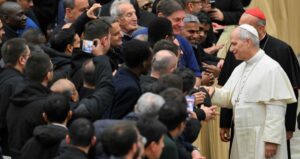
VATICAN CITY, OCT. 11, 2007 (Zenit) - Here is a translation of the address Benedict XVI delivered Wednesday at the general audience in St. Peter's Square. The reflection focused on St. Hilary of Poitiers.
* * *
Dear Brothers and Sisters,
Today I would like to speak about a great Father of the Western Church, St. Hilary of Poitiers, one of the great bishops of the 4th century. Confronted with the Arians, who considered the Son of God a creature, albeit an excellent one, Hilary dedicated his life to the defense of faith in the divinity of Jesus Christ, Son of God, and God as the Father, who generated him from all eternity.
We do not have definitive data about most of Hilary's life. Ancient sources say that he was born in Poitiers, probably around the year 310. From a well-to-do family, he received a good literary education, which is clearly evident in his writings. It does not seem that he was raised in a Christian environment. He himself tells us about a journey of searching for the truth, which little by little led him to the recognition of God the creator and of the incarnate God, who died to give us eternal life. He was baptized around 345, and elected bishop of Poitiers around 353-354.
In the years that followed, Hilary wrote his first work, the "Commentary on the Gospel of Matthew." It is the oldest surviving commentary in Latin that we have on this Gospel. In 356, Hilary, as bishop, attended the Synod of Beziers in southern France, which he called the "Synod of the False Apostles," given that the assembly was dominated by bishops who were followers of Arianism, and thus negated the divinity of Jesus Christ. These "false apostles" asked Emperor Constantine to condemn to exile the bishop of Poitiers. So Hilary was forced to leave Gaul during the summer of 356.
Exiled to Phrygia, in present-day Turkey, Hilary found himself in contact with a religious environment totally dominated by Arianism. There, too, his pastoral solicitude led him to work tirelessly for the re-establishment of the Church's unity, based on the correct faith, as formulated by the Council of Nicea. To this end, he began writing his most important and most famous dogmatic work: "De Trinitatae" (On the Trinity).
In it, Hilary talks about his own personal journey toward knowing God, and he is intent on showing that Scriptures clearly attest to the Son's divinity and his equality with the Father, not only in the New Testament, but also in many pages of the Old Testament, in which the mystery of Christ is already presented. Faced with the Arians, he insists on the truth of the names of the Father and the Son and develops his entire Trinitarian theology departing from the formula of baptism given to us by the Lord himself: "In the name of the Father and the Son and the Holy Spirit."
The Father and the Son are of the same nature. And if some passages of the New Testament could lead one to think that the Son is inferior to the Father, Hilary offers precise rules to avoid misleading interpretations: Some passages in Scripture speak about Jesus as God, others emphasize his humanity. Some refer to him in his pre-existence with the Father; others take into consideration his self lowering ("kenosis"), his lowering himself unto death; and lastly, others contemplate him in the glory of the resurrection.
During the years of his exile, Hilary also wrote the "Book of the Synod," in which, for his brother bishops of Gaul, he reproduces and comments on the confessions of faith and other documents of the synods which met in the East around the middle of the 4th century. Always firm in his opposition to radical Arians, St. Hilary showed a conciliatory spirit with those who accepted that the Son was similar to the Father in essence, naturally trying to lead them toward the fullness of faith, which says that there is not only a similarity, but a true equality of the Father and the Son in their divinity.
This also seems characteristic: His conciliatory spirit tries to understand those who still have not yet arrived to the fullness of the truth and helps them, with great theological intelligence, to reach the fullness of faith in the true divinity of the Lord Jesus Christ.
In 360 or 361, Hilary was finally able to return from exile to his homeland and immediately resumed the pastoral work in his Church, but the influence of his teaching extended, in fact, well beyond its borders. A synod celebrated in Paris in 360 or 361 took up again the language used by the Council of Nicea. Some ancient authors think that this anti-Arian development of the bishops of Gaul was due, in large part, to the strength and meekness of the bishop of Poitiers.
This was precisely his gift: uniting strength of faith and meekness in interpersonal relationships. During the last years of his life, he wrote "Treatises on the Psalms," a commentary on 58 psalms, interpreted according to the principle highlighted in the introduction to the work: "There is no doubt that all the things said in the Psalms must be understood according to the Gospel proclamation, so that, independently of the voice with which the prophetic spirit has spoken, everything refers to the knowledge of the coming of our Lord Jesus Christ, incarnation, passion and kingdom, and the glory and power of our resurrection" ("Instructio Psalmorum," 5).
In all of the Psalms, he sees this transparency of Christ's mystery and of his body, which is the Church. On various occasions, Hilary met with St. Martin: The future bishop of Tours founded a monastery near Poitiers, which still exists today. Hilary died in 367. His feast day is celebrated on Jan. 13. In 1851, Blessed Pius IX proclaimed him a doctor of the Church.
To summarize the essential aspects of his doctrine, I would like to say that the starting point for Hilary's theological reflection is the baptismal faith. In "De Trinitate," he writes: Jesus "commanded to baptize in the name of the Father and the Son and the Holy Spirit (cf. Matthew 28:19), that is to say, confessing the Author, the Only Begotten One and the Gift. One alone is the author of all things, because there is only one God the Father, from whom all things proceed. And one alone is our Lord Jesus Christ, through whom all things were made (1 Corinthians 8:6), and one alone is the Spirit (Ephesians 4:4), gift in everything. ... Nothing can be found lacking in a plenitude that is so grand, in which converges in the Father, and in the Son, and in the Holy Spirit, the immensity of the Eternal, the revelation in the Image, the joy in the Gift" ("De Trinitatae" 2:1).

God the Father, being all love, is able to communicate the fullness of his divinity to the Son. I find this phrase of St. Hilary to be particularly beautiful: "God only knows how to be love, only knows how to be Father. And he who loves is not envious, and whoever is Father, is so totally. This name does not allow for compromise, as if to say that God is father only in certain aspects and not in others" (ibid. 9:61).
For this reason, the Son is fully God without lacking anything or having any lessening: "He who comes from the perfect is perfect, because he who has everything, has given him everything" (ibid. 2:8). Only in Christ, Son of God and Son of Man, does humanity find salvation. Taking on human nature, he united every man to himself, "he became our flesh" ("Tractatus in Psalmos" 54:9); "he took on the nature of all flesh, thus becoming the true vine, the root of all branches" (ibid. 51:16).
Precisely because of this motive, the path to Christ is open to all -- because he drew everyone into his humanity -- even though personal conversion is always required: "Through the relationship with his flesh, access to Christ is open to everyone, provided that they leave aside the old man (cf. Ephesians 4:22) and nail him to his cross (cf. Colossians 2:14); provided they abandon their former works and are converted, in order to be buried with him in baptism, in view of life (cf. Colossians 1:12; Romans 6:4)" (ibid. 91:9).
Faithfulness to God is a gift of his grace. Therefore St. Hilary asks, at the end of his treatise on the Trinity, to be able to remain faithful to the faith of baptism. One of the characteristics of this book is this: Reflection is transformed into prayer and prayer leads to reflection. The entire book is a dialogue with God.
I would like to end today's catechesis with one of these prayers, that also becomes our prayer: "Grant, O Lord," Hilary prays in a moment of inspiration, "that I may remain faithful to that which I professed in the symbol of my regeneration, when I was baptized in the Father, the Son and the Holy Spirit. That I may adore you, our Father, and together with you, your Son; that I may be worthy of your Holy Spirit, who proceeds from you through your only Son. ... Amen" ("De Trinitatae" 12:57).
[Translation by ZENIT]
[After the audience, the Pope greeted the people in various languages. In English, he said:]
Dear Brothers and Sisters,
The subject of today's catechesis is Saint Hilary of Poitiers. He was born around the year 310, baptized when he was about thirty-five, and became Bishop of Poitiers some eight years later. In opposition to the Arians, who believed Jesus was a created being, Hilary dedicated his life to defending our faith in the divinity of Christ. While exiled to Frigia, because of the stance he took against the Arians at the Synod of BĂ©ziers, he began his most important work, De Trinitate. In this text he demonstrates how both the old and new testaments clearly attest the divinity of the Son and his equality with the Father with whom he shares one nature. In his De Synodis Hilary maintained a conciliatory spirit with those who used deficient theological formulations, while leading them to accept fully the Nicean creed. In 360 he returned home, took up his pastoral duties, and continued to write. The influence of his teaching spread and many were strengthened in their resistance to Arian thought, realising that Christ is our Saviour precisely because he is true God and true man. Fundamental to Hilary's insight was the importance of our Trinitarian baptismal faith. Let us join him in praying to the Lord that we remain faithful to this confession, and always bear joyful witness to our baptismal call!
I welcome all the English speaking visitors present today, including members of the Congregation of Holy Cross, participants in the Nato Defence College Senior Course, and the student groups from Scotland and Denmark May your time in Rome be one of spiritual renewal. Upon all of you I invoke God's abundant blessings of joy and peace.
© Copyright 2007 -- Libreria Editrice Vaticana
Contact
Catholic Online
https://www.catholic.org
CA, US
Catholic Online - Publisher, 661 869-1000
info@yourcatholicvoice.org
Keywords
Wednesday, Hilary, Poitiers, Pope, Benedict

More Catholic PRWire
Showing 1 - 50 of 4,716
A Recession Antidote
Randy Hain
Monaco & The Vatican: Monaco's Grace Kelly Exhibit to Rome--A Review of Monegasque-Holy See Diplomatic History
Dna. Maria St. Catherine Sharpe, t.o.s.m., T.O.SS.T.
The Why of Jesus' Death: A Pauline Perspective
Jerom Paul
A Royal Betrayal: Catholic Monaco Liberalizes Abortion
Dna. Maria St.Catherine De Grace Sharpe, t.o.s.m., T.O.SS.T.
Embrace every moment as sacred time
Mary Regina Morrell
My Dad
JoMarie Grinkiewicz
Letting go is simple wisdom with divine potential
Mary Regina Morrell
Father Lombardi's Address on Catholic Media
Catholic Online
Pope's Words to Pontifical Latin American College
Catholic Online
Prelate: Genetics Needs a Conscience
Catholic Online
State Aid for Catholic Schools: Help or Hindrance?
Catholic Online
Scorsese Planning Movie on Japanese Martyrs
Catholic Online
2 Nuns Kidnapped in Kenya Set Free
Catholic Online
Holy See-Israel Negotiation Moves Forward
Catholic Online
Franchising to Evangelize
Catholic Online
Catholics Decry Anti-Christianity in Israel
Catholic Online
Pope and Gordon Brown Meet About Development Aid
Catholic Online
Pontiff Backs Latin America's Continental Mission
Catholic Online
Cardinal Warns Against Anti-Catholic Education
Catholic Online
Full Circle
Robert Gieb

Three words to a deeper faith
Paul Sposite
Relections for Lent 2009
chris anthony
Wisdom lies beyond the surface of life
Mary Regina Morrell
World Food Program Director on Lent
Catholic Online
Moral Clarity
DAN SHEA
Pope's Lenten Message for 2009
Catholic Online
A Prayer for Monaco: Remembering the Faith Legacy of Prince Rainier III & Princess Grace and Contemplating the Moral Challenges of Prince Albert II
Dna. Maria St. Catherine Sharpe
Keeping a Lid on Permissiveness
Sally Connolly
Glimpse of Me
Sarah Reinhard
The 3 stages of life
Michele Szekely
Sex and the Married Woman
Cheryl Dickow
A Catholic Woman Returns to the Church
Cheryl Dickow
Modernity & Morality
Dan Shea
Just a Minute
Sarah Reinhard
Catholic identity ... triumphant reemergence!
Hugh McNichol
Edging God Out
Paul Sposite
Burying a St. Joseph Statue
Cheryl Dickow
George Bush Speaks on Papal Visit
Catholic Online
Sometimes moving forward means moving the canoe
Mary Regina Morrell
Action Changes Things: Teaching our Kids about Community Service
Lisa Hendey
Easter... A Way of Life
Paul Spoisite
Papal initiative...peace and harmony!
Hugh McNichol
Proclaim the mysteries of the Resurrection!
Hugh McNichol
Jerusalem Patriarch's Easter Message
Catholic Online
Good Friday Sermon of Father Cantalamessa
Catholic Online
Papal Address at the End of the Way of the Cross
Catholic Online
Cardinal Zen's Meditations for Via Crucis
Catholic Online
Interview With Vatican Aide on Jewish-Catholic Relations
Catholic Online
Pope Benedict XVI On the Easter Triduum
Catholic Online
Holy Saturday...anticipation!
Hugh McNichol

Join the Movement
When you sign up below, you don't just join an email list - you're joining an entire movement for Free world class Catholic education.
Our Important Lenten Message - Please Watch
- Easter / Lent
- 5 Lenten Prayers
- Ash Wednesday
- 7 Morning Prayers
- Mysteries of the Rosary
- Litany of the Bl. Virgin Mary
- Popular Saints
- Popular Prayers
- Female Saints
- Saint Feast Days by Month
- Stations of the Cross
- St. Francis of Assisi
- St. Michael the Archangel
- The Apostles' Creed
- Unfailing Prayer to St. Anthony
- Pray the Rosary




Copyright 2026 Catholic Online. All materials contained on this site, whether written, audible or visual are the exclusive property of Catholic Online and are protected under U.S. and International copyright laws, © Copyright 2026 Catholic Online. Any unauthorized use, without prior written consent of Catholic Online is strictly forbidden and prohibited.
Catholic Online is a Project of Your Catholic Voice Foundation, a Not-for-Profit Corporation. Your Catholic Voice Foundation has been granted a recognition of tax exemption under Section 501(c)(3) of the Internal Revenue Code. Federal Tax Identification Number: 81-0596847. Your gift is tax-deductible as allowed by law.