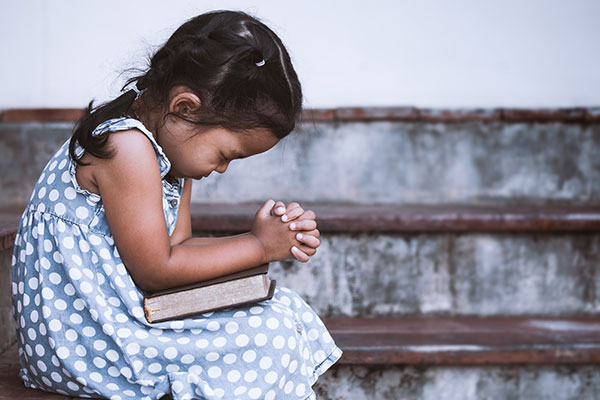
The Way to Inner Peace
FREE Catholic Classes
+J.M.J.+
by Monsignor Charles M. Mangan
©Catholic Online 2005
On Dec. 14, 1989, the Vatican's Congregation for the Doctrine of the Faith released its "Letter to the Bishops of the Catholic Church on Some Aspects of Christian Meditation."
This document, approved by Pope John Paul II, recognizes that some Christians, experiencing a "spiritual restlessness arising from a life subjected to the driving pace of a technologically advanced society," have investigated certain Eastern techniques of prayer, seeking "a path to interior peace and psychic balance."
Eastern methods of prayer often depart from Christian principles by "abandoning not only meditation on the salvific works accomplished in history by the God of the Old and New Covenant, but also the very idea of the One and Triune God."
Instead, inner peace and union with the Absolute is attained by "immersion 'in the indeterminate abyss of the divinity'"; hence, a person can lose his identity by being "swallowed up" by the Deity.
Contemporary Catholics seeking inner peace need not dive headlong into Eastern mysticism. A host of Catholic writers has advocated ways by which spiritual happiness may be realized.
One of the best but least recognized guides is Saint Leonard of Port Maurice (1676-1751), a Franciscan friar known for his preaching in defense of the Immaculate Conception. He offered four "rules" to help achieve peace of soul.
1. To be attached only to God. Status and wealth may be beneficial, but to be overly concerned about them is to invite inner spiritual havoc. The soul's primary need is communication with its Creator. One needs to view objects and persons in reference to God and His will if peace is to reign. To be "dead" to the world and creatures is paramount.
2. To surrender to Divine Providence. All Catholic spiritual writers are unanimous on this point: Sanctity and inner peace are attained only when God's will holds sway. The Lord knows best. Humbly accepting His will is vastly different from reluctantly putting up with it. When a person yields to the divine plan, he demonstrates a belief that God will sustain him--come what may.
3. To welcome suffering and hardship. Human nature tends to resist difficulties. Yet, spiritual perfection entails carrying the cross of Jesus. Scorn and rejection from others--while hardly pleasant--must be seen as an opportunity to experience solidarity with the suffering Christ.
4. To undertake only that which our situation in life demands. Often a person takes upon himself too many activities at once. "The more, the better" does not necessarily apply in the realm of good works. Prudence dictates what one can accomplish. Inner turmoil may spring from a plethora of activities, even when they are morally good acts. Prayer and counsel will determine what to undertake and what to forego.
When thousands are turning to Eastern methods of prayer in search of peace, Catholics should take heed of the advice offered nearly three centuries ago by this Italian preacher.
Happiness of soul occurs when a person conforms himself to Christ through acceptance of the Father's will. Only then may one experience the peace which the world cannot give (cf. John 14:27).
(Slightly adapted from an article originally published on page 4 in the July 15, 1990 issue of the "National Catholic Register.")
Contact
Mary's Field
https://www.catholic.org
, VA
Monsignor Charles M. Mangan - Official, 390 66616-1125
fathermangan@catholic.org
Keywords
Inner Peace; Sanctity
More Catholic PRWire
Showing 1 - 50 of 4,716
A Recession Antidote
Randy Hain
Monaco & The Vatican: Monaco's Grace Kelly Exhibit to Rome--A Review of Monegasque-Holy See Diplomatic History
Dna. Maria St. Catherine Sharpe, t.o.s.m., T.O.SS.T.
The Why of Jesus' Death: A Pauline Perspective
Jerom Paul
A Royal Betrayal: Catholic Monaco Liberalizes Abortion
Dna. Maria St.Catherine De Grace Sharpe, t.o.s.m., T.O.SS.T.
Embrace every moment as sacred time
Mary Regina Morrell
My Dad
JoMarie Grinkiewicz
Letting go is simple wisdom with divine potential
Mary Regina Morrell
Father Lombardi's Address on Catholic Media
Catholic Online
Pope's Words to Pontifical Latin American College
Catholic Online
Prelate: Genetics Needs a Conscience
Catholic Online
State Aid for Catholic Schools: Help or Hindrance?
Catholic Online
Scorsese Planning Movie on Japanese Martyrs
Catholic Online
2 Nuns Kidnapped in Kenya Set Free
Catholic Online
Holy See-Israel Negotiation Moves Forward
Catholic Online
Franchising to Evangelize
Catholic Online
Catholics Decry Anti-Christianity in Israel
Catholic Online
Pope and Gordon Brown Meet About Development Aid
Catholic Online
Pontiff Backs Latin America's Continental Mission
Catholic Online
Cardinal Warns Against Anti-Catholic Education
Catholic Online
Full Circle
Robert Gieb

Three words to a deeper faith
Paul Sposite
Relections for Lent 2009
chris anthony
Wisdom lies beyond the surface of life
Mary Regina Morrell
World Food Program Director on Lent
Catholic Online
Moral Clarity
DAN SHEA
Pope's Lenten Message for 2009
Catholic Online
A Prayer for Monaco: Remembering the Faith Legacy of Prince Rainier III & Princess Grace and Contemplating the Moral Challenges of Prince Albert II
Dna. Maria St. Catherine Sharpe
Keeping a Lid on Permissiveness
Sally Connolly
Glimpse of Me
Sarah Reinhard
The 3 stages of life
Michele Szekely
Sex and the Married Woman
Cheryl Dickow
A Catholic Woman Returns to the Church
Cheryl Dickow
Modernity & Morality
Dan Shea
Just a Minute
Sarah Reinhard
Catholic identity ... triumphant reemergence!
Hugh McNichol
Edging God Out
Paul Sposite
Burying a St. Joseph Statue
Cheryl Dickow
George Bush Speaks on Papal Visit
Catholic Online
Sometimes moving forward means moving the canoe
Mary Regina Morrell
Action Changes Things: Teaching our Kids about Community Service
Lisa Hendey

Easter... A Way of Life
Paul Spoisite
Papal initiative...peace and harmony!
Hugh McNichol
Proclaim the mysteries of the Resurrection!
Hugh McNichol
Jerusalem Patriarch's Easter Message
Catholic Online
Good Friday Sermon of Father Cantalamessa
Catholic Online
Papal Address at the End of the Way of the Cross
Catholic Online
Cardinal Zen's Meditations for Via Crucis
Catholic Online
Interview With Vatican Aide on Jewish-Catholic Relations
Catholic Online
Pope Benedict XVI On the Easter Triduum
Catholic Online
Holy Saturday...anticipation!
Hugh McNichol
Come Grow With Us
Sign up and walk the Catholic journey with millions around the world.
Receive inspiring emails on saints, daily readings, and free faith-building resources—no cost, ever.
Catholic Online Is Free. But We Need Your Help.
Please Watch
- 7 Morning Prayers
- Mysteries of the Rosary
- Litany of the Bl. Virgin Mary
- Popular Saints
- Popular Prayers
- Female Saints
- Saint Feast Days by Month
- Stations of the Cross
- St. Francis of Assisi
- St. Michael the Archangel
- The Apostles' Creed
- Unfailing Prayer to St. Anthony
- Pray the Rosary








Copyright 2026 Catholic Online. All materials contained on this site, whether written, audible or visual are the exclusive property of Catholic Online and are protected under U.S. and International copyright laws, © Copyright 2026 Catholic Online. Any unauthorized use, without prior written consent of Catholic Online is strictly forbidden and prohibited.
Catholic Online is a Project of Your Catholic Voice Foundation, a Not-for-Profit Corporation. Your Catholic Voice Foundation has been granted a recognition of tax exemption under Section 501(c)(3) of the Internal Revenue Code. Federal Tax Identification Number: 81-0596847. Your gift is tax-deductible as allowed by law.
