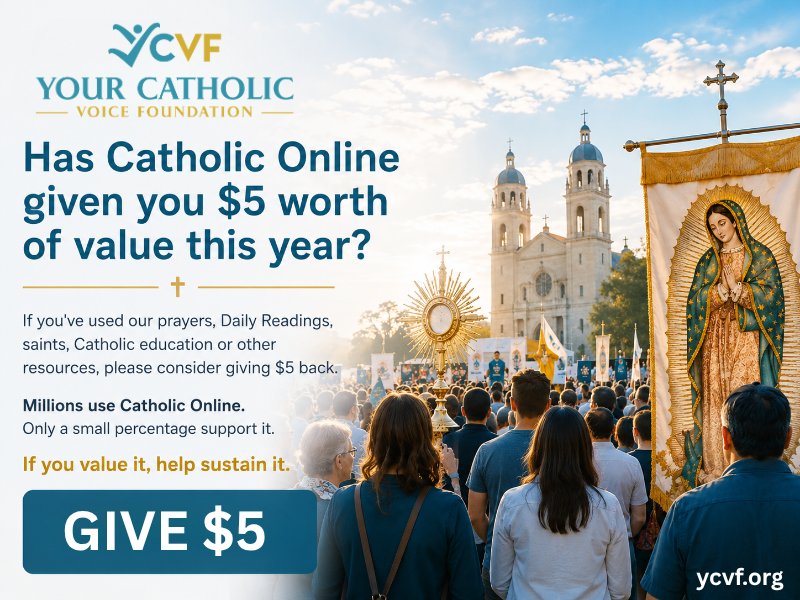
We have one question for you.
Has Catholic Online given you $5 worth of value this year? Maybe you came here for a prayer. Maybe you read today's Mass readings. Maybe you researched a saint. Maybe you needed an answer about the Catholic Faith. Maybe your child used Catholic Online School. If the answer is no, you don't owe us anything. Keep using Catholic Online. But if the answer is yes, we're asking you to give $5 today.
Catholic Online School has served 2.2 million student enrollments in 193 countries, and we continue working to make Catholic education available regardless of a family's financial circumstances. We don't need every reader to give. We need the readers who recognize the value of what they've received to stand behind it. Is Catholic Online worth $5 to you?
GIVE TODAY >>Nicomedia
FREE Catholic Classes
Titular see of Bithynia Prima, founded by King Zipoetes. About 264 B.C. his son Nicodemes I dedicated the city anew, gave it his name, made it his capital, and adorned it with magnificent monuments. At his court the vanquished Hannibal sought refuge. When Bithynia became a Roman province Nicomedia remained its capital. Pliny the Younger mentions, in his letters to Trajan, several public edifices of the city — a senate house, an aqueduct which he had built, a forum, the temple of Cybele, etc. He also proposed to join the Black Sea with the Sea of Marmora by a canal which should follow the river Sangarius and empty the waters of the Lake of Sabandja into the Gulf of Astacus. A fire then almost destroyed the town. From Nicomedia perhaps, he wrote to Trajan his famous letter concerning the Christians. Under Marcus Aurelius, Dionysius, Bishop of Corinth, addressed a letter to his community warning them against the Marcionites ( Eusebius, "Hist. Eccl.", IV, xxiii). Bishop Evander, who opposed the sect of the Ophites (P.L., LIII, 592), seems to have lived at the same time. Nicomedia was the favorite residence of Diocletian, who built there a palace, a hippodrome, a mint, and an arsenal. In 303 the edict of the tenth persecution caused rivers of blood to flow through the empire, especially in Nicomedia, where the Bishop Anthimus and a great many Christians were martyred. The city was then half Christian, the palace itself being filled with them. In 303, in the vast plain east of Nicomedia, Diocletian renounced the empire in favour of Galerius. In 311 Lucian, a priest of Antioch, delivered a discourse in the presence of the judge before he was executed. Other martyrs of the city are numbered by hundreds. Nicomedia suffered greatly during the fourth century from an invasion of the Goths and from an earthquake (24 Aug., 354), which overthrew all the public and private monuments; fire completed the catastrophe. The city was rebuilt, on a smaller scale. In the reign of Justinian new public buildings were erected, which were destroyed in the following century by the Shah Chosroes. Pope Constantine I visited the city in 711. In 1073 John Comnenus was there proclaimed emperor and shortly afterwards was compelled to abdicate. In 1328 it was captured by the Sultan Orkhan, who restored its ramparts, parts of which are still preserved.
Le Quien (Oriens Christ., I, 581-98) has drawn up a list of fifty metropolitans, which may easily be completed, for Nicomedia has never ceased to be a metropolitan see. Some Latin archbishops are also mentioned by Le Quien (III, 1017) and by Eubel (Hierarchia Catholica medii aevi, I, 381). As early as the eighth century the metropolitan See of Nicomedia had eight suffragan sees which disappeared by degrees. Among its bishops, apart from those already mentioned, were: the three Arians, Eusebius, Eudoxius, and Demophilus, who exchanged their see for that of Constantinople; St. Theophylactus, martyred by the Iconoclasts in the ninth century; George, a great preacher and a friend of Photius ; Philotheus Bryennios, the present titular, who discovered and published Didache ton apostolon . To-day Nicomedia is called Ismidt, the chief town of a sanjak directly dependent on Constantinople. It has about 25,000 inhabitants, who are very poor, for the German port of Haidar Pacha has completely ruined its commerce. Since 1891 the Augustinians of the Assumption have a mission and school, and the Oblates of the Assumption, a school and a dispensary. The Latin Catholics number about 250 in the region of the mission, seventy of them living in the city. The Armenian Catholic parish numbers 120.
Come Grow With Us
Sign up and walk the Catholic journey with millions around the world.
Receive inspiring emails on saints, daily readings, and free faith-building resources—no cost, ever.
Catholic Online Is Free. But We Need Your Help.
Please Watch
- 7 Morning Prayers
- Mysteries of the Rosary
- Litany of the Bl. Virgin Mary
- Popular Saints
- Popular Prayers
- Female Saints
- Saint Feast Days by Month
- Stations of the Cross
- St. Francis of Assisi
- St. Michael the Archangel
- The Apostles' Creed
- Unfailing Prayer to St. Anthony
- Pray the Rosary







Copyright 2026 Catholic Online. All materials contained on this site, whether written, audible or visual are the exclusive property of Catholic Online and are protected under U.S. and International copyright laws, © Copyright 2026 Catholic Online. Any unauthorized use, without prior written consent of Catholic Online is strictly forbidden and prohibited.
Catholic Online is a Project of Your Catholic Voice Foundation, a Not-for-Profit Corporation. Your Catholic Voice Foundation has been granted a recognition of tax exemption under Section 501(c)(3) of the Internal Revenue Code. Federal Tax Identification Number: 81-0596847. Your gift is tax-deductible as allowed by law.
