Mush
FREE Catholic Classes
An Armenian Catholic see, comprising the sanjaks of Mush and Seert, in the vilayet of Bitlis. It was created by Leo XIII in 1883, and numbers about 5000 faithful, 7 secular priests, 7 churches or chapels, 5 schools, and an establishment of the Venetian Mechitarists. The chief stations outside of Mush are some neighbouring villages such as Bitlis or Van. The town is built on a hill, at the foot of a ruined citadel and in the midst of vineyards below stretches a well-cultivated plain, about fifty miles long by eighteen miles wide. The climate is healthy and the country tolerably rich, but exposed to constant incursions of the Kurds and other nomads, who terrorize the inhabitants, especially the Christians. Built by an Armenian prince named Muchigh, the town of Mush has about 27000 inhabitants, of whom 3,000 are Armenian Catholics, 10,000 Armenian schismatics, and 700 Protestants, the rest being Mussulmans. Besides the Catholic bishop there is an Armenian Gregorian bishop ; also a Protestant missionary. The celebrated Moses of Chorene was born in the neighbouring village of Chorene.


Join the Movement
When you sign up below, you don't just join an email list - you're joining an entire movement for Free world class Catholic education.


-

-
Mysteries of the Rosary
-
St. Faustina Kowalska
-
Litany of the Blessed Virgin Mary
-
Saint of the Day for Wednesday, Oct 4th, 2023
-
Popular Saints
-
St. Francis of Assisi
-
Bible
-
Female / Women Saints
-
7 Morning Prayers you need to get your day started with God
-
Litany of the Blessed Virgin Mary


Sacrifices of Faith: The Pro-Life Legacies of St. Gianna and Jessica Hanna
-
How to love God by caring for our bodies
-
Pope Francis calls for negotiations to End Russia-Ukraine War
-
Pope Francis Contemplates Return to U.S. for United Nations Assembly Address
-
Pope Francis Calls on Faithful to Embrace Faith, Hope, and Charity in New Teaching Series

Daily Catholic
- Daily Readings for Monday, April 29, 2024
- St. Catherine of Siena: Saint of the Day for Monday, April 29, 2024
- Prayer for the Dead # 3: Prayer of the Day for Monday, April 29, 2024
- Daily Readings for Sunday, April 28, 2024
- St. Peter Chanel: Saint of the Day for Sunday, April 28, 2024
- Prayer before a Crucifix: Prayer of the Day for Sunday, April 28, 2024
 Daily Readings for Monday, April 29, 2024
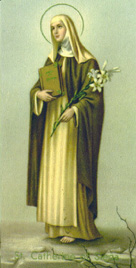 St. Catherine of Siena: Saint of the Day for Monday, April 29, 2024
 Prayer for the Dead # 3: Prayer of the Day for Monday, April 29, 2024


Copyright 2024 Catholic Online. All materials contained on this site, whether written, audible or visual are the exclusive property of Catholic Online and are protected under U.S. and International copyright laws, © Copyright 2024 Catholic Online. Any unauthorized use, without prior written consent of Catholic Online is strictly forbidden and prohibited.
Catholic Online is a Project of Your Catholic Voice Foundation, a Not-for-Profit Corporation. Your Catholic Voice Foundation has been granted a recognition of tax exemption under Section 501(c)(3) of the Internal Revenue Code. Federal Tax Identification Number: 81-0596847. Your gift is tax-deductible as allowed by law.
