 Hi readers, it seems you use Catholic Online a lot; that's great! It's a little awkward to ask, but we need your help. If you have already donated, we sincerely thank you. We're not salespeople, but we depend on donations averaging $14.76 and fewer than 1% of readers give. If you donate just $5.00, the price of your coffee, Catholic Online School could keep thriving. Thank you. Help Now >
Joannes Maxentius
FREE Catholic Classes
Joannes Maxentius, leader of the so-called Scythian monks, appears in history at Constantinople in 519 and 520. These monks adapted the formula: "One of the Trinity suffered in the flesh" to exclude Nestorianism and Monophysitism, and they sought to have the works of Faustus of Riez condemned as being tainted with Pelagianism. On both these points they met with opposition. John Maxentius presented an appeal to the papal legates than at Constantinople (Ep. ad legatos sedis apostolicae, P, G, LXXXVI, i, 75-86); but it failed to bring forth a favourable decision. Some of the monks (not Maxentius, however) proceeded, therefore, to Rome to lay the case before Pope Hormisdas. As the latter delayed his decision, they addressed themselves to some African bishops, banished to Sardinia, and St. Fulgentius, answering in the name of these prelates, warmly endorsed their cause (Fulg. ep., xvii in P.L., LXV, 451-93). Early in August, 520, the monks left Rome. Shortly after, 13 August, 520, Hormisdas addressed a letter to the African bishop, Possessor, then at Constantinople, in which he severely condemned the conduct of the Scythian monks, also declaring that the writings of Faustus were not received among the authoritative works of the Fathers and that the sound doctrine on grace was contained in the works of St. Augustine (Hormisdae ep., cxxiv in Thiel, p. 926). Maxentius assailed this letter in the strongest language as a document written by heretics and circulated under the pope's name (Ad epistulam Hormisdae responsio, P, G, LXXXVI, i, 93-112). This is the last trace of the Scythian monks and their leader in history. The identification of John Maxentius with the priest John to whom Fulgentius addressed his "De veritate praedestinationis etc" and with the priest and archminandrite, John, to whom the African bishops sent their "Epistula synodica", rests on a baseless assumption. Maxentius is also the author of: (1) two dialogues against the Nestorians ; (2) twelve anathematisms against the Nestorians ; (3) a treatise against the Acephali ( Monophysites ). As to the "Professio de Christo", printed as a separate work, it is but a part of the "Epistola ad legatos sedis apostolicae". His works, originally written in Latin, have reached us in a rather unsatisfactory condition. They were first published by Cochlæus (Basle and Hagenau, 1520), reprinted in P.G., LXXXVI, i, 75-158.
Hi readers, it seems you use Catholic Online a lot; that's great! It's a little awkward to ask, but we need your help. If you have already donated, we sincerely thank you. We're not salespeople, but we depend on donations averaging $14.76 and fewer than 1% of readers give. If you donate just $5.00, the price of your coffee, Catholic Online School could keep thriving. Thank you. Help Now >


Join the Movement
When you sign up below, you don't just join an email list - you're joining an entire movement for Free world class Catholic education.


-

-
Mysteries of the Rosary
-
St. Faustina Kowalska
-
Litany of the Blessed Virgin Mary
-
Saint of the Day for Wednesday, Oct 4th, 2023
-
Popular Saints
-
St. Francis of Assisi
-
Bible
-
Female / Women Saints
-
7 Morning Prayers you need to get your day started with God
-
Litany of the Blessed Virgin Mary


Sacrifices of Faith: The Pro-Life Legacies of St. Gianna and Jessica Hanna
-
How to love God by caring for our bodies
-
Pope Francis calls for negotiations to End Russia-Ukraine War
-
Pope Francis Contemplates Return to U.S. for United Nations Assembly Address
-
Pope Francis Calls on Faithful to Embrace Faith, Hope, and Charity in New Teaching Series


Daily Catholic
- Daily Readings for Monday, April 29, 2024
- St. Catherine of Siena: Saint of the Day for Monday, April 29, 2024
- Prayer for the Dead # 3: Prayer of the Day for Monday, April 29, 2024
- Daily Readings for Sunday, April 28, 2024
- St. Peter Chanel: Saint of the Day for Sunday, April 28, 2024
- Prayer before a Crucifix: Prayer of the Day for Sunday, April 28, 2024
 Daily Readings for Monday, April 29, 2024
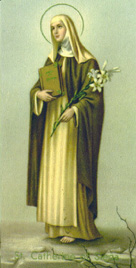 St. Catherine of Siena: Saint of the Day for Monday, April 29, 2024
 Prayer for the Dead # 3: Prayer of the Day for Monday, April 29, 2024

We ask you, humbly: don't scroll away.
Hi readers, it seems you use Catholic Online a lot; that's great! It's a little awkward to ask, but we need your help. If you have already donated, we sincerely thank you. We're not salespeople, but we depend on donations averaging $14.76 and fewer than 1% of readers give. If you donate just $5.00, the price of your coffee, Catholic Online School could keep thriving. Thank you.Help Now >

Copyright 2024 Catholic Online. All materials contained on this site, whether written, audible or visual are the exclusive property of Catholic Online and are protected under U.S. and International copyright laws, © Copyright 2024 Catholic Online. Any unauthorized use, without prior written consent of Catholic Online is strictly forbidden and prohibited.
Catholic Online is a Project of Your Catholic Voice Foundation, a Not-for-Profit Corporation. Your Catholic Voice Foundation has been granted a recognition of tax exemption under Section 501(c)(3) of the Internal Revenue Code. Federal Tax Identification Number: 81-0596847. Your gift is tax-deductible as allowed by law.