We ask you, humbly: don't scroll away.
Hi readers, it seems you use Catholic Online a lot; that's great! It's a little awkward to ask, but we need your help. If you have already donated, we sincerely thank you. We're not salespeople, but we depend on donations averaging $14.76 and fewer than 1% of readers give. If you donate just $5.00, the price of your coffee, Catholic Online School could keep thriving. Thank you.Help Now >
Lectionary
FREE Catholic Classes
( Lectionarium or Legenda ).
Lectionary is a term of somewhat vague significance, used with a good deal of latitude by liturgical writers. It must be rememered that in the early Middle Ages neither the Liturgy of the Mass, nor the Divine Office recited by monks and other ecclesiastics in choir, were to be found, as in the Missal and the Breviary of the present day, complete in one volume. Both for the Mass and for the Office a variety of books were used, for it was obviously a matter of convenience when books were both bulky and costly to produce that the prayers, e.g. which the priest had to say at the altar, should be contained in a different volume from the antiphons to be sung by the choir. The word lectionary , then, in its wider sense, is a term which may be correctly applied to any liturgical volume containing passages to be read aloud in the services of the Church. In this larger signification it would include all Scriptural books written continuously, in which readings were marked, such as the "Evangeliaria" (also often known as "Textus"), as well as books, known also as "Plenaria", containing both Epistles and Gospels combined, such as are commonly employed in a high Mass at the present day, and also those collections, either of extracts from the Fathers or of historical narrations about the martyrs and other saints, which were read aloud as lessons in the Divine Office. This wider signification is, however, perhaps the less usual, and in practice the term lectionary is more commonly used to denote one of two things: (1) the book containing the collection of Scriptural readings which are chanted by the deacon, subdeacon, or a lector during Mass; (2) any book from which the readings were taken which are read aloud in the Office of Matins, after each nocturn or group of psalms. With regard to these last the practice seems to have varied greatly. Sometimes collections were made containing just the extracts to be used in choir, such as we find them in a modern Breviary. Sometimes a large volume of patristic homilies (known also as sermonarium ) or historical matter was employed, in which certain passages were marked to be used as lessons. This last custom seems more particularly to have obtained with regard to the short biographical accounts of martyrs and other saints, which in our modern Breviary form the lessons of the second nocturn. In this connection the word legenda in particular is of common occurrence. The Bollandist Poncelet is, consequently, inclined to draw a distinction between the "Legenda" and the ‘Lectionarium" (see Analecta Bollandiana, XXIX, 13). The "Legenda", also called "Passionarium" is a collection of narratives of variable length, in which are recounted the life, martyrdom, translation, or miracles of the saints. This usually forms a large volume, and the order of the pieces in the collection is commonly, though not necessarily, that of the calendar. A few such "Legendæ" come down from quite the early Middle Ages. But the vast majority of those now preserved in our libraries belong to the eleventh, twelfth. and thirteenth centuries. The earliest, is the ‘‘ Codex Velseri", manuscript Lat. 3514, of the Royal Library at Munich, written probably before the year 700. When these books were used in choir during Office the reader either read certain definitely marked passages, indicated by markings of which our existing manuscripts constantly show traces, or, in the earlier periods especially, he read on until the abbot or priest who presided gave him the signal to stop. After the thirteenth century however, this type of book was much more rarely transcribed. It was replaced by what may conveniently be called for distinction's sake the "Lectionarium" par excellence , a book which consisted not of entire narratives, but only of extracts arranged according to feasts, and made expressly to be read in the Office. It may be added that about the same period the still more comprehensive liturgical book, known to us so familiarly as the Breviary also began to make its appearance. In the early centuries the Scriptural passages to be read at Mass, whether taken from the Gospels, the Epistles, or the Old Testament, were very commonly included in one book, often called a "Comes" or "Liber Comicus". But no constant or uniform practice was followed, for sometimes the Epistles and Lessons were read from a continuous text equipped with rubrics indicating the different days for which the passages were intended — this is the case with the famous "Epistolarium" of St. Victor of Capua in the sixth century; sometimes Lessons, Epistles, and Gospels were all transcribed in their proper order into one volume, as in the case of the Liber Comicus" of the Church of Toledo lately edited by Dom Morin, or of the Lectionnaire de Luxeuil, published by Mabillon in his "Liturgia Gallicana".


We ask you, humbly: don't scroll away.
Hi readers, it seems you use Catholic Online a lot; that's great! It's a little awkward to ask, but we need your help. If you have already donated, we sincerely thank you. We're not salespeople, but we depend on donations averaging $14.76 and fewer than 1% of readers give. If you donate just $5.00, the price of your coffee, Catholic Online School could keep thriving. Thank you.Help Now >
Join the Movement
When you sign up below, you don't just join an email list - you're joining an entire movement for Free world class Catholic education.


-

-
Mysteries of the Rosary
-
St. Faustina Kowalska
-
Litany of the Blessed Virgin Mary
-
Saint of the Day for Wednesday, Oct 4th, 2023
-
Popular Saints
-
St. Francis of Assisi
-
Bible
-
Female / Women Saints
-
7 Morning Prayers you need to get your day started with God
-
Litany of the Blessed Virgin Mary


Sacrifices of Faith: The Pro-Life Legacies of St. Gianna and Jessica Hanna
-
How to love God by caring for our bodies
-
Pope Francis calls for negotiations to End Russia-Ukraine War
-
Pope Francis Contemplates Return to U.S. for United Nations Assembly Address
-
Pope Francis Calls on Faithful to Embrace Faith, Hope, and Charity in New Teaching Series


Daily Catholic
- Daily Readings for Monday, April 29, 2024
- St. Catherine of Siena: Saint of the Day for Monday, April 29, 2024
- Prayer for the Dead # 3: Prayer of the Day for Monday, April 29, 2024
- Daily Readings for Sunday, April 28, 2024
- St. Peter Chanel: Saint of the Day for Sunday, April 28, 2024
- Prayer before a Crucifix: Prayer of the Day for Sunday, April 28, 2024
 Daily Readings for Monday, April 29, 2024
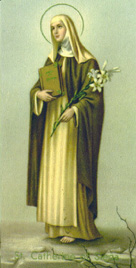 St. Catherine of Siena: Saint of the Day for Monday, April 29, 2024
 Prayer for the Dead # 3: Prayer of the Day for Monday, April 29, 2024


Copyright 2024 Catholic Online. All materials contained on this site, whether written, audible or visual are the exclusive property of Catholic Online and are protected under U.S. and International copyright laws, © Copyright 2024 Catholic Online. Any unauthorized use, without prior written consent of Catholic Online is strictly forbidden and prohibited.
Catholic Online is a Project of Your Catholic Voice Foundation, a Not-for-Profit Corporation. Your Catholic Voice Foundation has been granted a recognition of tax exemption under Section 501(c)(3) of the Internal Revenue Code. Federal Tax Identification Number: 81-0596847. Your gift is tax-deductible as allowed by law.