 Hi readers, it seems you use Catholic Online a lot; that's great! It's a little awkward to ask, but we need your help. If you have already donated, we sincerely thank you. We're not salespeople, but we depend on donations averaging $14.76 and fewer than 1% of readers give. If you donate just $5.00, the price of your coffee, Catholic Online School could keep thriving. Thank you. Help Now >
Joseph Deharbe
FREE Catholic Classes
Theologian, catechist, b. at Straburg, Alsace, 11 April, 1800; d. at Maria-Laach, 8 November, 1871. He entered the Society of Jesus in 1817 and after teaching for eleven years at the Jesuit College at Brieg, Switzerland, he became in 1840 a missionary and catechist in Cöthen. With Father Rohe, S.J., he established at Lucerne in 1845 the academy of St. Charles Borromeo. When in 1847 a persecution broke out against the Jesuits in Switzerland, Deharbe barely escaped with his life. After that he was chiefly engaged in giving missions in Germany. As a catechist in Cöthen he felt very keenly the lack of a good catechism, and was encouraged by his superior, Fr. Devis, to compose a serviceable textbook, but always hesitated, feeling himself incompetent. His superior, knowing Deharbe's spirit of obedience, simply commanded him to undertake the task. As a model he took the Mainz catechism of 1842 and made use also of other good textbooks, notably of Bossuet's catechism. He completed his first catechism, called "Katholischer Katechismus oder Lehrbegriff" in 1847. In 1848 it appeared anonymously at Ratisbon and immediately won universal approval. Bishop Blum of Linsburg introduced officially into his diocese the same year; the following year the bishops of Trier and Hildesheim did likewise for their dioceses. In 1850 the Bavarian bishops resolved to introduce a common catechism for the entire kingdom, and accepted Deharbe's catechism, which was then introduced in 1853. Other German dioceses adopted it as follows: Cologne, 1854; Main and Paderborn, 1855; Fulda, 1858; Ermland, 1861; Culm, 1863; Gnesen-Posen, 1868. At the same time it spread outside of Germany, in Switzerland, Austria-Hungary, and the United States. It was translated in 1851 into Magyar, then into Bohemian, Italian, and French; into Swedish and Marathi, 1861; into Polish and Lithuanian, 1862; into Slovenian, 1868; into Danish, 1869; and later repeatedly into Spanish and Portuguese. It was reintroduced into Bavaria in 1908; and it is still in use in most German dioceses, in Denmark and Sweden, in Brazil, Chile, East India, and in many schools in the United States. In a revised form, Austria adopted it in 1897. Deharbe himself prepared and published at Ratisbon four extracts of his first work, entitled(1) "Katholischer Katechismus" (1847); (2) "Kleiner katholischer Katechismus" (1847); (3) "Anfangsgründe der katholichen Lehre für die kleinen Schüler" (1847); "Kleiner katholischer Katechismus" (1849-50). According to Father Linder, S.J., Deharbe's catechism possesses theological correctness, brevity of sentences, preciseness of expression, clearness, and good order; according to the same authority, its defects consists of redundancy of memory-matter, abstraction of expression, incomplete sentences. It is to Deharbe's credit that in his catechism he preserved catechetical tradition, but abandoned the Canisian division, arranging the text-matter under chapters on Faith, Commandments, and Means of Grace. Deharbe's catechisms have been frequently edited and revised. His other works, all published at Ratisbon, are: "Die vollkommene Liebe Gottes" (1855); "Erklärung des katholischen Katechismus (4 vols., 1857-64, fifth ed., (1880—); "Kürzeres Handbuch zum Religionsunterrichte" (1865-68, sixth ed., Linden ed., 1898).



Join the Movement
When you sign up below, you don't just join an email list - you're joining an entire movement for Free world class Catholic education.


-

-
Mysteries of the Rosary
-
St. Faustina Kowalska
-
Litany of the Blessed Virgin Mary
-
Saint of the Day for Wednesday, Oct 4th, 2023
-
Popular Saints
-
St. Francis of Assisi
-
Bible
-
Female / Women Saints
-
7 Morning Prayers you need to get your day started with God
-
Litany of the Blessed Virgin Mary


Sacrifices of Faith: The Pro-Life Legacies of St. Gianna and Jessica Hanna
-
How to love God by caring for our bodies
-
Pope Francis calls for negotiations to End Russia-Ukraine War
-
Pope Francis Contemplates Return to U.S. for United Nations Assembly Address
-
Pope Francis Calls on Faithful to Embrace Faith, Hope, and Charity in New Teaching Series


Daily Catholic
- Daily Readings for Monday, April 29, 2024
- St. Catherine of Siena: Saint of the Day for Monday, April 29, 2024
- Prayer for the Dead # 3: Prayer of the Day for Monday, April 29, 2024
- Daily Readings for Sunday, April 28, 2024
- St. Peter Chanel: Saint of the Day for Sunday, April 28, 2024
- Prayer before a Crucifix: Prayer of the Day for Sunday, April 28, 2024
 Daily Readings for Monday, April 29, 2024
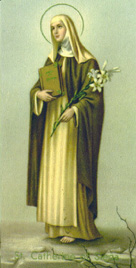 St. Catherine of Siena: Saint of the Day for Monday, April 29, 2024
 Prayer for the Dead # 3: Prayer of the Day for Monday, April 29, 2024
We ask you, humbly: don't scroll away.
Hi readers, it seems you use Catholic Online a lot; that's great! It's a little awkward to ask, but we need your help. If you have already donated, we sincerely thank you. We're not salespeople, but we depend on donations averaging $14.76 and fewer than 1% of readers give. If you donate just $5.00, the price of your coffee, Catholic Online School could keep thriving. Thank you.Help Now >


Copyright 2024 Catholic Online. All materials contained on this site, whether written, audible or visual are the exclusive property of Catholic Online and are protected under U.S. and International copyright laws, © Copyright 2024 Catholic Online. Any unauthorized use, without prior written consent of Catholic Online is strictly forbidden and prohibited.
Catholic Online is a Project of Your Catholic Voice Foundation, a Not-for-Profit Corporation. Your Catholic Voice Foundation has been granted a recognition of tax exemption under Section 501(c)(3) of the Internal Revenue Code. Federal Tax Identification Number: 81-0596847. Your gift is tax-deductible as allowed by law.