 Hi readers, it seems you use Catholic Online a lot; that's great! It's a little awkward to ask, but we need your help. If you have already donated, we sincerely thank you. We're not salespeople, but we depend on donations averaging $14.76 and fewer than 1% of readers give. If you donate just $5.00, the price of your coffee, Catholic Online School could keep thriving. Thank you. Help Now >
St. Sebastian
FREE Catholic Classes
Roman martyr ; little more than the fact of his martyrdom can be proved about St. Sebastian. In the "Depositio martyrum" of the chronologer of 354 it is mentioned that Sebastian was buried on the Via Appia. St. Ambrose ("In Psalmum cxviii"; "Sermo", XX, no. sliv in PL, XV, 1497) states that Sebastian came from Milan and even in the time of St. Ambrose was venerated there. The Acts, probably written at the beginning of the fifth century and formerly ascribed erroneously to Ambrose, relate that he was an officer in the imperial bodyguard and had secretly done many acts of love and charity for his brethren in the Faith. When he was finally discovered to be a Christian, in 286, he was handed over to the Mauretanian archers, who pierced him with arrows; he was healed, however, by the widowed St. Irene. He was finally killed by the blows of a club. These stories are unhistorical and not worthy of belief. The earliest mosaic picture of St. Sebastian, which probably belongs to the year 682, shows a grown, bearded man in court dress but contains no trace of an arrow. It was the art of the Renaissance that first portrayed him as a youth pierced by arrows. In 367 a basilica which was one of the seven chief churches of Rome was built over his grave. The present church was completed in 1611 by Scipio Cardinal Borghese. His relics in part were taken in the year 826 to St. Medard at Soissons. Sebastian is considered a protector against the plague. Celebrated answers to prayer for his protection against the plague are related of Rome in 680, Milan in 1575, and Lisbon in 1599. His feast day is 20 January.
Hi readers, it seems you use Catholic Online a lot; that's great! It's a little awkward to ask, but we need your help. If you have already donated, we sincerely thank you. We're not salespeople, but we depend on donations averaging $14.76 and fewer than 1% of readers give. If you donate just $5.00, the price of your coffee, Catholic Online School could keep thriving. Thank you. Help Now >

We ask you, humbly: don't scroll away.
Hi readers, it seems you use Catholic Online a lot; that's great! It's a little awkward to ask, but we need your help. If you have already donated, we sincerely thank you. We're not salespeople, but we depend on donations averaging $14.76 and fewer than 1% of readers give. If you donate just $5.00, the price of your coffee, Catholic Online School could keep thriving. Thank you.Help Now >
Join the Movement
When you sign up below, you don't just join an email list - you're joining an entire movement for Free world class Catholic education.


-

-
Mysteries of the Rosary
-
St. Faustina Kowalska
-
Litany of the Blessed Virgin Mary
-
Saint of the Day for Wednesday, Oct 4th, 2023
-
Popular Saints
-
St. Francis of Assisi
-
Bible
-
Female / Women Saints
-
7 Morning Prayers you need to get your day started with God
-
Litany of the Blessed Virgin Mary


Sacrifices of Faith: The Pro-Life Legacies of St. Gianna and Jessica Hanna
-
How to love God by caring for our bodies
-
Pope Francis calls for negotiations to End Russia-Ukraine War
-
Pope Francis Contemplates Return to U.S. for United Nations Assembly Address
-
Pope Francis Calls on Faithful to Embrace Faith, Hope, and Charity in New Teaching Series


Daily Catholic
- Daily Readings for Monday, April 29, 2024
- St. Catherine of Siena: Saint of the Day for Monday, April 29, 2024
- Prayer for the Dead # 3: Prayer of the Day for Monday, April 29, 2024
- Daily Readings for Sunday, April 28, 2024
- St. Peter Chanel: Saint of the Day for Sunday, April 28, 2024
- Prayer before a Crucifix: Prayer of the Day for Sunday, April 28, 2024
 Daily Readings for Monday, April 29, 2024
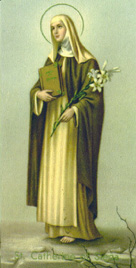 St. Catherine of Siena: Saint of the Day for Monday, April 29, 2024
 Prayer for the Dead # 3: Prayer of the Day for Monday, April 29, 2024


Copyright 2024 Catholic Online. All materials contained on this site, whether written, audible or visual are the exclusive property of Catholic Online and are protected under U.S. and International copyright laws, © Copyright 2024 Catholic Online. Any unauthorized use, without prior written consent of Catholic Online is strictly forbidden and prohibited.
Catholic Online is a Project of Your Catholic Voice Foundation, a Not-for-Profit Corporation. Your Catholic Voice Foundation has been granted a recognition of tax exemption under Section 501(c)(3) of the Internal Revenue Code. Federal Tax Identification Number: 81-0596847. Your gift is tax-deductible as allowed by law.