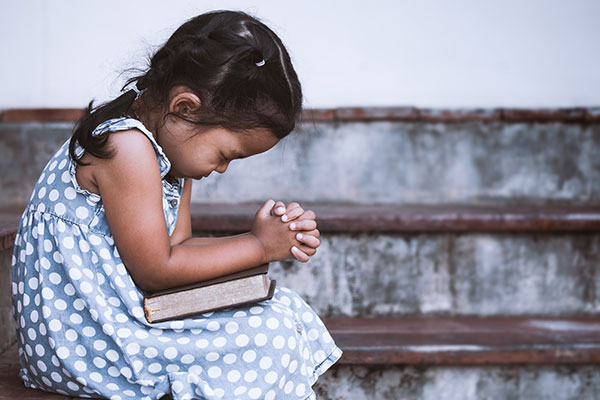
TUESDAY HOMILY: The Obedience of Faith
FREE Catholic Classes
Jesus wasn't disparaging his mother in any way but pointing to the real source of her beatitude and ours. It comes not through a physical relationship with him or even through tracing our identity back to the day of our baptism, but through hearing and living God's word. Jesus' and Mary's obedience shows us the path to become Jesus' true spiritual brothers and sisters.
Highlights
Catholic Online (https://www.catholic.org)
1/29/2013 (1 decade ago)
Published in Year of Faith
Keywords: Year of faith, daily homily, gospels, Jesus, Mary, Father Roger Landry
FALL RIVER, MA (Catholic Online). When we trust someone, we believe in what he says, even if it we might not totally understand what he tells us to do. When we trust a doctor, we will take the prescription she writes. When we trust a coach, we will do things the way he trains us. When we trust a teacher, we will study as truth what she teaches.
If that's true at a purely human level, it's so much more important at the level of our interaction with God. To have faith in God means that we trust Him and, because of our trust in Him, we believe what he says and does. The real test of our faith is seen in our loving obedience to Him.
Obedience has almost become a bad word in our culture that has made autonomy a god. We believe that obedience to anyone, including God, is against our free nature rather than its genuine foundation, a form of slavery that shackles rather than liberates.
This false idea of obedience is not new. The seeds were planted 700 years ago when some theologians began to look at God's will as arbitrary and obedience means not as something in accordance with the way God made us and with the true good but as a whimsical dictate or a rule that we have to follow lest God, who is obviously stronger than we are, impose his will on us and punish us forever for our disobedience. This false idea is called voluntarism and opposes, rather than aligns, our will with God's.
But I think the problem with obedience is worse today. Our culture has a massive problem with any and all authority, including God's. Like Jesus' example of the children sitting in the marketplace, we want to play the tunes to which God and others dance rather than attune our lives to God's music (Mt 11:16-17).
That's why in this Year of Faith, it is key for us to grasp the importance of what St. Paul in his letter to the Romans called the "obedience of faith" (Rom 1:4; 16:26; 2 Cor 10:5-6).
The Catechism of the Catholic Church, right at the beginning of its treatment of the subject of faith, talks about this obedience. "To obey . in faith is to submit freely to the word that has been heard, because its truth is guaranteed by God, who is Truth itself" (CCC 144).
Obey comes from the Latin word ob-audire, which means to listen attentively, almost to eaves drop, so that we can hear every syllable. Imagine an investor trying to listen to the conversation of stock experts sitting across from him on a plane. That's only a glimpse of the way we should be hanging on "every word that comes from the mouth of God."
Today's readings focus on the obedience that flows from faith. In the Gospel, Jesus describes that if we're going to be true members of his family, we're going to imitate Mary in our obedience to God's word. After having been informed that Mary and Jesus' relatives were outside asking for him, Jesus replied, "Whoever does the will of God is my brother and sister and mother."
This echoed another time in the Gospel when an anonymous woman cried out "Blessed is the womb that bore you and the breasts at which you nursed," and Jesus responded by saying, "Blessed, rather, are those who hear the word of God and keep it!" (Lk 11:27-28).
In both cases, Jesus wasn't disparaging his mother in any way but pointing to the real source of her beatitude and ours. It comes not through a physical relationship with him or even through tracing our identity back to the day of our baptism, but through hearing and living God's word. The essence of the Christian life is to become another Mary in our conceiving the Word of God within us, letting that Word grow until we "give birth" to it in deeds of love, putting that word into practice.
The Catechism describes Mary precisely as a model for all of us in faith. "The Virgin Mary most perfectly embodies the obedience of faith. By faith Mary welcomes the tidings and promise brought by the angel Gabriel, believing that 'with God nothing will be impossible' and so giving her assent: 'Behold I am the handmaid of the Lord; let it be [done] to me according to your word.' Elizabeth greeted her: 'Blessed is she who believed that there would be a fulfillment of what was spoken to her from the Lord.' It is for this faith that all generations have called Mary blessed. Throughout her life and until her last ordeal when Jesus her son died on the cross, Mary's faith never wavered. She never ceased to believe in the fulfilment of God's word. And so the Church venerates in Mary the purest realization of faith" (CCC 148-149).
Mary always leads us to Jesus and her faith-filled obedience leads us to Jesus' own obedience.
In the first reading from the Letter to the Hebrews, the sacred author describes that the whole meaning of Jesus' taking on our human nature was so that he could be obedient in humanity and right the wrong of the disobedience of Adam and Eve in the beginning.
It tells us that God the Father ultimately didn't desire and delight in all of the Old Testament "sacrifices and offerings, burnt offerings and sin offerings," the holocaust of animals that were offered not only in the temple but in so many other altars. The sacrifice that he did desire and delight in was the pleasing sacrifice of His Son and all of us in him.
"Then I said," the text has Jesus indicate, "As it is written of me in the scroll, Behold, I come to do your will, O God." And the author adds, "By this 'will,' we have been consecrated through the offering of the Body of Jesus Christ once for all."
Our obedience in faith is not only modeled on Jesus' obedience to the Father but takes place within his very obedience. To follow Christ means ultimately to follow him on the inside, to be incorporated into Him by the Holy Spirit as he says with trust to the Father, "Not my will, but thine be done."
Each of us is called to echo the words of today's responsorial psalm antiphon, words that Jesus made the theme of his very life, "Here am I, Lord. I come to do your will." A life of faith is a life of trusting obedience.
Pope Benedict wrote beautifully on this connection between faith and obedience in his 2010 apostolic exhortation on the Word of God in the Life and Mission of the Church, "Verbum Domini."
A life of faith, he wrote, is one of obedience to the word of God: "The obedience of faith must be our response to God who reveals. . The divine word, in fact, .gives rise to faith, whereby we give our heartfelt assent to the truth that has been revealed to us and we commit ourselves entirely to Christ.. The whole history of salvation progressively demonstrates this profound bond between the word of God and the faith that arises from an encounter with Christ. Faith thus takes shape as an encounter with a person to whom we entrust our whole life" (VD 25).
Sin, he continued, can be best defined as a refusal to hear and obey that word: "Quite frequently in both the Old and in the New Testament, we find sin described as a refusal to hear the word, as a breaking of the covenant and thus as being closed to God who calls us to communion with himself. Sacred Scripture shows how man's sin is essentially disobedience and refusal to hear" (VD 26).
But the good news is what Jesus himself did when he took on our nature and made it obedient to his Father: "The radical obedience of Jesus even to his death on the cross completely unmasks this sin. His obedience brings about the New Covenant between God and man, and grants us the possibility of reconciliation. Jesus was sent by the Father as a sacrifice of atonement for our sins and for those of the whole world (cf. 1 Jn 2:2; 4:10; Heb 7:27). We are thus offered the merciful possibility of redemption and the start of a new life in Christ. For this reason it is important that the faithful be taught to acknowledge that the root of sin lies in the refusal to hear the word of the Lord, and to accept in Jesus, the Word of God, the forgiveness which opens us to salvation."
Today's readings and the entire Year of Faith are occasions in which all the faithful are being taught these lessons indicated by Pope Benedict. But these are lessons we're not just supposed to learn intellectually, but live.
And so let us in prayer ask God to help us to say, mean and live the words first uttered by Jesus, his obedient mother, so many Old Testament Prophets, New Testament Apostles, and Saints, "Here I am, Lord. I have come to do your will."
This is the path by which we will truly be his family members here on earth.
And this is the path by which we will join his mother, brothers, sisters and Father forever in heaven.
-----
Father Roger Landry is pastor of St. Bernadette Parish in Fall River, MA and national chaplain of Catholic Voices USA. His homilies and articles are found on catholicpreaching.com.
---
'Help Give every Student and Teacher FREE resources for a world-class Moral Catholic Education'
Copyright 2021 - Distributed by Catholic Online
Come Grow With Us
Sign up and walk the Catholic journey with millions around the world.
Receive inspiring emails on saints, daily readings, and free faith-building resources—no cost, ever.
World Catholic Education Alliance
Your Child Needs Help Tonight—Could the Answer Be Right Here?
Watch the Video.
- 7 Morning Prayers
- Mysteries of the Rosary
- Litany of the Bl. Virgin Mary
- Popular Saints
- Popular Prayers
- Female Saints
- Saint Feast Days by Month
- Stations of the Cross
- St. Francis of Assisi
- St. Michael the Archangel
- The Apostles' Creed
- Unfailing Prayer to St. Anthony
- Pray the Rosary





Copyright 2026 Catholic Online. All materials contained on this site, whether written, audible or visual are the exclusive property of Catholic Online and are protected under U.S. and International copyright laws, © Copyright 2026 Catholic Online. Any unauthorized use, without prior written consent of Catholic Online is strictly forbidden and prohibited.
Catholic Online is a Project of Your Catholic Voice Foundation, a Not-for-Profit Corporation. Your Catholic Voice Foundation has been granted a recognition of tax exemption under Section 501(c)(3) of the Internal Revenue Code. Federal Tax Identification Number: 81-0596847. Your gift is tax-deductible as allowed by law.