THURSDAY HOMILY: John the Baptizer and Taking the Kingdom by the Force of Love
FREE Catholic Classes
The choice is ours. Just as it was with John the Baptizer. He shows us the way to give away our freedom in love - and then find it anew in the One who truly sets us free. (John 8:36). The kingdom of heaven is still being taken by force.The force of love.

We ask you, humbly: don't scroll away.
Hi readers, it seems you use Catholic Online a lot; that's great! It's a little awkward to ask, but we need your help. If you have already donated, we sincerely thank you. We're not salespeople, but we depend on donations averaging $14.76 and fewer than 1% of readers give. If you donate just $5.00, the price of your coffee, Catholic Online School could keep thriving. Thank you.Help Now >
Highlights
Catholic Online (https://www.catholic.org)
12/14/2012 (1 decade ago)
Published in Year of Faith
Keywords: Kingdom, John the Baptizer, Advent, force, sin, asceticism, holiness, forerunner, John the Baptist, Deacon Keith Fournier
P>CHESAPEAKE, VA. (Catholic Online) - During Advent, we are regularly presented with two very important people in God's loving plan of salvation, Mary, the Mother of the Lord, and John the Baptizer, the forerunner. They offer us, by their example, a key to human freedom and flourishing. That is being emptied of self - so that we can be filled with the life of God.
On this Thursday of the Second week of Advent I proclaim this Gospel at today's Mass: "Jesus said to the crowds: "Amen, I say to you, among those born of women there has been none greater than John the Baptist; yet the least in the Kingdom of heaven is greater than he. From the days of John the Baptist until now, the Kingdom of heaven suffers violence, and the violent are taking it by force. All the prophets and the law prophesied up to the time of John. And if you are willing to accept it, he is Elijah, the one who is to come. Whoever has ears ought to hear." (Matt. 11:11-15)
The "violence" which characterized the Baptizers zeal for the kingdom was not directed against others but against sin, the greatest impediment to progressing in the kingdom or reign of God. It is that force of love which we are invited to imitate as we continue our preparation during Advent. We must root sin out of our lives to make room for Jesus Christ.He must increase and we must decrease.
St Josemaria Escriva wrote in Christ is Passing By, "A Christian can rest completely assured that if he wants to fight, God will take him by the right hand, as we read in today's Mass. It is Jesus the king of peace who says on entering Jerusalem astride a miserable donkey: "The kingdom of heaven has been subjected to violence and the violent are taking it by storm." This violence is not directed against others. It is a violence used to fight your own weaknesses and miseries, a fortitude which prevents you from camouflaging your own infidelities, a boldness to own up to the faith even when the environment is hostile." (#82)
From the very earliest moments of his life, John the Baptizer showed this kind of fighting spirit, this zeal for the Lord and his kingdom. When Our Lady went to visit her kinswoman Elizabeth she was carrying the Incarnate Word and Elizabeth was carrying John. The Gospel of Luke tells us: "When Elizabeth heard Mary's greeting, the infant leaped in her womb, and Elizabeth, filled with the Holy Spirit, cried out in a loud voice and said:"Most blessed are you among women, and blessed is the fruit of your womb."
"And how does this happen to me that the mother of my Lord should come to me? For at the moment the sound of your greeting reached my ears, the infant in my womb leaped for joy. Blessed are you who believed that what was spoken to you by the Lord would be fulfilled." And Mary said: "My soul proclaims the greatness of the Lord; my spirit rejoices in God my savior." (Luke 1: 41-47)
Living in the first home of the whole human race, his mother's womb, this last Prophet of the Old Testament and First Prophet of the New responded to the arrival of Jesus the Savior with a dance of Joy. St. John the great theologian records in his Gospel where John the Baptizer explained the reason for his joy:
"The one who has the bride is the bridegroom; the best man, who stands and listens for him, rejoices greatly at the bridegroom's voice. So this joy of mine has been made complete. He must increase; I must decrease." (John 1:29 - 30) John the Baptizer was a man of Joy because he was a man of true humility!

He was a man who understood that life wasn't all about him. He emptied himself willingly and was thus able to reveal Jesus to others. He was the "best man" at the wedding. His humility opened a space within him for true joy to take root and set him free! John is a sign of contradiction for this age, drunk on self worship and lost in narcissistic self absorption.
John points us along the path to true freedom, a lifestyle of self emptying." He must increase and I must decrease". This emptying leads us to ongoing conversion; becoming a new creation. (2 Cor. 5:17) John is a man to be imitated in both life and death. We learn from him to live our lives as joyful penitents; ever aware of our utter dependency on God's grace. It is sin which leads us into slavery and takes away our joy. Only by being freed from its entanglement can we become happy. (See, Romans 6: 6, 7 and Gal. 5:1) John still points to Jesus, in both his birth and his martyr's death. That is why we celebrate both.
Two millennia after his illustrious mission as the harbinger of Christ, we readily accept, as we should, his prophetic role in the revelation of God's plan of salvation and the advent of the Gospel. Yet, how might we have seen John if we had been his contemporaries? Would we have so readily accepted him, or might we have rejected him as a fanatic or extremist?
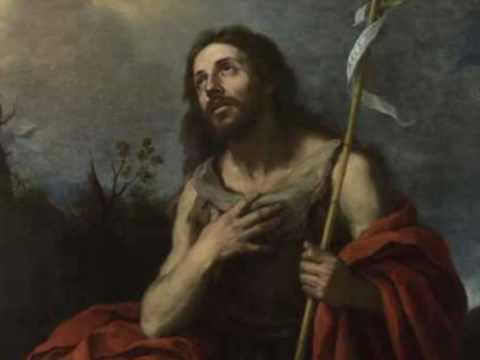
Let's face it: John was peculiar. He dressed like a cave man, ate insects and railed at politicians for their fornication and marital infidelity. He sequestered himself in the desert where he tirelessly initiated converts fleeing the sinful pollution of the cities. He proclaimed the end if the people failed to repent and he used vivid and mystical imagery. In the popular "media" of the day, he was portrayed as a nut and dangerous fanatic.
By standing apart, boldly calling out evil doers without regard to their prestige or rank, by challenging his own co-religionists, John made himself terribly unpopular. At the end, he publicly and relentlessly criticized the personal behavior of the most powerful politician in Judea, Herod. As a result he was arrested and executed as a traitor.
Today we tend to reject those who similarly publicly decry sin and heresy. Street preachers, prophets and clerics who confront sinful policies, bad behavior and false ideologies are decried as trouble makers, fanatics and dangerous "extremists".
John the Baptizer was a simple man, not a member of the elite. He was stirred by conscience and the Holy Spirit to speak bluntly and throw convention to the wind. He paid dearly for it. As Christians we inherit the abundant fruit of his daring and liberating choices. The way he exercised the great gift of his human freedom instructs us in exercising our own.
The Lord desires our human flourishing and happiness. He wants us to be truly free. He invites us to choose Him over our own selfish pursuits. In that continual choosing we are freed and made new. In Jesus Christ we have been given all that we need to overcome the obstacles which impede us.
Because of sin, our freedom was fractured. Through grace given by the splint of the Cross it is healed. We are capacitated to choose what is true, to choose the good. In those choices we become the men and women the Lord wants us to become as we are recreated in Christ.
Notice the language with which we discuss eternal life and heaven. We speak of receiving the receiving the "beatific vision" when we finally stand in His presence and enter into the fullness of communion. The word "beatitude" actually means happiness! Living in the Lord will make us happy. Not only in the life to come, but beginning now in this life.
Too often we associate repentance with some kind of wrong- headed self hatred. To the contrary, for those who have been schooled in its lessons like John the Baptizer, the way of voluntary penitence and conversion becomes the path to true joy.
Blessed John Paul II wrote frequently about human freedom. In one of his letters of instruction on the Christian family he wrote these insightful words: "History is not simply a fixed progression toward what is better - but rather, an event of freedom. Specifically, it is a struggle between freedoms that are in mutual conflict: a conflict between two loves - the love of God to the point of disregarding self and the love of self to the point of disregarding God (John Paul II, Christian Family in the Modern World, n. 6)"
This conflict between two loves, this "event of freedom", is played out on a daily basis. The recurring questions of Eden echo in our personal histories. How will we exercise our own human freedom? At which tree will we make our choices?
Will it be the tree of disobedience, where the first Adam chose against God's invitation to a communion of love, or the tree on Golgotha's hill where the second Adam, the Son of God, brought heaven to earth when He stretched out His arms to embrace all men and women, bearing the consequences of all their wrong choices and setting them free from the law of sin and death? (Romans 8:2) John the Baptizer was one of the freeset of men because he knew the answer.
The Catechism of the Catholic Church teaches us that : "Freedom is the power, rooted in reason and will, to act or not to act, to do this or that, and so to perform deliberate actions on one's own responsibility. By free will one shapes one's own life. Human freedom is a force for growth and maturity in truth and goodness; it attains its perfection when directed toward God, our beatitude.
"As long as freedom has not bound itself definitively to its ultimate good which is God, there is the possibility of choosing between good and evil, and thus of growing in perfection or of failing and sinning. This freedom characterizes properly human acts. It is the basis of praise or blame, merit or reproach. The more one does what is good, the freer one becomes. There is no true freedom except in the service of what is good and just. The choice to disobey and do evil is an abuse of freedom and leads to "the slavery of sin." (CCC 1731 - 1733).
The choice is ours. Just as it was with John the Baptizer. He shows us the way to give away our freedom in love - and then find it anew in the One who truly sets us free. (John 8:36). The kingdom of heaven is still being taken by force.The force of love.

---
'Help Give every Student and Teacher FREE resources for a world-class Moral Catholic Education'
Copyright 2021 - Distributed by Catholic Online
Join the Movement
When you sign up below, you don't just join an email list - you're joining an entire movement for Free world class Catholic education.


 Daily Readings for Friday, April 26, 2024
 St. Cletus: Saint of the Day for Friday, April 26, 2024
 Prayer before the Closing of the Day: Prayer of the Day for Friday, April 26, 2024