April 11 Address on the Risen Christ
FREE Catholic Classes
"We Cannot Keep the Great News to Ourselves"
VATICAN CITY, APRIL 16, 2007 (Zenit) - Here is a translation of the address Benedict XVI gave at the general audience last Wednesday in St. Peter's Square.
* * *
Dear Brothers and Sisters,
We meet each other today after the solemn Easter celebrations for our usual Wednesday audience, and it is my desire above all to renew to each of you the most fervent vows of well-wishing. I thank you for your presence here in such great numbers and I thank the Lord for the beautiful sun he has given us today.
In the Easter Vigil there resounded this announcement: "The Lord is truly risen, alleluia!" Now it is he himself who speaks to us: "I shall not die but live," he proclaims. To sinners he says: "Receive the remission of sins. Indeed I am your remission." To all, in the end, he repeats: "I am the Passover of salvation, the Lamb slain for you, I your ransom, I your life, I your resurrection, I your light, I your salvation, I your king. I will show you the Father." This is how a writer of the second century, Melito of Sardis, expresses himself, realistically interpreting the words of the Risen One ("On Easter," 102-103).
In these days, the liturgy recalls the different meetings with Jesus after his resurrection: with Mary Magdalene and the other women who had gone in the early morning to the tomb the day after the Sabbath; with the incredulous apostles who were together in the cenacle; with Thomas and other disciples. These different appearances of his constitute for us, too, an invitation to delve into the fundamental message of Easter; they stimulate us to retrace the spiritual journey of those who met Christ and recognized him in those first days after the events of Easter.
The Evangelist John tells us of how Peter and he himself, having heard the news from Mary Magdalene, ran, almost racing, to the tomb (cf. John 20:3ff). The Fathers of the Church saw in their hurried haste toward the empty tomb an exhortation to the only legitimate competition among believers: the race in seeking Christ.
And what should we say of Mary Magdalene? Weeping, she remains alongside the empty tomb, only desiring to know where they have taken her master. She finds him and recognizes him when he calls her by name (cf. John 20:11-18). We too, if we seek the Lord with a simple and sincere heart, will meet him. Indeed, he himself will come to meet us; he will make us recognize him, he will call us by name, he will bring us into the intimacy of his love.
Today, Wednesday in the octave of Easter, the liturgy brings us to meditate on another singular encounter with the Risen One, that of the two disciples of Emmaus (cf. Luke 24:13-35). Saddened over the death of their master, they return home and the Lord comes along to travel with them, but they do not recognize him. His words, commenting on the Scriptures that refer to him, cause a fire to burn in the disciples' hearts so that they ask him to stay with them when they arrive at their destination. When, at the end, he "takes the bread, says the blessing, breaks it and gives it to them" (Luke 24:30), their eyes are opened. But at that very instant Jesus disappears. They recognized him, therefore, when he disappeared.
Commenting on this episode of the Gospel, St. Augustine observes: "Jesus breaks the bread, they recognize him. Now we no longer say that we do not recognize the Christ! If we believe, we know him! Indeed, if we believe, we have him! They had Christ at their table, we have him in our soul!" He concludes: "Having Christ in your heart is much more than having him in your house: In fact our heart is closer to us than our house" (Sermon 232, VII, 7). Let us try truly to carry Jesus in our hearts.
In the prologue to the Acts of the Apostles, St. Luke affirms that the risen Lord "shows himself (to the apostles) living, after his passion, with many proofs, appearing to them for forty days" (Acts 1:3). We must understand this well: When the sacred author says "he showed himself living" he does not want to say that Jesus was returned to his former life, as Lazarus. St. Bernard observes that "Pascha" (Easter), which we are celebrating, means "passage" and not "return," because Jesus has not returned to the previous situation, but rather he has "crossed a frontier" toward a more glorious, new, and definitive condition (cf. Sermon on Easter).
To Mary Magdalene the Lord said: "Do not cling to me for I have not yet ascended to the Father" (John 20:17). This is an expression that surprises us, especially when we compare it to what happens with the incredulous Thomas. There, in the cenacle, it was the Risen One himself who presented his hands and his side so that Thomas touch them and find the certainty that it was Jesus (cf. 20:27). In reality the two episodes are not opposed to each other; on the contrary, the one helps us understand the other.
Mary Magdalene wanted to have the same master as before, taking the cross to be a dramatic memory to forget. Now, however, there is no room for a merely human relationship with the Risen One. To encounter him one need not go back but place oneself into a new relationship with him: One must go forward! St. Bernard emphasizes this: Jesus "invites all of us to this new life, to this passage.... We do not see Christ if we turn backward" (Sermon on Easter). This is what happened to Thomas. Jesus showed him his wounds not so as to forget the cross, but to make it unforgettable even in the future.
It is toward the future that our gaze in now directed. The task of the disciple is to bear witness to the death and Resurrection of his master and his new life. For this reason Jesus invites his incredulous friend to "touch him": He wants to give direct testimony of his resurrection.
Dear brothers and sisters, we too, like Mary Magdalene, Thomas and the other apostles, are called to be witnesses of the death and resurrection of Christ. We cannot keep the great news to ourselves. We must tell it to all the world: "We have seen the Lord!" (John 20:25).
May the Virgin Mary help us to fully taste the Easter joy, so that, sustained by the strength of the Holy Spirit, we become able in turn to spread it wherever we live and work.
Once again, Happy Easter to all of you!
[After the audience, Benedict XVI greeted visitors in various languages. In English, he said:]
I greet all the English-speaking visitors present at today's Audience, including the groups from Britain and Ireland, Sweden, Australia and the United States. I extend a special welcome the newly ordained deacons and the Golden Jubilarians from Ireland. I pray that the Risen Lord will fill your hearts with joy and that he will inspire you to proclaim to the world the good news of the Lord's Resurrection! Happy Easter to you all!
© Copyright 2007 -- Libreria Editrice Vaticana
Contact
Catholic Online
https://www.catholic.org
CA, US
Catholic Online - Publisher, 661 869-1000
info@yourcatholicvoice.org
Keywords
Pope, Benedict, Easter, Lent, Christ, Wednesday, Audience
More Catholic PRWire
Showing 1 - 50 of 4,716
A Recession Antidote
Randy Hain
Monaco & The Vatican: Monaco's Grace Kelly Exhibit to Rome--A Review of Monegasque-Holy See Diplomatic History
Dna. Maria St. Catherine Sharpe, t.o.s.m., T.O.SS.T.
The Why of Jesus' Death: A Pauline Perspective
Jerom Paul
A Royal Betrayal: Catholic Monaco Liberalizes Abortion
Dna. Maria St.Catherine De Grace Sharpe, t.o.s.m., T.O.SS.T.
Embrace every moment as sacred time
Mary Regina Morrell
My Dad
JoMarie Grinkiewicz
Letting go is simple wisdom with divine potential
Mary Regina Morrell
Father Lombardi's Address on Catholic Media
Catholic Online
Pope's Words to Pontifical Latin American College
Catholic Online
Prelate: Genetics Needs a Conscience
Catholic Online
State Aid for Catholic Schools: Help or Hindrance?
Catholic Online
Scorsese Planning Movie on Japanese Martyrs
Catholic Online
2 Nuns Kidnapped in Kenya Set Free
Catholic Online
Holy See-Israel Negotiation Moves Forward
Catholic Online
Franchising to Evangelize
Catholic Online
Catholics Decry Anti-Christianity in Israel
Catholic Online
Pope and Gordon Brown Meet About Development Aid
Catholic Online
Pontiff Backs Latin America's Continental Mission
Catholic Online
Cardinal Warns Against Anti-Catholic Education
Catholic Online
Full Circle
Robert Gieb
Three words to a deeper faith
Paul Sposite
Relections for Lent 2009
chris anthony
Wisdom lies beyond the surface of life
Mary Regina Morrell
World Food Program Director on Lent
Catholic Online
Moral Clarity
DAN SHEA
Pope's Lenten Message for 2009
Catholic Online
A Prayer for Monaco: Remembering the Faith Legacy of Prince Rainier III & Princess Grace and Contemplating the Moral Challenges of Prince Albert II
Dna. Maria St. Catherine Sharpe
Keeping a Lid on Permissiveness
Sally Connolly
Glimpse of Me
Sarah Reinhard
The 3 stages of life
Michele Szekely
Sex and the Married Woman
Cheryl Dickow
A Catholic Woman Returns to the Church
Cheryl Dickow
Modernity & Morality
Dan Shea
Just a Minute
Sarah Reinhard
Catholic identity ... triumphant reemergence!
Hugh McNichol
Edging God Out
Paul Sposite
Burying a St. Joseph Statue
Cheryl Dickow
George Bush Speaks on Papal Visit
Catholic Online
Sometimes moving forward means moving the canoe
Mary Regina Morrell
Action Changes Things: Teaching our Kids about Community Service
Lisa Hendey

Easter... A Way of Life
Paul Spoisite
Papal initiative...peace and harmony!
Hugh McNichol
Proclaim the mysteries of the Resurrection!
Hugh McNichol
Jerusalem Patriarch's Easter Message
Catholic Online
Good Friday Sermon of Father Cantalamessa
Catholic Online
Papal Address at the End of the Way of the Cross
Catholic Online
Cardinal Zen's Meditations for Via Crucis
Catholic Online
Interview With Vatican Aide on Jewish-Catholic Relations
Catholic Online
Pope Benedict XVI On the Easter Triduum
Catholic Online
Holy Saturday...anticipation!
Hugh McNichol

Join the Movement
When you sign up below, you don't just join an email list - you're joining an entire movement for Free world class Catholic education.
-

- Easter / Lent
- Ascension Day
- 7 Morning Prayers
- Mysteries of the Rosary
- Litany of the Bl. Virgin Mary
- Popular Saints
- Popular Prayers
- Female Saints
- Saint Feast Days by Month
- Stations of the Cross
- St. Francis of Assisi
- St. Michael the Archangel
- The Apostles' Creed
- Unfailing Prayer to St. Anthony
- Pray the Rosary

A Generation Without Christ Breeds Violence — The Answer Is Catholic Education

Rediscovering the Face of God in Others: Pope Leo’s Call to Fraternity

‘Blessed are the Peacemakers’: A Catholic Response to America’s Mass-Shooting Crisis
Daily Catholic
- Daily Readings for Saturday, September 13, 2025
- St. John Chrysostom: Saint of the Day for Saturday, September 13, 2025
- A Prayer for the Gift of Wisdom: Prayer of the Day for Saturday, September 13, 2025
- Daily Readings for Friday, September 12, 2025
- St. Ailbhe: Saint of the Day for Friday, September 12, 2025
- Family Prayer Time: Prayer of the Day for Friday, September 12, 2025
 Daily Readings for Saturday, September 13, 2025
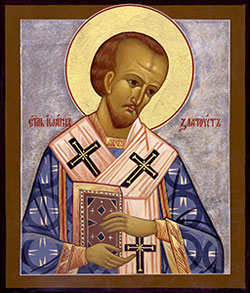 St. John Chrysostom: Saint of the Day for Saturday, September 13, 2025
 A Prayer for the Gift of Wisdom: Prayer of the Day for Saturday, September 13, 2025
 St. Ailbhe: Saint of the Day for Friday, September 12, 2025

Copyright 2025 Catholic Online. All materials contained on this site, whether written, audible or visual are the exclusive property of Catholic Online and are protected under U.S. and International copyright laws, © Copyright 2025 Catholic Online. Any unauthorized use, without prior written consent of Catholic Online is strictly forbidden and prohibited.
Catholic Online is a Project of Your Catholic Voice Foundation, a Not-for-Profit Corporation. Your Catholic Voice Foundation has been granted a recognition of tax exemption under Section 501(c)(3) of the Internal Revenue Code. Federal Tax Identification Number: 81-0596847. Your gift is tax-deductible as allowed by law.