Because of You, 2.2 Million Students Are Being Formed in the Faith
Because of generous supporters like you, Catholic Online School has already delivered free, faithful Catholic education to over 2.2 million students across 193 countries. In an age of noise and algorithms, you are helping form souls with truth, prayer, Scripture, and Christ.
If everyone who reads this gave just $5 — the cost of a coffee — we could reach even more families and keep this life-changing formation free for all. Be Courageous. Be Catholic. Stand with us today.
DONATE TODAY >2nd Lenten Sermon of Father Cantalamessa
FREE Catholic Classes
"Blessed Are the Meek, For They Shall Inherit the Land"
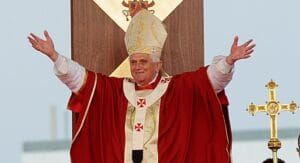
VATICAN CITY, MARCH 19, 2007 (Zenit) - Here is a translation of the Lenten sermon delivered Friday by Capuchin Father Raniero Cantalamessa in the presence of Benedict XVI and officials of the Roman Curia. The Pontifical Household preacher delivered the reflection in the Mater Redemptoris Chapel of the Apostolic Palace.
* * *
1. Who are the meek?
The beatitude on which we wish to meditate today lends itself to an important observation. It says: "Blessed are the meek for they shall inherit the land." Now, in another passage of the same Gospel, Jesus exclaims: "Learn from me, for I am meek and humble of heart" (Matthew 11:29). We conclude from this that the beatitudes are not a nice ethical program traced by the master for his followers; they are a self-portrait of Jesus! Jesus is the one who is truly poor, meek, pure of heart, persecuted for the sake of justice.
Here is the limitation of Gandhi's interpretation of the Sermon on the Mount, which he so much admired. For Gandhi the whole sermon might have just as well been considered apart from the historical person of Christ. "It does not matter to me," he once said, "if someone demonstrated that the man Jesus never lived and that what we read in the Gospels is nothing more than a production of the author's imagination. The Sermon on the Mount will always remain true in my eyes."[1]
On the contrary, it is the person and life of Christ that make of the beatitudes and the whole Sermon on the Mount something more than a beautiful ethical utopia; they make of them an historical reality, from which everyone can draw strength through mystical union with the person of the Savior. They do not merely belong to the order of duties but to the order of grace.
To see who the meek whom Jesus proclaims "blessed" are, it would be helpful to briefly review the various terms with which the word "meek" ("praeis") is rendered in modern translations: "meek" ("miti") and "mild" ("mansueti"). The latter is also the word used in the Spanish translations, "los mansos," the mild. In French the word is translated with "doux," literally "the sweet," those who have the virtue of sweetness. (There is no specific word in French for "meekness"; in the "Dictionnaire de spiritualité," this virtue is treated in the entry "douceur," that is, "sweetness.")
In German, different translations alternate. Luther translated the term with "SanftmĂĽtigen," that is, "meek," "sweet"; in the ecumenical translation of the Bible, the "Einheits Bibel," the meek are those who do not act violently -- "die Keine Gewalt anwenden -- thus the non-violent; some authors accentuate the objective and sociological dimension and translate "praeis" with "machtlosen," "the weak," "those without power." English usually renders "praeis" with "the gentle," introducing the nuance of niceness and courtesy into the beatitude.
Each of these translations highlights a true but partial component of the beatitude. If we want to get an idea of the original richness of the Gospel term it is necessary to keep all the elements together and to not isolate any. Two regular associations, in the Bible and in ancient Christian exhortation, help us to grasp the "full meaning" of meekness: one is the linking of meekness and humility and the other is the linking of meekness and patience; the one highlights the interior dispositions from which meekness flows, the other the attitudes that meekness causes us to have toward our neighbor: affability, sweetness, kindness. These are the same traits that the Apostle emphasizes when speaking about charity: "Charity is patient, it is kind, it is not disrespectful, it is not angry." (1 Corinthians 13:4-5).
2. Jesus, the meek
If the beatitudes are a self-portrait of Christ, the first thing to do in commenting on them is to see how they were lived by him. The Gospels are from beginning to end a demonstration of the meekness of Christ in its dual aspect of humility and patience. Jesus himself, we pointed out, proposes himself as the model of meekness. Matthew applies to Jesus the saying of the Servant of God in Isaiah: "He will no wrangle or cry out, he will not break a bruised reed nor quench a smoldering wick" (cf. Mark 12:19-20). His entrance into Jerusalem on the back of a donkey is seen as an example of a "meek" king who refuses all ideas of violence and war (cf. Matthew 21:4).
The maximum proof of Christ's meekness is in his passion. There is no wrath, there are no threats: "When he was reviled he did not revile in return, when he suffered, he did not threaten" (1 Peter 2:23). This trait of the person of Christ was so stamped in the memory of his disciples that Paul, wanting to swear by something dear and sacred in his second letter to the Corinthians writes: "I entreat you by the meekness ("prautes") and the gentleness ("epiekeia") of Christ" (2 Corinthians 10:1).
But Jesus did much more than give us an example of heroic meekness and patience; he made of meekness and nonviolence the true sign of greatness. This will no longer mean holding oneself alone above, above the crowd, but to humble oneself to serve and elevate others. On the cross, St. Augustine says, the true victory does not consist in making victims of others but in making oneself a victim: "Victor quia victima."[2]
Nietzsche, we know, was opposed to this vision, calling it "slave morality," suggested by a natural "resentment" of the weak toward the strong. According to him, in preaching humility and meekness, making oneself small, turning the other cheek, Christianity introduced a type of cancer into humanity which destroyed its Ă©lan and mortified life. In the introduction to "Thus Spake Zarathustra," Nietzsche's sister summarized the philosopher's thought in this way: "He believes that, on account of the resentment of a weak and falsified Christianity, all that was beautiful, strong, superior, powerful -- like the virtues that come from strength -- was proscribed and banned and thus the forces that promote and exalt life were diminished. But now a new table of values must be given to humanity, that is, the man who is strong, powerful, magnificent to excess, the 'superman,' which is presented to us with great passion as the goal of our life, our will, our hope."[3]
For some time we have been witnessing this attempt to absolve Nietzsche from every accusation, to domesticate and, in the end, Christianize him. It is said that at bottom he was not against Christ, but against Christians who made self-denial an end in itself, despising life and acting cruelly toward the body. Everyone has apparently betrayed Nietzsche's true thought, starting with Hitler. In reality, he would have been the prophet of a new era, the precursor of postmodernity.
One might say that there has been a lone voice to oppose himself to this tendency, the French thinker René Girard. According to him, all of these efforts have done an injustice, above all to Nietzsche himself. With a perspicacity unique for his time, Girard got to the heart of the matter. With Nietzsche we are faced with two absolute alternatives: paganism or Christianity.

Paganism exalts the sacrifice of the weak for the benefit of the strong and the advancement of life; Christianity exalts the sacrifice of the strong for the benefit of the weak. It is hard not to see an objective connection between Nietzsche's proposal and Hitler's program of eliminating whole groups of human beings for the advancement of civilization and the purity of the race.
Nietzsche does not just target Christianity, but Christ. "Dionysus against the Crucified: this is the antithesis," he exclaimed in one posthumous fragment.[4]
Girard shows that one of the greatest boasts of modern society -- concern for victims, taking the side of the weak and oppressed, the defense of the life that is threatened -- is in truth a direct product of the revolution brought by the Gospel. However, by a paradoxical play of imitative rivalries, these values have been claimed by other movements as their own achievement and this precisely in opposition to Christianity.[5]
In the previous meditation I spoke about the social relevance of the beatitudes. The beatitude of the meek is perhaps the clearest example, but what is said of it is valid for all the beatitudes. They are the manifesto of the new greatness, the way of Christ to self-realization, to happiness.
It is not true that the Gospel kills the desire to do great things and to esteem. Jesus says: "If someone wants to be first, he must become the least of all and the servant of all" (Mark 9:35). The desire to be first is thus legitimate, indeed it is recommended; it is only that the way to first place has changed: It is not reached by raising ourselves up above others, squashing them perhaps if they are in our way, but by lowering ourselves to raise up others together with us.
3. Meekness and tolerance
The beatitude of the weak has come to be extraordinarily relevant in the debate about religion and violence that was ignited following the events of 9/11. It reminds us Christians, above all, that the Gospel leaves no room for doubt. There are no exhortations to nonviolence mixed with contrary exhortations. Christians may, at certain times, distance themselves from it, but the Gospel is clear and the Church can return to it always and be inspired, knowing that it will find nothing else there but moral perfection.
The Gospel says that "he who does not believe will be condemned" (Mark 16:16), but condemned in heaven, not on earth, by God not by men. "When they persecute you in one city," Jesus says, "flee to another" (Matthew 10:23); he does not say: "Fight back." Once two of his disciples, James and John, who were not welcomed in a certain Samaritan village, said to Jesus: "Lord, do you want us to call down fire from heaven upon them to consume them?" Jesus, it is written, "turned and reproved them." Many manuscripts also report the tenor of the reproof: "You do not know of which spirit you are. The Son of Man did not come to lose the souls of men but to save them" (cf. Luke 9:53-55).

The famous "compelle intrare," "constrain them to enter," with which St. Augustine, even if with a heavy heart [6], justifies his approval of the imperial laws against the Donatists, and which will be used afterward to justify the coercion of heretics, stems from an obvious forcing of the Gospel text, fruit of a mechanical literal reading of the Bible.
Jesus puts the line in the mouth of a man who had prepared a great feast and, faced with the refusal of those invited to come, he tells his servants to go out into the highways and hedges and "force the poor, the feeble, the blind, and the lame to come" (cf. Luke 14:15-24). It is clear from the context that "force" does not mean anything other than a friendly insistence. The poor and the feeble, as all the unfortunate, might feel embarrassed to come to the house: Wear down their resistance, says the master, and tell them to not be afraid to come. How often we ourselves have said in similar circumstances: "I was forced to accept," knowing that insistence in these cases is a sign of benevolence and not violence.
In a recent book on Jesus that has had a great deal of attention in Italy, the following statement is attributed to Jesus: "And those enemies of mine who did not want me to become their king, bring them here and kill them before me" (Luke 19:27) and it is concluded that it is to statements such as this that "supporters of 'holy war' have recourse."[7] Now it needs to be said that Luke does not attribute these words to Jesus, but to the king in the parable, and we know that all the details of the parable are not supposed to be transferred to reality, and in any case, they are to be transferred from the material to the spiritual level.
4. With meekness and respect
But let us leave aside these considerations of an apologetic sort and try to see what light the beatitude of the meek can shed on our Christian life. There is a pastoral application of the beatitude of the meek that is initiated by the first letter of Peter. It regards dialogue with the outside world: "Worship the Lord, Christ, in your hearts, always ready to answer whoever asks you the reason for the hope in you. But let this be done with meekness ("prautes") and respect" (1 Peter 3:15-16).

From ancient times there has been two types of apologetics, one that has its model in Tertullian, and the other that has its model in Justin; the one aims at winning, the other at convincing. Justin wrote a "Dialogue with Trypho the Jew," Tertullian (or his disciple) wrote "Against the Jews." Both of these styles have had their following in Christian writing (our Giovanni Papini was certainly closer to Tertullian than to Justin), but today the first style is preferred of course.
The martyr St. Ignatius of Antioch suggested to the Christians of his time, in relation to the outside world, this always relevant attitude: "Faced with their rage, be meek; faced with their arrogance, be humble."[8]
The promise linked to the beatitude of the meek -- "they will inherit the land" -- is realized on different levels; there is the definitive promised land of eternal life, but there is also the land which is the hearts of men. The meek win confidence, they attract souls. The saint of meekness and sweetness par excellence, St. Francis de Sales, often said: "Be as sweet as you can and remember that more flies are captured by a drop of honey than with a barrel of vinegar."
5. Learn from me
We could remain for a long time on these pastoral applications of the beatitude of the meek but let us pass to a more personal application. Jesus says: "Learn from me for I am meek." We might object: But Jesus himself was not always meek! He said, for example, not to oppose the evil doer and "to him who strikes you on the right cheek, turn and give him the other" (Matthew 5:39). However, when one the guards strikes him on the cheek during the trial before the Sanhedrin, it is not written that he gave him the other cheek, but that with calmness he replied: "If I said something wrong, show it to me; but if I spoke well, why do you strike me?" (John 18:23).
This means that not everything in the Sermon on the Mount should be understood mechanically in a literal way; Jesus, according to his style, uses hyperbole and images to better imprint the idea on the mind of his disciples. In the case of turning the other cheek, for example, what is important is not the gesture of turning the other cheek (which might sometimes serve more to provoke a person), but not responding to violence with violence, but to win with calm.

In this sense, his response to the guard is an example of divine meekness. To measure its range, it is enough to compare it to the reaction of his apostle Paul (who was himself a saint) in an analogous situation. When, during Paul's trial before the Sanhedrin, the high priest Ananias orders Paul to be struck on the mouth, he answers: "God will strike you, you whitewashed wall!" (Acts 23:2-3).
Another matter should be clarified. In the same Sermon on the Mount Jesus says: "He who says to his brother: 'Idiot,' will be subject to the Sanhedrin; and he who says to him: 'Fool,' will suffer the fire of Gahenna" (Matthew 5:22). Now on many occasions in the Gospel Jesus turns to the scribes and the Pharisees, calling them "hypocrites," "fools" and "blind men" (cf. Matthew 23:17). Jesus also reproves the disciples, calling them "idiots" and "slow of heart" (cf. Luke 24:25).
Here the explanation is likewise simple. We need to distinguish between injury and correction. Jesus condemns the words said with anger and with the intention of offending the brother, not those that aim at making one aware of his error and at correcting. A father who says to his son that he is undisciplined, disobedient, does not intend to offend him but to correct him. Moses is called by Scripture "the most mild of all men on earth" (Numbers 12:3), and yet in Deuteronomy we hear him respond to the rebellious Israel: "Thus you repay the Lord, you foolish and senseless people?" (Deuteronomy 12:3).
Let us take are guide here from St. Augustine. "Love and do what you will," he says. If you love, whether you correct or not, it will be from love. Love does no evil to one's neighbor. From the root of love, as from a good tree, only good fruit can grow.[9]
6. The meek of heart
Thus we arrive on the proper terrain of the beatitude of the meek, the heart. Jesus says: "Learn from me, for I am meek and humble of heart." True meekness is decided there. It is from the heart, he says, that murders, wickedness, calumny come (Mark 7:21-22), as from the boiling within a volcano come lava, ashes, and fiery stones. The greatest explosions of violence begin, says St. James, secretly in "the passions that are stirred up within man" (cf. James 4:1-2). Just as there is an adultery in the heart, there is also a murder in the heart: "Whoever hates his own brother," writes John, "is a murderer" (1 John 3:15).

There is not only the violence of hands, there is also that of thoughts. Inside of us, if we pay attention, there are almost always "trials behind closed doors" going on. An anonymous monk has written pages of great penetration on this theme. He speaks as a monk, but what he says is not just valid for monasteries; he considers the example of inferiors in a religious community, but it is plain that the problem occurs in another way also for superiors.
"Observe," he says, "even for just one day, the course of your thoughts: You will be surprised by the frequency and the vivacity of the internal criticisms made with imaginary interlocutors. What is their typical origin? It is this: The unhappiness with superiors who do not care for us, do not esteem us, do not understand us; they are severe, unjust, or too stingy with us or with other 'oppressed persons.' We are unhappy with our brothers, who are 'without understanding, hard-bitten, curt, confused, or injurious.... Thus in our spirit a tribunal is created in which we are the prosecutor, judge, and jury; we defend and justify ourselves; the absent accused is condemned. Perhaps we make plans for our vindication or revenge."[10]
The desert fathers, not having to fight against external enemies, made of this interior battle with thoughts (the famous "logismoi") the benchmark for all spiritual progress. They also worked out a method for their combat. Our mind, they said, has the capacity to anticipate the unfolding of a thought, to know, from the beginning, where it will go: To excuse or condemn a brother, toward our own glory or the glory of God. "It is the monk's task," said an older monk, "to see his thoughts from afar"[11] and to bar their way when they go against charity. The easiest way to do it is say a short prayer or to bless the person that we are tempted to judge. Afterward, with a calm mind, we can decide how we should act toward him.
7. Put on the meekness of Christ
One observation before concluding. By their nature the beatitudes are oriented toward practice; they call for imitation, they accentuate the work of man. There is the danger that we will become discouraged in experiencing an incapacity to put them to practice in our own lives, and by the great distance between the ideal and the practice.

We must recall to mind what was said at the beginning: The beatitudes are Jesus' self-portrait. He lived them all and did so in the highest degree; but -- and this is the good news -- he did not live them only for himself, but also for all of us. With the beatitudes we are called not only to imitation, but also to appropriation. In faith we can draw from the meekness of Christ, just as we can draw from his purity of heart and every other virtue. We can pray to have meekness as Augustine prayed to have chastity: "O God, you have commanded me to be meek; give to me that which you command and command me to do what you will."[12]
"As the elect of God, holy and beloved, put on the sentiments of mercy, goodness, humility, mildness ("prautes"), and patience" (Colossians 3:12), writes the Apostle to the Colossians. Mildness and meekness are like a robe that Christ merited for us and which, in faith, we can put on, not to be dispensed from pursuing them but to help us in their practice. Meekness ("prautes") is placed by Paul among the fruits of the Spirit (Galatians 5:23), that is, among the qualities that the believer manifests in his life when he receives the Spirit of Christ and makes an effort to correspond to the Spirit.
We can end reciting together with confidence the beautiful invocation of the litany of the Sacred Heart: "Jesus meek and humble of heart, make our hearts like yours" ("Jesu, mitis et humilis corde: fac cor nostrum secundum cor tutum").
* * *
[1] Gandhi, "Buddismo, Cristianesimo, Islamismo," Rome, Tascabili Newton Compton, 1993, p. 53.
[2] St. Augustine, "Confessions," X, 43.
[3] Introduction to the 1919 edition of "Also sprach Zarathustra."
[4] Friedrich Nietzsche, "Complete Works," VIII, Frammenti postumi 1888-1889, Milan, Adelphi, 1974, p. 56.
[5] R. Girard, "Vedo Satana cadere come folgore," Milano, Adelphi, 2001, pp. 211-236.
[6] St. Augustine, Epistle 93, 5: "Before I was of the opinion that no one should be forced into the unity of Christ but that we should only act with words, fight through discussion, and convince with reason."
[7] Corrado Augias and Mauro Pesce, "Inchiesta su GesĂą," Milan, Mondadori, 2006, p. 52.
[8] St. Ignatius of Antioch, "Letter to the Ephesians," 10, 2-3.
[9] St. Augustine, "Commentary on the First Letter of John," 7, 8 (PL 35, 2023).
[10] A monk, "Le porte del silenzio," Milan, Ancora, 1986, p. 17 (Originale: "Les porte du silence," Geneva, Libraire Claude Martigny).
[11] "Detti e fatti dei Padri del deserto," edited by C. Campo and P. Draghi, Milan, Rusconi, 1979, p. 66.
[12] Cf. St. Augustine, "Confessions," X, 29.

Contact
Catholic Online
https://www.catholic.org
CA, US
Catholic Online - Publisher, 661 869-1000
info@yourcatholicvoice.org
Keywords
Cantalamessa, Lent, Sermon, Meek, Mass

More Catholic PRWire
Showing 1 - 50 of 4,716
A Recession Antidote
Randy Hain
Monaco & The Vatican: Monaco's Grace Kelly Exhibit to Rome--A Review of Monegasque-Holy See Diplomatic History
Dna. Maria St. Catherine Sharpe, t.o.s.m., T.O.SS.T.
The Why of Jesus' Death: A Pauline Perspective
Jerom Paul
A Royal Betrayal: Catholic Monaco Liberalizes Abortion
Dna. Maria St.Catherine De Grace Sharpe, t.o.s.m., T.O.SS.T.
Embrace every moment as sacred time
Mary Regina Morrell
My Dad
JoMarie Grinkiewicz
Letting go is simple wisdom with divine potential
Mary Regina Morrell
Father Lombardi's Address on Catholic Media
Catholic Online
Pope's Words to Pontifical Latin American College
Catholic Online
Prelate: Genetics Needs a Conscience
Catholic Online
State Aid for Catholic Schools: Help or Hindrance?
Catholic Online
Scorsese Planning Movie on Japanese Martyrs
Catholic Online
2 Nuns Kidnapped in Kenya Set Free
Catholic Online
Holy See-Israel Negotiation Moves Forward
Catholic Online
Franchising to Evangelize
Catholic Online
Catholics Decry Anti-Christianity in Israel
Catholic Online
Pope and Gordon Brown Meet About Development Aid
Catholic Online
Pontiff Backs Latin America's Continental Mission
Catholic Online
Cardinal Warns Against Anti-Catholic Education
Catholic Online
Full Circle
Robert Gieb
Three words to a deeper faith
Paul Sposite
Relections for Lent 2009
chris anthony
Wisdom lies beyond the surface of life
Mary Regina Morrell
World Food Program Director on Lent
Catholic Online
Moral Clarity
DAN SHEA
Pope's Lenten Message for 2009
Catholic Online
A Prayer for Monaco: Remembering the Faith Legacy of Prince Rainier III & Princess Grace and Contemplating the Moral Challenges of Prince Albert II
Dna. Maria St. Catherine Sharpe
Keeping a Lid on Permissiveness
Sally Connolly
Glimpse of Me
Sarah Reinhard
The 3 stages of life
Michele Szekely
Sex and the Married Woman
Cheryl Dickow
A Catholic Woman Returns to the Church
Cheryl Dickow
Modernity & Morality
Dan Shea
Just a Minute
Sarah Reinhard
Catholic identity ... triumphant reemergence!
Hugh McNichol
Edging God Out
Paul Sposite
Burying a St. Joseph Statue
Cheryl Dickow
George Bush Speaks on Papal Visit
Catholic Online
Sometimes moving forward means moving the canoe
Mary Regina Morrell
Action Changes Things: Teaching our Kids about Community Service
Lisa Hendey
Easter... A Way of Life
Paul Spoisite
Papal initiative...peace and harmony!
Hugh McNichol
Proclaim the mysteries of the Resurrection!
Hugh McNichol
Jerusalem Patriarch's Easter Message
Catholic Online
Good Friday Sermon of Father Cantalamessa
Catholic Online
Papal Address at the End of the Way of the Cross
Catholic Online
Cardinal Zen's Meditations for Via Crucis
Catholic Online
Interview With Vatican Aide on Jewish-Catholic Relations
Catholic Online
Pope Benedict XVI On the Easter Triduum
Catholic Online
Holy Saturday...anticipation!
Hugh McNichol
Come Grow With Us
Sign up and walk the Catholic journey with millions around the world.
Receive inspiring emails on saints, daily readings, and free faith-building resources—no cost, ever.
Who is forming our children—algorithms or Christ?
Watch Sister Sara's Message Now
- 7 Morning Prayers
- Mysteries of the Rosary
- Litany of the Bl. Virgin Mary
- Popular Saints
- Popular Prayers
- Female Saints
- Saint Feast Days by Month
- Stations of the Cross
- St. Francis of Assisi
- St. Michael the Archangel
- The Apostles' Creed
- Unfailing Prayer to St. Anthony
- Pray the Rosary







Copyright 2026 Catholic Online. All materials contained on this site, whether written, audible or visual are the exclusive property of Catholic Online and are protected under U.S. and International copyright laws, © Copyright 2026 Catholic Online. Any unauthorized use, without prior written consent of Catholic Online is strictly forbidden and prohibited.
Catholic Online is a Project of Your Catholic Voice Foundation, a Not-for-Profit Corporation. Your Catholic Voice Foundation has been granted a recognition of tax exemption under Section 501(c)(3) of the Internal Revenue Code. Federal Tax Identification Number: 81-0596847. Your gift is tax-deductible as allowed by law.
