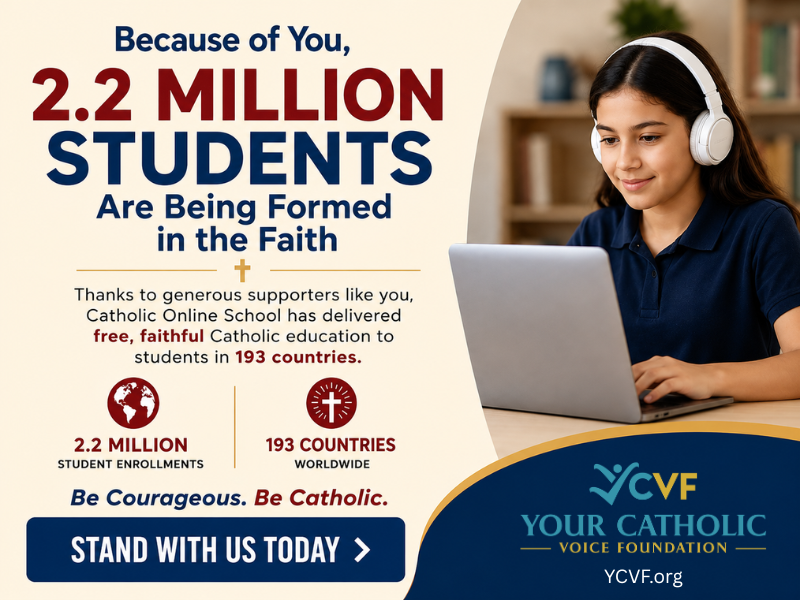
Because of You, 2.2 Million Students Are Being Formed in the Faith
Because of generous supporters like you, Catholic Online School has already delivered free, faithful Catholic education to over 2.2 million students across 193 countries. In an age of noise and algorithms, you are helping form souls with truth, prayer, Scripture, and Christ.
If everyone who reads this gave just $5 — the cost of a coffee — we could reach even more families and keep this life-changing formation free for all. Be Courageous. Be Catholic. Stand with us today.
DONATE TODAY >Arabic and Islamic Studies - formation of Christians for encounter with Islam
FREE Catholic Classes
Interview With Father M.A. Ayuso, New Rector
ROME, NOV. 17 2006 (Zenit) - Interest in Islam is growing, but at times the focus is more on information rather than formation, says the new rector of the Pontifical Institute for Arabic and Islamic Studies.
Father Miguel Ăngel Ayuso Guixot, a Comboni missionary, is the new rector of the PISAI. In this interview with us, he presents the nature of this Church institution at the service of interreligious and intercultural dialogue.
Born in Seville, Spain, Father Ayuso has a doctorate in dogmatic theology and has been a missionary in Egypt and Sudan.
Q: There are many people who do not know that the Pontifical Institute for Arabic and Islamic Studies exists in Rome. Since when has it been operating and what does Benedict XVI think about this institution?
Father Ayuso: Yes, the ignorance is somewhat surprising in certain sectors, except in the academic, of the existence in Rome of a pontifical institute which is dedicated specifically to the objective study of Islam, in view of establishing an interreligious and intercultural dialogue between Muslims and Christians.
Surprising too is the fact that in the Muslim environment we are well known and appreciated for our seriousness and determination to know Islam objectively, from the study of its sciences, through intensive study of the Arab language, as an absolutely necessary instrument to that end.
The Pontifical Institute for Arabic and Islamic Studies was created in 1926 in Tunis by the Society of Missionaries of Africa [the White Fathers]. Its aim was the specific formation of missionaries to live in an Arab-Muslim environment.
In 1949, the center of studies was moved to Manouba, near Tunis, where the Arab language and Islamic sciences were taught, while the Tunis center was becoming what up to today is called Institute of Arab Literature.
In 1960, the center was established as a pontifical institute and, in 1964, because of the policy of nationalizations, it was transferred from Tunis to Rome, where it received the support of Pope Paul VI, as an ideal instrument for interreligious dialogue, in keeping with the new spirit of the Second Vatican Council.
Since then [...] PISAI has been and is an institution of the Church of international prestige at the service of interreligious and intercultural dialogue.
In recent years, its academic authorities have tried to solve some difficulties to be able to ensure PISAI's continuity and permanence in Rome.
In fact, Benedict XVI's intervention for this excellent institute allows us to continue to offer this service to the Church, and for this we are enormously grateful to him. The institute will continue its mission of being a bridge between cultures and religions.
Q: On what will you focus your term as rector?
Father Ayuso: Simply on giving continuity to all the work that has been done up to today, that is, to work seriously in three essential fields: education, scientific publications and research.
To do this, we have a team of 25 professors for our students' formation; three scientific publications -- one on Arabic studies and the other two on the Islamic-Christian dialogue from the scientific perspective and the pastoral program of meetings; and, finally, for the purpose of research we have a specialized library with more than 31,000 volumes and more than 450 journal titles; and a consultation room frequented by our students, by students from other universities, and by a good number of researchers from all parts of the world.
Moreover, it is my great hope as rector to promote, among our more effective and motivated former students, the need for serious and continuing specialized study in this very important field of the Church's mission, to try to create a new team of professors who will be able to replace the elite team that PISAI has had since the beginning.
I also see an urgent need to continue the process of collaboration between the institute and religious congregations and diocesan and academic institutions in view of enriching this Church institution.
This collaboration would be obtained through the offer of teaching staff and possible collaborators, as well as with academic exchanges in the field of study of religions and cultures.
I think that at the Church level, we must "globalize" ourselves, that is, be truly catholic, to give consistency to a priority task of the Church. Hence, we need collaborators.
Finally, I wish to say that collaboration is translated also in financial terms. We need to create an "Association of Friends of PISAI," to collect funds which will allow us to promote extra-academic activities of an interreligious and intercultural character, which will enable us to enrich the institute's activities. Hence, we need donations.
Q: Some of the professors -- many of them White Fathers -- are considered world authorities on Islam. Do you think they are sufficiently known in the Catholic realm?
Father Ayuso: Yes, as I was saying, we have a series of professors who have marked a milestone in the history of this institution. The merit lies, I believe, in the seriousness and scientific rigor that they have been able to cultivate and promote during their academic service.
This effort carried out over long years has opened for them, with authority and respect, the doors of "interreligiosity" and "interculturality" toward our Muslim men and women friends.
Many of them are White Fathers. To mention one: Father Michel Lagarde, UNESCO 2005 prize of Arab Culture. I believe they are well known in Catholic realms, but probably knowledge of them is more widespread in the Arab-Muslim environment.
Q: Have you noticed an increase in students since Islam has been at the center of world attention?
Father Ayuso: Not in the quantity but yes in their countries of origin. Today we continue to have a group of some 50 students for the licentiate and doctorate degrees. It must be kept in mind that PISAI is a center of excellence, namely, of very specialized studies.
The endeavor of the Church in the field of dialogue has meant that some students are sent to study at PISAI, from all parts of the world, as prior pastoral preparation to exercise a function in the field of dialogue in their native dioceses or their own communities.
As we travel through the world it is a pleasure to meet with former students of PISAI who are responsible for centers of dialogue, be it at the local, diocesan, regional or national level, etc.
Since the beginning, PISAI has had some 1,300 students, who have been prepared for interreligious and intercultural dialogue.
Obviously, the present importance of Islam, as a center of social attention, should entail an increase of students, but at times one has the impression that interest is concentrated more on information than on formation. Today formation is absolutely necessary.
Q: How can PISAI contribute to the interreligious and intercultural dialogue?
Father Ayuso: PISAI continues to be a point of reference in the ambit of dialogue between cultures and religions, offering a renewed impulse to Arabic and Islamic studies, for the purpose of contributing to greater mutual knowledge and understanding, ever more necessary in the world in which we live.
As a Church institution and recalling Benedict XVI's words -- our future depends on dialogue with Islam -- PISAI's contribution will continue to bear fruits, as it has always done from its humble but significant creation.
Contact
Catholic Online
https://www.catholic.org
CA, US
Catholic Online - Publisher, 661 869-1000
info@yourcatholicvoice.org
Keywords
Islam, Arabic, Muslim, Pontifical, Institute, Rome
More Catholic PRWire
Showing 1 - 50 of 4,716
A Recession Antidote
Randy Hain
Monaco & The Vatican: Monaco's Grace Kelly Exhibit to Rome--A Review of Monegasque-Holy See Diplomatic History
Dna. Maria St. Catherine Sharpe, t.o.s.m., T.O.SS.T.
The Why of Jesus' Death: A Pauline Perspective
Jerom Paul
A Royal Betrayal: Catholic Monaco Liberalizes Abortion
Dna. Maria St.Catherine De Grace Sharpe, t.o.s.m., T.O.SS.T.
Embrace every moment as sacred time
Mary Regina Morrell
My Dad
JoMarie Grinkiewicz
Letting go is simple wisdom with divine potential
Mary Regina Morrell
Father Lombardi's Address on Catholic Media
Catholic Online
Pope's Words to Pontifical Latin American College
Catholic Online
Prelate: Genetics Needs a Conscience
Catholic Online
State Aid for Catholic Schools: Help or Hindrance?
Catholic Online
Scorsese Planning Movie on Japanese Martyrs
Catholic Online
2 Nuns Kidnapped in Kenya Set Free
Catholic Online
Holy See-Israel Negotiation Moves Forward
Catholic Online
Franchising to Evangelize
Catholic Online
Catholics Decry Anti-Christianity in Israel
Catholic Online
Pope and Gordon Brown Meet About Development Aid
Catholic Online
Pontiff Backs Latin America's Continental Mission
Catholic Online
Cardinal Warns Against Anti-Catholic Education
Catholic Online
Full Circle
Robert Gieb
Three words to a deeper faith
Paul Sposite
Relections for Lent 2009
chris anthony
Wisdom lies beyond the surface of life
Mary Regina Morrell
World Food Program Director on Lent
Catholic Online
Moral Clarity
DAN SHEA
Pope's Lenten Message for 2009
Catholic Online
A Prayer for Monaco: Remembering the Faith Legacy of Prince Rainier III & Princess Grace and Contemplating the Moral Challenges of Prince Albert II
Dna. Maria St. Catherine Sharpe
Keeping a Lid on Permissiveness
Sally Connolly
Glimpse of Me
Sarah Reinhard
The 3 stages of life
Michele Szekely
Sex and the Married Woman
Cheryl Dickow
A Catholic Woman Returns to the Church
Cheryl Dickow
Modernity & Morality
Dan Shea
Just a Minute
Sarah Reinhard
Catholic identity ... triumphant reemergence!
Hugh McNichol
Edging God Out
Paul Sposite
Burying a St. Joseph Statue
Cheryl Dickow
George Bush Speaks on Papal Visit
Catholic Online
Sometimes moving forward means moving the canoe
Mary Regina Morrell
Action Changes Things: Teaching our Kids about Community Service
Lisa Hendey

Easter... A Way of Life
Paul Spoisite
Papal initiative...peace and harmony!
Hugh McNichol
Proclaim the mysteries of the Resurrection!
Hugh McNichol
Jerusalem Patriarch's Easter Message
Catholic Online
Good Friday Sermon of Father Cantalamessa
Catholic Online
Papal Address at the End of the Way of the Cross
Catholic Online
Cardinal Zen's Meditations for Via Crucis
Catholic Online
Interview With Vatican Aide on Jewish-Catholic Relations
Catholic Online
Pope Benedict XVI On the Easter Triduum
Catholic Online
Holy Saturday...anticipation!
Hugh McNichol

Come Grow With Us
Sign up and walk the Catholic journey with millions around the world.
Receive inspiring emails on saints, daily readings, and free faith-building resources—no cost, ever.
Thank You for Being Part of Our Catholic Family.
Watch Sister Sara's Special Message
- 7 Morning Prayers
- Mysteries of the Rosary
- Litany of the Bl. Virgin Mary
- Popular Saints
- Popular Prayers
- Female Saints
- Saint Feast Days by Month
- Stations of the Cross
- St. Francis of Assisi
- St. Michael the Archangel
- The Apostles' Creed
- Unfailing Prayer to St. Anthony
- Pray the Rosary




Copyright 2026 Catholic Online. All materials contained on this site, whether written, audible or visual are the exclusive property of Catholic Online and are protected under U.S. and International copyright laws, © Copyright 2026 Catholic Online. Any unauthorized use, without prior written consent of Catholic Online is strictly forbidden and prohibited.
Catholic Online is a Project of Your Catholic Voice Foundation, a Not-for-Profit Corporation. Your Catholic Voice Foundation has been granted a recognition of tax exemption under Section 501(c)(3) of the Internal Revenue Code. Federal Tax Identification Number: 81-0596847. Your gift is tax-deductible as allowed by law.