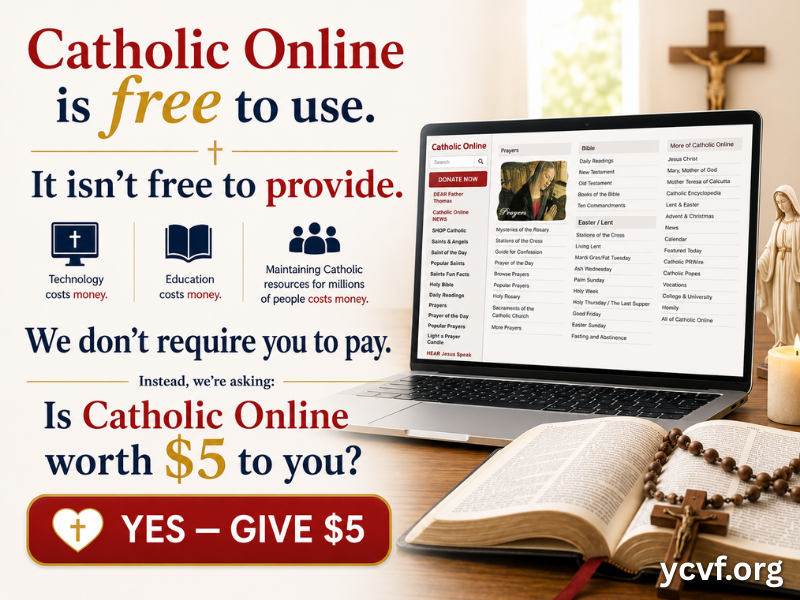
We have one question for you.
Has Catholic Online given you $5 worth of value this year? Maybe you came here for a prayer. Maybe you read today's Mass readings. Maybe you researched a saint. Maybe you needed an answer about the Catholic Faith. Maybe your child used Catholic Online School. If the answer is no, you don't owe us anything. Keep using Catholic Online. But if the answer is yes, we're asking you to give $5 today.
Catholic Online School has served 2.2 million student enrollments in 193 countries, and we continue working to make Catholic education available regardless of a family's financial circumstances. We don't need every reader to give. We need the readers who recognize the value of what they've received to stand behind it. Is Catholic Online worth $5 to you?
GIVE TODAY >>Benedict XVI's Homily on Feast of St. Joseph
FREE Catholic Classes
"Man Is Subject and Protagonist of Work"
VATICAN CITY, MARCH 20, 2006 (Zenit) - Here is a translation of the homily Benedict XVI delivered today during a Mass dedicated to workers, in anticipation of Monday's feast of St. Joseph. Today was the third Sunday of Lent.
* * *
Dear Brothers and Sisters:
We have heard together a well-known passage of the Book of Exodus, in which the holy author recounts God's giving of the Decalogue to Israel.
A detail causes an immediate impression: The enunciation of the Commandments is introduced by a significant reference to the liberation of the people of Israel. The text says: "I am the Lord your God, who brought you out of the land of Egypt, out of the house of bondage" (Exodus 20:20). The Decalogue, therefore, is a confirmation of the freedom won.
In fact, if the Commandments are examined in depth, they are the means the Lord gives us to defend our freedom both from the internal conditionings of the passions as well as from the external abuses of the malicious. The "noes" of the Commandments are as many "yeses" to the growth of authentic freedom. There is a second dimension in the Decalogue which must also be emphasized: Through the Law given by Moses' hand, the Lord reveals that he wills to conclude a covenant with Israel.
Therefore, more than an imposition, the Law is a gift. More than commanding what man must do, the Law manifests God's choice to all: He is on the side of the chosen people; he has delivered them from slavery and surrounds them with merciful kindness. The Decalogue is a testimony of a love of predilection.
Today's liturgy gives us a second message: The Mosaic law has found fulfillment in Jesus, who revealed the wisdom and love of God through the mystery of the Cross, "a stumbling block to Jews and folly to Gentiles," as St. Paul says to us in the second reading, "but to those who are called, both Jews and Greeks, Christ the power of God and the wisdom of God" (1 Corinthians 1:23-24). The Gospel page just proclaimed makes reference precisely to this mystery: Jesus drives the vendors and money changers from the temple. The evangelist gives the key to the reading of this significant episode through the verse of a Psalm: "Zeal for your house consumes me" (Psalm 68[69]:10).
It is Jesus who is "consumed" by this "zeal" for "God's house," used for purposes other than those for which it was designed. In response to the request of the religious leaders for a sign of his authority, amid the astonishment of those present, he affirms: "Destroy this temple, and in three days I will raise it up (John 2:19).
Mysterious words, incomprehensible at the moment, but which John reformulates for his Christian readers, observing: "He spoke of the temple of his body" (John 2:21). That "temple" would be destroyed by his adversaries, but, after three days, he would rebuild it through the resurrection. Christ's painful and "scandalous" death will be crowned by the triumph of his glorious resurrection. While in this Lenten season we prepare to relive in the Easter triduum this central event of our salvation, we already see the crucified one perceiving in him the splendor of the risen one.
Dear brothers and sisters: Today's Eucharistic celebration, which unites the meditations of the liturgical texts of the third Sunday of Lent with the remembrance of St. Joseph, gives us the opportunity to consider, in the light of the paschal mystery, another important aspect of human existence. I am referring to the reality of work, situated today at the center of rapid and complex changes.
In various passages, the Bible shows how work belongs to man's original condition. When the creator made man to his image and likeness, he invited him to work the earth (Genesis 2:5-6). It was because of the sin of our fathers that work was transformed into effort and pain (Genesis 3:6-8), but in the divine plan it keeps its value unaltered. The Son of God himself, making himself similar to us in everything, dedicated himself for many years to manual activities, so much so that he was known as the "son of the carpenter" (Matthew 13:55).
The Church has always shown, especially in the last century, attention and concern for this realm of society, as attested by the magisterium's numerous social interventions and the action of many associations of Christian inspiration, some of which are gathered here today to represent the whole world of laborers.
I am happy to welcome you, dear friends, and to each of you I address my cordial greeting. I address a special thought to Bishop Arrigo Miglio of Ivrea and president of the Italian episcopal Commission for Social Problems and Work, Justice and Peace, who has made himself interpreter of your common sentiments and manifested kind expressions of congratulations for my name day. I am very grateful to him.
Work is of primary importance for man's fulfillment and the development of society, and this is why it is necessary that it always be organized and developed in full respect of human dignity and at the service of the common good. At the same time, it is indispensable that man not allow himself to be subjected to work, that he not idolize it, intending to find in it the ultimate and definitive meaning of life.
In this connection, the invitation contained in the first reading is timely: "Remember the Sabbath day, to keep it holy. Six days you shall labor, and do all your work; but the seventh day is a Sabbath to the Lord your God" (Exodus 20:8-9). The Sabbath is a holy day, namely, consecrated to God, in which man understands better the meaning of his existence and also of his work activity. Therefore, it can be affirmed that the biblical teaching on work finds its coronation in the commandment to rest.
In this regard, the Compendium of the Social Doctrine of the Church observes opportunely: "To man, bound to the necessity of work, rest opens the perspective of a fuller liberty, that of the eternal Sabbath (cf. Hebrew 4:9-10). Rest allows men to remember and relive God's works, from the creation to the redemption, recognize themselves has His work (cf. Hebrew 2:10) to give thanks to him who is their author for their life and their existence" (No. 258).
Work activity must serve the true good of humanity, allowing "man, as individual and member of society, to cultivate and fulfill his full vocation" ("Gaudium et Spes," No. 35). For this to occur, the necessary technical and professional qualification is not enough; neither is the creation of a just social order attentive to the good of all sufficient. A spirituality must be lived that will help believers to sanctify themselves through their work, imitating St. Joseph, who every day had to provide for the needs of the Holy Family with his hands, and who because of this the Church indicates as patron of workers.
His testimony shows that man is subject and protagonist of work. I would like to entrust to him the young people who have difficulty in entering the world of work, the unemployed and those who suffer the inconveniences due to the widespread occupational crisis. Together with Mary, his spouse, may St. Joseph watch over all workers and obtain serenity and peace for families and for the whole of humanity. Contemplating this great saint, may Christians learn to witness in all labor realms the love of Christ, source of true solidarity and stable peace. Amen!
Contact
The Vatican
https://www.catholic.org
, VA
Pope Benedict XVI - Bishop of Rome, 661 869-1000
info@yourcatholicvoice.org
Keywords
St. Joseph, Faith, Angelus, Pope, Benedict
More Catholic PRWire
Showing 1 - 50 of 4,716
A Recession Antidote
Randy Hain
Monaco & The Vatican: Monaco's Grace Kelly Exhibit to Rome--A Review of Monegasque-Holy See Diplomatic History
Dna. Maria St. Catherine Sharpe, t.o.s.m., T.O.SS.T.
The Why of Jesus' Death: A Pauline Perspective
Jerom Paul
A Royal Betrayal: Catholic Monaco Liberalizes Abortion
Dna. Maria St.Catherine De Grace Sharpe, t.o.s.m., T.O.SS.T.
Embrace every moment as sacred time
Mary Regina Morrell
My Dad
JoMarie Grinkiewicz
Letting go is simple wisdom with divine potential
Mary Regina Morrell
Father Lombardi's Address on Catholic Media
Catholic Online
Pope's Words to Pontifical Latin American College
Catholic Online
Prelate: Genetics Needs a Conscience
Catholic Online
State Aid for Catholic Schools: Help or Hindrance?
Catholic Online
Scorsese Planning Movie on Japanese Martyrs
Catholic Online
2 Nuns Kidnapped in Kenya Set Free
Catholic Online
Holy See-Israel Negotiation Moves Forward
Catholic Online
Franchising to Evangelize
Catholic Online
Catholics Decry Anti-Christianity in Israel
Catholic Online
Pope and Gordon Brown Meet About Development Aid
Catholic Online
Pontiff Backs Latin America's Continental Mission
Catholic Online
Cardinal Warns Against Anti-Catholic Education
Catholic Online
Full Circle
Robert Gieb

Three words to a deeper faith
Paul Sposite
Relections for Lent 2009
chris anthony
Wisdom lies beyond the surface of life
Mary Regina Morrell
World Food Program Director on Lent
Catholic Online
Moral Clarity
DAN SHEA
Pope's Lenten Message for 2009
Catholic Online
A Prayer for Monaco: Remembering the Faith Legacy of Prince Rainier III & Princess Grace and Contemplating the Moral Challenges of Prince Albert II
Dna. Maria St. Catherine Sharpe
Keeping a Lid on Permissiveness
Sally Connolly
Glimpse of Me
Sarah Reinhard
The 3 stages of life
Michele Szekely
Sex and the Married Woman
Cheryl Dickow
A Catholic Woman Returns to the Church
Cheryl Dickow
Modernity & Morality
Dan Shea
Just a Minute
Sarah Reinhard
Catholic identity ... triumphant reemergence!
Hugh McNichol
Edging God Out
Paul Sposite
Burying a St. Joseph Statue
Cheryl Dickow
George Bush Speaks on Papal Visit
Catholic Online
Sometimes moving forward means moving the canoe
Mary Regina Morrell
Action Changes Things: Teaching our Kids about Community Service
Lisa Hendey

Easter... A Way of Life
Paul Spoisite
Papal initiative...peace and harmony!
Hugh McNichol
Proclaim the mysteries of the Resurrection!
Hugh McNichol
Jerusalem Patriarch's Easter Message
Catholic Online
Good Friday Sermon of Father Cantalamessa
Catholic Online
Papal Address at the End of the Way of the Cross
Catholic Online
Cardinal Zen's Meditations for Via Crucis
Catholic Online
Interview With Vatican Aide on Jewish-Catholic Relations
Catholic Online
Pope Benedict XVI On the Easter Triduum
Catholic Online
Holy Saturday...anticipation!
Hugh McNichol
Come Grow With Us
Sign up and walk the Catholic journey with millions around the world.
Receive inspiring emails on saints, daily readings, and free faith-building resources—no cost, ever.
Catholic Online Is Free. But We Need Your Help.
Please Watch
- 7 Morning Prayers
- Mysteries of the Rosary
- Litany of the Bl. Virgin Mary
- Popular Saints
- Popular Prayers
- Female Saints
- Saint Feast Days by Month
- Stations of the Cross
- St. Francis of Assisi
- St. Michael the Archangel
- The Apostles' Creed
- Unfailing Prayer to St. Anthony
- Pray the Rosary







Copyright 2026 Catholic Online. All materials contained on this site, whether written, audible or visual are the exclusive property of Catholic Online and are protected under U.S. and International copyright laws, © Copyright 2026 Catholic Online. Any unauthorized use, without prior written consent of Catholic Online is strictly forbidden and prohibited.
Catholic Online is a Project of Your Catholic Voice Foundation, a Not-for-Profit Corporation. Your Catholic Voice Foundation has been granted a recognition of tax exemption under Section 501(c)(3) of the Internal Revenue Code. Federal Tax Identification Number: 81-0596847. Your gift is tax-deductible as allowed by law.