Liturgy: Breast-beating
FREE Catholic Classes
And More on Religious Receiving the Chalice
ROME, NOV. 4, 2004 (Zenit) - Answered by Father Edward McNamara, professor of liturgy at the Regina Apostolorum Pontifical University.
Q: Recently I was advised by a parish priest that I should not strike my breast during the Agnus Dei -- that it was liturgically incorrect. I have done this for years and I am sure I have seen this "rubric" somewhere. Has something changed or has it expressly been forbidden? -- A.G., Anaheim, California
A: From a technical point of view the parish priest is correct. Striking one's breast is a gesture implying penance and admission of sinfulness.
In the present rite it is done, above all, within the context of the first form of rite of penance at the beginning of Mass when the "I confess" is used and by the priest when he uses the Roman canon (Eucharistic Prayer 1) at the words "though we are sinners."
Before the reforms of the Second Vatican Council it was also customary to do so at the "Lamb of God" and at the "Lord, I am not worthy," and this is probably where you get your custom.
The gesture is no longer prescribed at these latter moments and should not be fomented among younger Catholics. But it would be probably going too far to say it is forbidden to those who have been raised in this custom.

What motivated the removal of the gesture of striking the breast at the Lamb of God and the "Lord, I am not worthy" is not really known. This gesture entered into the Roman liturgy at these moments relatively late, the first notice of the gesture at the "Lamb of God" is from around 1311, and from a Spanish manuscript dated 1499 for the "Lord, I am not worthy."
I'd guess that the removal of these gestures was a consequence of the general desire for simplification of the rites. Then again, neither the "Lamb of God" nor the "Lord, I am not worthy" are, strictly speaking, penitential rites. They do not mention the personal sin of the individual but rather the sin of the world and a general state of unworthiness.
The "Lamb of God" is rather a hymn of praise for the work of redemption. And the petition of mercy asks for forgiveness of sin as well as for grace, which is a fruit of God's mercy.
This is a possible argument, but admittedly a weak one, for it is theoretically possible that the gesture of striking the breast could be interpreted, not only as an admission of sin, but also signify a general state of unworthiness and indignity.
Several experts have pointed out that the liturgical reform has tended to privilege the written word over other forms of human expression. The liturgy has been enriched with a vast array of new texts. But perhaps the world of gestures and signs, especially those carried out by the whole assembly, has been somewhat neglected.
Since gestures often serve to reinforce the message of the written and spoken word they should be taken into account. For example, the substitution of a single striking of the breast in the current English translation of the missal, instead of the traditional triple striking still common in many other countries, has often served to vacate the gesture of meaning or even promote its demise through distraction.
The Second Vatican Council rightly called for the elimination of useless repetitions from the liturgy but in some cases repetition is not only useful but even necessary to get a message across.
* * *
Follow-up: Religious Receiving the Chalice
Following our reply to a Philippine bishop's question regarding religious taking the chalice at the altar (Oct. 19), a New Jersey reader suggested that I had misread the question. What was really asked, the reader said, was on what occasions could a religious receive, rather than take, Communion at the altar as is specifically foreseen in some rites such as during a Mass of perpetual profession.
We ask you, humbly: don't scroll away.
Hi readers, it seems you use Catholic Online a lot; that's great! It's a little awkward to ask, but we need your help. If you have already donated, we sincerely thank you. We're not salespeople, but we depend on donations averaging $14.76 and fewer than 1% of readers give. If you donate just $5.00, the price of your coffee, Catholic Online School could keep thriving. Thank you.Help Now >
I don't believe I misread the question since the bishop specifically mentioned that he had suggested the use of an alternative table from which the religious could partake of the chalice. And this suggestion would have been useless if they were receiving through the hands of a minister.
However, I welcome the suggestion, as it has afforded the opportunity to mention the possibility of a religious receiving at that altar on some very significant moments of his or her life, especially those which express a definitive self offering to God.
A member of an association of Catholic university graduates from an African country, perhaps Nigeria, wrote that they frequently share our column among themselves. One of whom wrote some "posers" to our piece.
Not wanting to be a source of discord, I will attempt to answer his doubts.
-- Is Communion in the hand not the same as taking the host by oneself?
Not exactly, because a minister still presents the host to the communicant who then receives it. What differs is the mode of reception (on the tongue or in the hand) not the fact of reception.
-- What is the difference between "cup" and "chalice"?
Actually both terms should be equivalents, as the Precious Blood should always be offered in a chalice. The term "cup" is used in the current English translation of the Mass to refer to the chalice, although it is possible that the new translation now being prepared will return to the more traditional term.
He also suggests that I should have taken issue with other issues such as extraordinary ministers and desecration of the Eucharist.
I can only observe that I usually try to stick to the question at hand. The limits of space do not allow me to range widely.
We have dealt with the subject and norms regarding extraordinary ministers of holy Communion on several occasions.
Also, the original question referred to an error of knowledge regarding a liturgical norm. There was no hint of the least disrespect for the Eucharist on the part of the persons involved, much less a question of desecration
Contact
Catholic Online
https://www.catholic.org
CA, US
Catholic Online - Publisher, 661 869-1000
info@yourcatholicvoice.org
Keywords
Liturgy, Breast-beating, Mass, Priest, Parish

More Catholic PRWire
Showing 1 - 50 of 4,716
A Recession Antidote
Randy Hain
Monaco & The Vatican: Monaco's Grace Kelly Exhibit to Rome--A Review of Monegasque-Holy See Diplomatic History
Dna. Maria St. Catherine Sharpe, t.o.s.m., T.O.SS.T.
The Why of Jesus' Death: A Pauline Perspective
Jerom Paul
A Royal Betrayal: Catholic Monaco Liberalizes Abortion
Dna. Maria St.Catherine De Grace Sharpe, t.o.s.m., T.O.SS.T.
Embrace every moment as sacred time
Mary Regina Morrell
My Dad
JoMarie Grinkiewicz
Letting go is simple wisdom with divine potential
Mary Regina Morrell
Father Lombardi's Address on Catholic Media
Catholic Online
Pope's Words to Pontifical Latin American College
Catholic Online
Prelate: Genetics Needs a Conscience
Catholic Online
State Aid for Catholic Schools: Help or Hindrance?
Catholic Online
Scorsese Planning Movie on Japanese Martyrs
Catholic Online
2 Nuns Kidnapped in Kenya Set Free
Catholic Online
Holy See-Israel Negotiation Moves Forward
Catholic Online
Franchising to Evangelize
Catholic Online
Catholics Decry Anti-Christianity in Israel
Catholic Online
Pope and Gordon Brown Meet About Development Aid
Catholic Online
Pontiff Backs Latin America's Continental Mission
Catholic Online
Cardinal Warns Against Anti-Catholic Education
Catholic Online
Full Circle
Robert Gieb
Three words to a deeper faith
Paul Sposite
Relections for Lent 2009
chris anthony
Wisdom lies beyond the surface of life
Mary Regina Morrell
World Food Program Director on Lent
Catholic Online
Moral Clarity
DAN SHEA
Pope's Lenten Message for 2009
Catholic Online
A Prayer for Monaco: Remembering the Faith Legacy of Prince Rainier III & Princess Grace and Contemplating the Moral Challenges of Prince Albert II
Dna. Maria St. Catherine Sharpe
Keeping a Lid on Permissiveness
Sally Connolly
Glimpse of Me
Sarah Reinhard
The 3 stages of life
Michele Szekely
Sex and the Married Woman
Cheryl Dickow
A Catholic Woman Returns to the Church
Cheryl Dickow
Modernity & Morality
Dan Shea
Just a Minute
Sarah Reinhard
Catholic identity ... triumphant reemergence!
Hugh McNichol
Edging God Out
Paul Sposite
Burying a St. Joseph Statue
Cheryl Dickow
George Bush Speaks on Papal Visit
Catholic Online
Sometimes moving forward means moving the canoe
Mary Regina Morrell
Action Changes Things: Teaching our Kids about Community Service
Lisa Hendey

Easter... A Way of Life
Paul Spoisite
Papal initiative...peace and harmony!
Hugh McNichol
Proclaim the mysteries of the Resurrection!
Hugh McNichol
Jerusalem Patriarch's Easter Message
Catholic Online
Good Friday Sermon of Father Cantalamessa
Catholic Online
Papal Address at the End of the Way of the Cross
Catholic Online
Cardinal Zen's Meditations for Via Crucis
Catholic Online
Interview With Vatican Aide on Jewish-Catholic Relations
Catholic Online
Pope Benedict XVI On the Easter Triduum
Catholic Online
Holy Saturday...anticipation!
Hugh McNichol
We ask you, humbly: don't scroll away.
Hi readers, it seems you use Catholic Online a lot; that's great! It's a little awkward to ask, but we need your help. If you have already donated, we sincerely thank you. We're not salespeople, but we depend on donations averaging $14.76 and fewer than 1% of readers give. If you donate just $5.00, the price of your coffee, Catholic Online School could keep thriving. Thank you.Help Now >
Join the Movement
When you sign up below, you don't just join an email list - you're joining an entire movement for Free world class Catholic education.






 Daily Readings for Friday, April 26, 2024
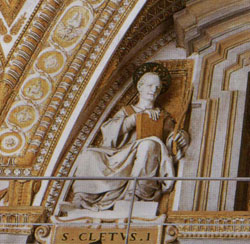 St. Cletus: Saint of the Day for Friday, April 26, 2024
 Prayer before the Closing of the Day: Prayer of the Day for Friday, April 26, 2024