 Hi readers, it seems you use Catholic Online a lot; that's great! It's a little awkward to ask, but we need your help. If you have already donated, we sincerely thank you. We're not salespeople, but we depend on donations averaging $14.76 and fewer than 1% of readers give. If you donate just $5.00, the price of your coffee, Catholic Online School could keep thriving. Thank you. Help Now >
Juan Fernández Navarrete
FREE Catholic Classes
Spanish painter, b. at Logrono, 1526 and died at Segovia, 1579 (at Toledo, February, 1579 or 28 March, 1579?). He is called el Mudo (the mute) because he lost his hearing when a child of three and, in consequence, his power of speech. His parents, who were well to do and perhaps of noble birth placed him with the Hieronymite monks of Estrella where Fray Vicente, a gifted brother, was his first teacher in art. Navarrete's talents were early discovered because he made all his wants known through rapid and vigorous black and white sketches. He may have been a pupil of Becerra, Spain's great fresco painter, but it is certain that he went when a youth to the great Italian centres of art and under Titian in Venice acquired that technique and knowledge of colour which earned him the name of "the Spanish Titian ". He returned to Spain a painter of repute, and travelled extensiveiy in his native country, leaving works from his hand in her important cities. In 1568 he was made painter to Philip II, received a salary of two hundred ducats "besides just payment for his work" and was commissioned to decorate the Escorial. In 1575 he completed a "Nativity" wherein are three dominant lights ; one from St. Joseph's candle, one from the glory above, and the most radiant of all from the divine Child as in Correggio's "Notte." In one "Holy Family" he painted such strange accessories, a cat, a dog, and a partridge, that the king made him promise never again to put "such indecorous things in a holy picture". Though called the Spanish Titian, Navarrete was not an imitator of any Italian; he was an original and he painted rapidly, freely, and spontaneously. His composition, especially in groups of figutes, was masterly and was excelled only by that of Velásquez. "He spoke by his pencil with the bravura of Rubens without his coarseness." Navarrete's work greatly influenced the development of Spanish art and after his death Lope de Vega wrote: "No countenance he painted was dumb". Despite the artists infirmity he was an agreeable companion, played cards, read, and wrote much, was broadminded and generous. When his patron ordered Titian's "Last Supper" to be cut because it was too large for a place in the refectory of the Escorial, it was el Mudo who protested most. In the refectory at Estrella, where he received his first instruction in painting are some of Navarrete's best pictures. The following works may be mentioned: "Holy Family", at Weimar; "St. John in Prison ", at St. Petersburg; "St. Jerome", in the Escorial ; "Holy Family", in the Escorial.
We ask you, humbly: don't scroll away.
Hi readers, it seems you use Catholic Online a lot; that's great! It's a little awkward to ask, but we need your help. If you have already donated, we sincerely thank you. We're not salespeople, but we depend on donations averaging $14.76 and fewer than 1% of readers give. If you donate just $5.00, the price of your coffee, Catholic Online School could keep thriving. Thank you.Help Now >


Join the Movement
When you sign up below, you don't just join an email list - you're joining an entire movement for Free world class Catholic education.


-

-
Mysteries of the Rosary
-
St. Faustina Kowalska
-
Litany of the Blessed Virgin Mary
-
Saint of the Day for Wednesday, Oct 4th, 2023
-
Popular Saints
-
St. Francis of Assisi
-
Bible
-
Female / Women Saints
-
7 Morning Prayers you need to get your day started with God
-
Litany of the Blessed Virgin Mary


Sacrifices of Faith: The Pro-Life Legacies of St. Gianna and Jessica Hanna
-
How to love God by caring for our bodies
-
Pope Francis calls for negotiations to End Russia-Ukraine War
-
Pope Francis Contemplates Return to U.S. for United Nations Assembly Address
-
Pope Francis Calls on Faithful to Embrace Faith, Hope, and Charity in New Teaching Series


Daily Catholic
- Daily Readings for Monday, April 29, 2024
- St. Catherine of Siena: Saint of the Day for Monday, April 29, 2024
- Prayer for the Dead # 3: Prayer of the Day for Monday, April 29, 2024
- Daily Readings for Sunday, April 28, 2024
- St. Peter Chanel: Saint of the Day for Sunday, April 28, 2024
- Prayer before a Crucifix: Prayer of the Day for Sunday, April 28, 2024
 Daily Readings for Monday, April 29, 2024
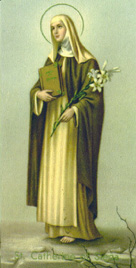 St. Catherine of Siena: Saint of the Day for Monday, April 29, 2024
 Prayer for the Dead # 3: Prayer of the Day for Monday, April 29, 2024
 Hi readers, it seems you use Catholic Online a lot; that's great! It's a little awkward to ask, but we need your help. If you have already donated, we sincerely thank you. We're not salespeople, but we depend on donations averaging $14.76 and fewer than 1% of readers give. If you donate just $5.00, the price of your coffee, Catholic Online School could keep thriving. Thank you. Help Now >

Copyright 2024 Catholic Online. All materials contained on this site, whether written, audible or visual are the exclusive property of Catholic Online and are protected under U.S. and International copyright laws, © Copyright 2024 Catholic Online. Any unauthorized use, without prior written consent of Catholic Online is strictly forbidden and prohibited.
Catholic Online is a Project of Your Catholic Voice Foundation, a Not-for-Profit Corporation. Your Catholic Voice Foundation has been granted a recognition of tax exemption under Section 501(c)(3) of the Internal Revenue Code. Federal Tax Identification Number: 81-0596847. Your gift is tax-deductible as allowed by law.