 Hi readers, it seems you use Catholic Online a lot; that's great! It's a little awkward to ask, but we need your help. If you have already donated, we sincerely thank you. We're not salespeople, but we depend on donations averaging $14.76 and fewer than 1% of readers give. If you donate just $5.00, the price of your coffee, Catholic Online School could keep thriving. Thank you. Help Now >
Patrick Murray
FREE Catholic Classes
Theologian, b. Clones, County Monaghan, Ireland, 18 November, 1811; d. 15 Nov., 1882, in Maynooth College . He received his early education in his native town of Clones, entered Maynooth College 25 August, 1829, the year of Catholic emancipation, among the first class of emancipated entrants, went through the ordinary course with great distinction and was elected a Dunboyne, or senior student in June, 1835. Towards the end of the Dunboyne course he accepted a curacy in Francis Street, Dublin, where in a short time he acquired the reputation of a zealous worker and an eloquent preacher. He was appointed professor of English and French in Maynooth, on 7 Sept. 1838, after the usual concursus, or examination. He was appointed professor of English and French in Maynooth, on 7 Sept., 1838, after the usual concursus, or examination, and after three years in this position he was appointed professor of theology, after another brilliant concursus, on 27 August, 1841. The remainder of his life he devoted mainly to theological science. In 1879 he was appointed prefect of the Dunboyne Establishment, which position he retained until his death in 1882. His principal works are: "Essays, Chiefly Theological" (4 vols., Dublin, 1850-53); "De Ecclesia Christi" (3 vols., Dublin, 1860-62-66); "De Ecclesia Christi", compendium (Dublin, 1874); "De Gratia" (Dublin, 1877), "De Veneratione et Invocatione Sanctorum", etc.; "De Impedimentis Matrimonï Dirimentibus" (Dublin, 1881); "Prose and Verse" (Dublin, 1867), "Lectures (on Moore's poetry) before Cork Young Men's Society" (Cork, 1856).
Dr. Murray was a man of high intellectual power, of big projects, and of great activity and perseverance. He would certainly have risen to great eminence in the world of literature, had he remained professor of English, as he was possessed of literary and poetic gifts of a high order. But he chose the domain of theology. He wrote for the Dublin Review and for magazines. In 1860 he announced his intention of publishing a series of volumes on subjects chiefly theological, to supply the Catholic laity with exact and reliable information on the debated religious questions of the day. He published four volumes under the title: "Essays, Chiefly Theological". But though he intended at the beginning to extend the work to seven or eight volumes, he discontinued the Essays after the fourth volume, to devote himself to the great work of his life, his "De Ecclesia Christi". This work involved immense labour. It is a work of great learning, a masterpiece in positive and controversial theology, which at once placed its author in the front rank of dogmatic theologians . While not neglecting the views of the continental reformers, the author made a special study of the works of all the leading Anglican divines; and hence his work became the standard authority for the exposition and refutation of the then current Anglican views about the Church. Though writing in 1860, ten years before the Vatican definition, the author with great power establishes the doctrine of papal infallibility. The treatise, "De Gratia", excellent in itself, was intended as a text-book for students; as was also the less perfect work, "De Veneratione et Invocatione Sanctorum". Dr. Murray was ever kind and considerate for his students, by whom he was always respected and loved. He was of a retiring disposition, of a deeply religious nature, and of great saintliness of life.
We ask you, humbly: don't scroll away.
Hi readers, it seems you use Catholic Online a lot; that's great! It's a little awkward to ask, but we need your help. If you have already donated, we sincerely thank you. We're not salespeople, but we depend on donations averaging $14.76 and fewer than 1% of readers give. If you donate just $5.00, the price of your coffee, Catholic Online School could keep thriving. Thank you.Help Now >
Join the Movement
When you sign up below, you don't just join an email list - you're joining an entire movement for Free world class Catholic education.


-

-
Mysteries of the Rosary
-
St. Faustina Kowalska
-
Litany of the Blessed Virgin Mary
-
Saint of the Day for Wednesday, Oct 4th, 2023
-
Popular Saints
-
St. Francis of Assisi
-
Bible
-
Female / Women Saints
-
7 Morning Prayers you need to get your day started with God
-
Litany of the Blessed Virgin Mary


Sacrifices of Faith: The Pro-Life Legacies of St. Gianna and Jessica Hanna
-
How to love God by caring for our bodies
-
Pope Francis calls for negotiations to End Russia-Ukraine War
-
Pope Francis Contemplates Return to U.S. for United Nations Assembly Address
-
Pope Francis Calls on Faithful to Embrace Faith, Hope, and Charity in New Teaching Series


Daily Catholic
- Daily Readings for Monday, April 29, 2024
- St. Catherine of Siena: Saint of the Day for Monday, April 29, 2024
- Prayer for the Dead # 3: Prayer of the Day for Monday, April 29, 2024
- Daily Readings for Sunday, April 28, 2024
- St. Peter Chanel: Saint of the Day for Sunday, April 28, 2024
- Prayer before a Crucifix: Prayer of the Day for Sunday, April 28, 2024
 Daily Readings for Monday, April 29, 2024
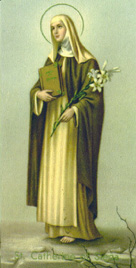 St. Catherine of Siena: Saint of the Day for Monday, April 29, 2024
 Prayer for the Dead # 3: Prayer of the Day for Monday, April 29, 2024


Copyright 2024 Catholic Online. All materials contained on this site, whether written, audible or visual are the exclusive property of Catholic Online and are protected under U.S. and International copyright laws, © Copyright 2024 Catholic Online. Any unauthorized use, without prior written consent of Catholic Online is strictly forbidden and prohibited.
Catholic Online is a Project of Your Catholic Voice Foundation, a Not-for-Profit Corporation. Your Catholic Voice Foundation has been granted a recognition of tax exemption under Section 501(c)(3) of the Internal Revenue Code. Federal Tax Identification Number: 81-0596847. Your gift is tax-deductible as allowed by law.