 Dear readers, Catholic Online was de-platformed by Shopify for our pro-life beliefs. They shut down our Catholic Online, Catholic Online School, Prayer Candles, and Catholic Online Learning Resources essential faith tools serving over 1.4 million students and millions of families worldwide. Our founders, now in their 70's, just gave their entire life savings to protect this mission. But fewer than 2% of readers donate. If everyone gave just $5, the cost of a coffee, we could rebuild stronger and keep Catholic education free for all. Stand with us in faith. Thank you. Help Now >
Monseigneur
FREE Catholic Classes
(From mon , "my" and seigneur , ("elder" or "lord," like Latin senior )
A French honorific appellation, etymologically corresponding to the English "my lord," and the Italian monsignore . It is, after all, nothing but the French monsieur ; but, while the latter has become current as applied to every man who is in good society, Monseigneur has retained its honorific force. In ecclesiastical usage it is reserved for bishops and archbishops, and is chiefly employed when speaking or writing to them. It is used before the name (thus abridged: Msgr. Dupanloup). Formerly it was not prefixed to the title of dignity, but it is now, as "Mgr l'évêque N. . . ." The term Monseigneur is also used as the equivalent of the Italian Monsignore , and as the latter title is given to Roman prelates, some confusion results; in Italy, however, no inconvenience arises from this usage as in that country bishops have the title of Eccellenza , i.e., Excellency. In France, only the Archbishop of Reims, as legatus natus , has the title of Excellency (See M ONSIGNOR ).
Join the Movement
When you sign up below, you don't just join an email list - you're joining an entire movement for Free world class Catholic education.
-

- Easter / Lent
- Ascension Day
- 7 Morning Prayers
- Mysteries of the Rosary
- Litany of the Bl. Virgin Mary
- Popular Saints
- Popular Prayers
- Female Saints
- Saint Feast Days by Month
- Stations of the Cross
- St. Francis of Assisi
- St. Michael the Archangel
- The Apostles' Creed
- Unfailing Prayer to St. Anthony
- Pray the Rosary


The Assumption of the Blessed Virgin Mary: A Sign of Our Eternal Hope

Mary’s ‘Magnificat’ Still Strengthens the Hope of the Faithful, Pope Leo Affirms

Mary, Our Icon of Hope, Leads Us to the Goal of Life
Daily Catholic
- Daily Readings for Sunday, August 17, 2025
- St. Clare of Montefalco: Saint of the Day for Sunday, August 17, 2025
- Act of Faith: Prayer of the Day for Sunday, August 17, 2025
- Daily Readings for Saturday, August 16, 2025
- St. Stephen the Great: Saint of the Day for Saturday, August 16, 2025
- Glory to God: Prayer of the Day for Saturday, August 16, 2025
 Daily Readings for Sunday, August 17, 2025
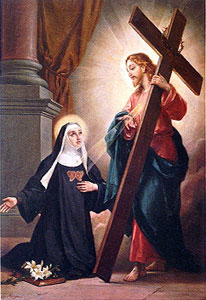 St. Clare of Montefalco: Saint of the Day for Sunday, August 17, 2025
 Act of Faith: Prayer of the Day for Sunday, August 17, 2025
 St. Stephen the Great: Saint of the Day for Saturday, August 16, 2025



Copyright 2025 Catholic Online. All materials contained on this site, whether written, audible or visual are the exclusive property of Catholic Online and are protected under U.S. and International copyright laws, © Copyright 2025 Catholic Online. Any unauthorized use, without prior written consent of Catholic Online is strictly forbidden and prohibited.
Catholic Online is a Project of Your Catholic Voice Foundation, a Not-for-Profit Corporation. Your Catholic Voice Foundation has been granted a recognition of tax exemption under Section 501(c)(3) of the Internal Revenue Code. Federal Tax Identification Number: 81-0596847. Your gift is tax-deductible as allowed by law.