We ask you, humbly: don't scroll away.
Hi readers, it seems you use Catholic Online a lot; that's great! It's a little awkward to ask, but we need your help. If you have already donated, we sincerely thank you. We're not salespeople, but we depend on donations averaging $14.76 and fewer than 1% of readers give. If you donate just $5.00, the price of your coffee, Catholic Online School could keep thriving. Thank you.Help Now >
Felix de Andreis
FREE Catholic Classes
First superior of the Congregation of the Mission ( Lazarists ) in the United States and Vicar-General of upper Louisiana, b. at Demonte, in Piedmont, Italy, 13 December, 1778; d. at St. Louis, Missouri, U.S., 15 October, 1820. After making his preparatory studies in his native place he entered the novitiate of the Congregation of the Mission, at Mondovì, 1 November, 1797, and was ordained priest at Piacenzia, 14 August, 1801. When only four years a priest, he conducted the retreats for those about to be ordained. His constitution was not robust and in 1806 he was sent to Monte Citorio, the house of the Congregation in Rome that seemed least likely to be affected by the rigorous religions persecutions of the time, which for while drove Pius VII from Rome. Here, Father De Andreis was constantly engaged from 1810 to 1815 in giving missions and retreats for the clergy or seminarians. He also gave many missions in the suburbs of the city. When the religious houses in Rome were suppressed, the Propaganda students attended his lectures on theology. It was no unusual thing for him to preach four times a day on different subjects. In view of later events, it is worthy of reflection that Father De Andreis received such a conviction that he was destined to a mission involving the need of English that he resolutely mastered that language. In 1815 Father Dubourg, Apostolic Administrator of the Diocese of Louisiana (which then extended along both sides of the Mississippi from the Gulf of Mexico to the Canadian Lakes) arrived in Rome to secure priests for that immense vineyard. As soon as he knew of Father De Andreis he applied to Father Sicardi, his superior, to let him go to Louisiana, and when the latter declared it impossible, as his place could not be filled, he exposed the situation to Pius VII, who appointed the young priest to this mission. In company with five others, Father De Andreis embarked from France, 12 June, 1816, and reached Baltimore 26 July. They remained there at St. Mary's Seminary as guests of Father Bruté until 3 September, and then started on a tedious journey to the west, arriving at Louisville, 19 November, where at Bishop Flaget's suggestion they remained in his seminary of St. Thomas at Bardstown until Bishop Dubourg should arrive. Father De Andreis taught theology and laboured at improving his English. Bishop Dubourg reached there with thirty priests, 29 December, 1817, and they went to St. Louis in 1818. There the Congregation had its first establishment. Father De Andreis had charge of two schools, one for religious students, another for seculars, established by Bishop Dubourg. Land for a seminary was given at "The Barrens", a colony 80 miles south of St. Louis, in Perry County, and when the Bishop allowed his residence to be used for a novitiate, Father De Andreis became master of novices. Exhausted by the hardships of missionary word, he died after a short life of forty-two years, greatly esteemed for sanctity. The process of his canonization, begun in St. Louis in 1900, was completed in August, 1902, when the evidence was presented to the Congregation of Rites, at Rome.

 Hi readers, it seems you use Catholic Online a lot; that's great! It's a little awkward to ask, but we need your help. If you have already donated, we sincerely thank you. We're not salespeople, but we depend on donations averaging $14.76 and fewer than 1% of readers give. If you donate just $5.00, the price of your coffee, Catholic Online School could keep thriving. Thank you. Help Now >

Join the Movement
When you sign up below, you don't just join an email list - you're joining an entire movement for Free world class Catholic education.


-

-
Mysteries of the Rosary
-
St. Faustina Kowalska
-
Litany of the Blessed Virgin Mary
-
Saint of the Day for Wednesday, Oct 4th, 2023
-
Popular Saints
-
St. Francis of Assisi
-
Bible
-
Female / Women Saints
-
7 Morning Prayers you need to get your day started with God
-
Litany of the Blessed Virgin Mary


Sacrifices of Faith: The Pro-Life Legacies of St. Gianna and Jessica Hanna
-
How to love God by caring for our bodies
-
Pope Francis calls for negotiations to End Russia-Ukraine War
-
Pope Francis Contemplates Return to U.S. for United Nations Assembly Address
-
Pope Francis Calls on Faithful to Embrace Faith, Hope, and Charity in New Teaching Series


Daily Catholic
- Daily Readings for Monday, April 29, 2024
- St. Catherine of Siena: Saint of the Day for Monday, April 29, 2024
- Prayer for the Dead # 3: Prayer of the Day for Monday, April 29, 2024
- Daily Readings for Sunday, April 28, 2024
- St. Peter Chanel: Saint of the Day for Sunday, April 28, 2024
- Prayer before a Crucifix: Prayer of the Day for Sunday, April 28, 2024
 Daily Readings for Monday, April 29, 2024
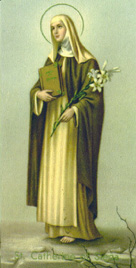 St. Catherine of Siena: Saint of the Day for Monday, April 29, 2024
 Prayer for the Dead # 3: Prayer of the Day for Monday, April 29, 2024
We ask you, humbly: don't scroll away.
Hi readers, it seems you use Catholic Online a lot; that's great! It's a little awkward to ask, but we need your help. If you have already donated, we sincerely thank you. We're not salespeople, but we depend on donations averaging $14.76 and fewer than 1% of readers give. If you donate just $5.00, the price of your coffee, Catholic Online School could keep thriving. Thank you.Help Now >

Copyright 2024 Catholic Online. All materials contained on this site, whether written, audible or visual are the exclusive property of Catholic Online and are protected under U.S. and International copyright laws, © Copyright 2024 Catholic Online. Any unauthorized use, without prior written consent of Catholic Online is strictly forbidden and prohibited.
Catholic Online is a Project of Your Catholic Voice Foundation, a Not-for-Profit Corporation. Your Catholic Voice Foundation has been granted a recognition of tax exemption under Section 501(c)(3) of the Internal Revenue Code. Federal Tax Identification Number: 81-0596847. Your gift is tax-deductible as allowed by law.