Jules Mansard
FREE Catholic Classes
French architect, grand-nephew of François, was originally Jules Hardouin, but took the name of Mansard; was born in Paris, 1646; died at Marly 1708. He had more apparent success than François, if less ability. He enjoyed in a high degree the favour of Louis XIV, who bestowed on him numerous titles and offices, as well as the dignity of Count and the inspectorship of buildings. Nearly all the architectural undertakings of this king are linked with the name of Jules Mansard, who, indeed, has been blamed, rightly or wrongly, for some of Louis's extravagant expenditures. Few architects have ever received such remunerative, or so many, commissions. He sought to combine the style of his grand-uncle, and of Le Brun, with the extreme classical style so much affected at that time, and thus became in some degree an exponent of the Baroque style. His best work is the church of the Invalides, with its dome and cupola similar to St Paul's in London, which is of the same period, and designed after the plan of St Peter's at Rome. Mansard generally laid more stress on elegance of effect than on monumental grandeur, so that some of his effects tend to triviality. The nave of the Invalides is merely a cubical base for the great dome and its double row of columns, though graceful, has little of imposing grandeur in its effect. The outer shell of the dome is of wood, a feature which this building shares with other French structures of similar character. The decoration between the ribs of the cupola, the pierced tapering lantern, encircled with corbels, and the pointed tip, all contributed to its elegance, so that the cap of the dome seems rather to soar than to rest on its supports. This graceful dome, with its high drum and attic, forms a striking point in the panorama of Paris. In the interior, Mansard made use of a happy artifice in order to secure the illuminating effect of the dome to the full without exposing the painting to the direct glare of day: he built two domes the one over the other, the one above with attic windows so placed as not to be visible from the interior; through an opening in the inner dome one sees the paintings in the outer, but not the windows. In spite of certain faults of detail this structure is, on the whole, one of the finest Baroque buildings in existence. With Leveau, Mansard finished the château of Versailles, which exercised so wide and powerful an influence on the architecture of the Baroque period. In the exterior, an effect of space and sweep was sought rather than pure beauty. The interior more than satisfies the anticipations raised by the exterior. The Grand Trianon and the Colonnades are also Jules Mansard's, as well as many other buildings in and near Versailles. His work, in domestic architecture and public buildings is, indeed, scattered all over France, and what is known as the "Mansard roof" takes its name from him.
 Hi readers, it seems you use Catholic Online a lot; that's great! It's a little awkward to ask, but we need your help. If you have already donated, we sincerely thank you. We're not salespeople, but we depend on donations averaging $14.76 and fewer than 1% of readers give. If you donate just $5.00, the price of your coffee, Catholic Online School could keep thriving. Thank you. Help Now >
We ask you, humbly: don't scroll away.
Hi readers, it seems you use Catholic Online a lot; that's great! It's a little awkward to ask, but we need your help. If you have already donated, we sincerely thank you. We're not salespeople, but we depend on donations averaging $14.76 and fewer than 1% of readers give. If you donate just $5.00, the price of your coffee, Catholic Online School could keep thriving. Thank you.Help Now >

Join the Movement
When you sign up below, you don't just join an email list - you're joining an entire movement for Free world class Catholic education.


-

-
Mysteries of the Rosary
-
St. Faustina Kowalska
-
Litany of the Blessed Virgin Mary
-
Saint of the Day for Wednesday, Oct 4th, 2023
-
Popular Saints
-
St. Francis of Assisi
-
Bible
-
Female / Women Saints
-
7 Morning Prayers you need to get your day started with God
-
Litany of the Blessed Virgin Mary


Sacrifices of Faith: The Pro-Life Legacies of St. Gianna and Jessica Hanna
-
How to love God by caring for our bodies
-
Pope Francis calls for negotiations to End Russia-Ukraine War
-
Pope Francis Contemplates Return to U.S. for United Nations Assembly Address
-
Pope Francis Calls on Faithful to Embrace Faith, Hope, and Charity in New Teaching Series
Daily Catholic
- Daily Readings for Monday, April 29, 2024
- St. Catherine of Siena: Saint of the Day for Monday, April 29, 2024
- Prayer for the Dead # 3: Prayer of the Day for Monday, April 29, 2024
- Daily Readings for Sunday, April 28, 2024
- St. Peter Chanel: Saint of the Day for Sunday, April 28, 2024
- Prayer before a Crucifix: Prayer of the Day for Sunday, April 28, 2024
 Daily Readings for Monday, April 29, 2024
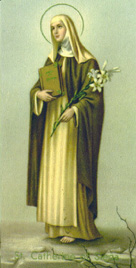 St. Catherine of Siena: Saint of the Day for Monday, April 29, 2024
 Prayer for the Dead # 3: Prayer of the Day for Monday, April 29, 2024
We ask you, humbly: don't scroll away.
Hi readers, it seems you use Catholic Online a lot; that's great! It's a little awkward to ask, but we need your help. If you have already donated, we sincerely thank you. We're not salespeople, but we depend on donations averaging $14.76 and fewer than 1% of readers give. If you donate just $5.00, the price of your coffee, Catholic Online School could keep thriving. Thank you.Help Now >


Copyright 2024 Catholic Online. All materials contained on this site, whether written, audible or visual are the exclusive property of Catholic Online and are protected under U.S. and International copyright laws, © Copyright 2024 Catholic Online. Any unauthorized use, without prior written consent of Catholic Online is strictly forbidden and prohibited.
Catholic Online is a Project of Your Catholic Voice Foundation, a Not-for-Profit Corporation. Your Catholic Voice Foundation has been granted a recognition of tax exemption under Section 501(c)(3) of the Internal Revenue Code. Federal Tax Identification Number: 81-0596847. Your gift is tax-deductible as allowed by law.