 Hi readers, it seems you use Catholic Online a lot; that's great! It's a little awkward to ask, but we need your help. If you have already donated, we sincerely thank you. We're not salespeople, but we depend on donations averaging $14.76 and fewer than 1% of readers give. If you donate just $5.00, the price of your coffee, Catholic Online School could keep thriving. Thank you. Help Now >
Benedictine Abbey of Jumièges
FREE Catholic Classes
Jumièges, situated on the north bank of the Seine, between Duclair and Caudebec, in Normandy (Seine-Inférieure). The abbey was founded in 634 by St. Philibert, who had been the companion of Sts. Ouen and Wandrille at the Merovingian court. Philibert became first abbot but was later on, through the jealousy of certain enemies, obliged to leave Jumièges, and afterwards founded another monastery at Noirmoûtier, where he died about 685. Under the second abbot, St. Achard, Jumièges flourished exceedingly and numbered within its walls nearly a thousand monks. Enjoying the patronage of the dukes of Normandy, the abbey became a great centre of religion and learning, its schools producing, amongst many other scholars, the national historian, William of Jumièges. It reached the zenith of its fame about the eleventh century, and was regarded as a model of perfection for all the monasteries of the province. It was renowned especially for its charity to the poor, being popularly called "Jumièges l'Aumônier". In the ninth century it was pillaged and burnt to the ground by the Normans, but was rebuilt on a grander scale by William, Duke of Normandy, surnamed Longue-Epée . The church was enlarged in 1256, and again restored in 1573. The abbots of Jumièges took part in all the great affairs of the Church and nation; one of them, Robert, became Archbishop of Canterbury in 1040; many others became bishops in France, and some were also raised to the cardinalitial dignity. The fortunes of the abbey suffered somewhat through the English invasion of the fifteenth century, but it recovered and maintained its prosperity and high position until the whole province was devastated by the Huguenots and the Wars of Religion. In 1649, during the abbacy of Francis III, Jumièges was taken over by the Maurist Congregation, under which rule some of its former grandeur was resuscitated. The French Revolution, however, closed its career as a monastery, and only its majestic ruins now remain to show what it was in the days of its splendour. These comprise the church, with its beautiful twin towers and western façade, and portions of the cloisters and library. The contents of the latter were removed to Rouen when the abbey was suppressed.
We ask you, humbly: don't scroll away.
Hi readers, it seems you use Catholic Online a lot; that's great! It's a little awkward to ask, but we need your help. If you have already donated, we sincerely thank you. We're not salespeople, but we depend on donations averaging $14.76 and fewer than 1% of readers give. If you donate just $5.00, the price of your coffee, Catholic Online School could keep thriving. Thank you.Help Now >


Join the Movement
When you sign up below, you don't just join an email list - you're joining an entire movement for Free world class Catholic education.


-

-
Mysteries of the Rosary
-
St. Faustina Kowalska
-
Litany of the Blessed Virgin Mary
-
Saint of the Day for Wednesday, Oct 4th, 2023
-
Popular Saints
-
St. Francis of Assisi
-
Bible
-
Female / Women Saints
-
7 Morning Prayers you need to get your day started with God
-
Litany of the Blessed Virgin Mary

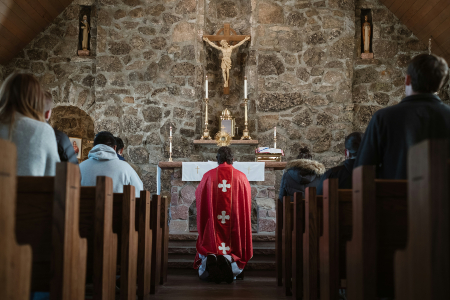
U.S. Catholic Parishes Experience Resurgence of Traditional Practices
-
Pope Francis Urges Faith and Prayers for Peace
-
Florida Welcomes Volunteer Chaplains to Public Schools
-
10 Fascinating Details About St. Joseph the Worker: Celebrating His Feast Day - May 1
-
St. Joseph the Worker: Model for Men, Young and Old


Daily Catholic
- Daily Readings for Thursday, May 02, 2024
- St. Athanasius: Saint of the Day for Thursday, May 02, 2024
- The Our Father: Prayer of the Day for Thursday, May 02, 2024
- Daily Readings for Wednesday, May 01, 2024
- St. Marculf: Saint of the Day for Wednesday, May 01, 2024
- To Saint Peregrine: Prayer of the Day for Wednesday, May 01, 2024
 Daily Readings for Thursday, May 02, 2024
 St. Athanasius: Saint of the Day for Thursday, May 02, 2024
 The Our Father: Prayer of the Day for Thursday, May 02, 2024
We ask you, humbly: don't scroll away.
Hi readers, it seems you use Catholic Online a lot; that's great! It's a little awkward to ask, but we need your help. If you have already donated, we sincerely thank you. We're not salespeople, but we depend on donations averaging $14.76 and fewer than 1% of readers give. If you donate just $5.00, the price of your coffee, Catholic Online School could keep thriving. Thank you.Help Now >


Copyright 2024 Catholic Online. All materials contained on this site, whether written, audible or visual are the exclusive property of Catholic Online and are protected under U.S. and International copyright laws, © Copyright 2024 Catholic Online. Any unauthorized use, without prior written consent of Catholic Online is strictly forbidden and prohibited.
Catholic Online is a Project of Your Catholic Voice Foundation, a Not-for-Profit Corporation. Your Catholic Voice Foundation has been granted a recognition of tax exemption under Section 501(c)(3) of the Internal Revenue Code. Federal Tax Identification Number: 81-0596847. Your gift is tax-deductible as allowed by law.