Giovanni Antonio Amadeo
FREE Catholic Classes
( Also spelled Omodeo).
An Italian architect and sculptor, born near Pavia in 1447; died 27 August, 1522, at Milan. In 1466 he was engaged as a sculptor, with his brother Protasio, at the famous Certosa, near Pavia. He was a follower of the style of Bramantino of Milan, and he represents, like him, the Lombard direction of the Renaissance. He practised cutting deeply into marble, arranging draperies in cartaceous folds, and treating surfaces flatly even when he sculptured figures in high relief. Excepting in these technical points he differed from his associates completely, and so far surpassed them that he may be ranked with the great Tuscan artists of his time, which can be said of hardly any other North-Italian sculptor.
While engaged at the Certosa, he executed the beautiful door leading from the church into the cloister, still known as "the door of Amadeo". It is exquisitely decorated in Bramantesque style, reliefs of angels and foliage surround the door, and in the tympanum is a fine relief of the Virgin and Child. He also produced many marble reliefs for the façades of the tombs in the Certosa. After completing his work in Pavia, Amadeo went to Bergamo to design the tomb of Medea, daughter of the famous condottiere Bartholomeo Colleoni, in the Colleoni chapel. He returned to Pavia in October, 1478. On the death of Guiniforte Solari (1481), Amadeo had been temporarily appointed to succeed him as head architect of the Certosa, and was commissioned to make a fresh design for the façade, with the assistance of Benedetto Briosco, Antonio della Porta, and Stefano di Sesto. But it was not till 1490, when he was confirmed in his office, that he made the design which was accepted, and which was subsequently carried out by him and his successors. It is not known when Amadeo made the Borromeo monuments, formerly in the church of St. Pietro in Gessote , at Milan, and now in the Borromeo chapel at Isola Bella, on Lago Maggiore.
We ask you, humbly: don't scroll away.
Hi readers, it seems you use Catholic Online a lot; that's great! It's a little awkward to ask, but we need your help. If you have already donated, we sincerely thank you. We're not salespeople, but we depend on donations averaging $14.76 and fewer than 1% of readers give. If you donate just $5.00, the price of your coffee, Catholic Online School could keep thriving. Thank you.Help Now >
About 1490, after an absence of eight or nine years, Amadeo returned to his post at the Certosa and received the contract for the interior, and also for the duomo of Milan, and, after constructing a clay model of the façade, built it without interruption up to the first corridor. He was joint architect of the Certosa and of the cathedrals of Pavia and Milan, until he undertook to crown the latter with a cupola in Gothic form, which aroused much opposition and criticism. He then resigned his other offices and took up his residence in Milan, where, assisted by his colleague Dolcebuono, he commenced his work, in 1497, according to the accepted model, and carried it up to the octagon. As its solidity was then questioned by Cristoforo Solari and Andrea Fusina, the directors stopped the work (1503). After this defeat he left Milan, with his brother Andrea, and resided at Venice for several years, during which he produced a St. George for a chapel in the church of La Carita, also a statue of Eve. Many vexations weighed heavily upon the old artist, who died ex decrepitate , says the record, worn out not less by adverse fortune than by a life of unremitting labour. A leader among North-Italian sculptors in technic, in facility, and refinement, he would hardly have any rival even among his Tuscan contemporaries, were his style free from mannerisms, and his standard of beauty more elevated.
 Hi readers, it seems you use Catholic Online a lot; that's great! It's a little awkward to ask, but we need your help. If you have already donated, we sincerely thank you. We're not salespeople, but we depend on donations averaging $14.76 and fewer than 1% of readers give. If you donate just $5.00, the price of your coffee, Catholic Online School could keep thriving. Thank you. Help Now >

Join the Movement
When you sign up below, you don't just join an email list - you're joining an entire movement for Free world class Catholic education.


-

-
Mysteries of the Rosary
-
St. Faustina Kowalska
-
Litany of the Blessed Virgin Mary
-
Saint of the Day for Wednesday, Oct 4th, 2023
-
Popular Saints
-
St. Francis of Assisi
-
Bible
-
Female / Women Saints
-
7 Morning Prayers you need to get your day started with God
-
Litany of the Blessed Virgin Mary

Sacrifices of Faith: The Pro-Life Legacies of St. Gianna and Jessica Hanna
-
How to love God by caring for our bodies
-
Pope Francis calls for negotiations to End Russia-Ukraine War
-
Pope Francis Contemplates Return to U.S. for United Nations Assembly Address
-
Pope Francis Calls on Faithful to Embrace Faith, Hope, and Charity in New Teaching Series

Daily Catholic
- Daily Readings for Monday, April 29, 2024
- St. Catherine of Siena: Saint of the Day for Monday, April 29, 2024
- Prayer for the Dead # 3: Prayer of the Day for Monday, April 29, 2024
- Daily Readings for Sunday, April 28, 2024
- St. Peter Chanel: Saint of the Day for Sunday, April 28, 2024
- Prayer before a Crucifix: Prayer of the Day for Sunday, April 28, 2024
 Daily Readings for Monday, April 29, 2024
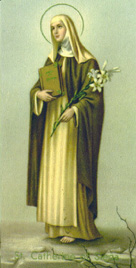 St. Catherine of Siena: Saint of the Day for Monday, April 29, 2024
 Prayer for the Dead # 3: Prayer of the Day for Monday, April 29, 2024


Copyright 2024 Catholic Online. All materials contained on this site, whether written, audible or visual are the exclusive property of Catholic Online and are protected under U.S. and International copyright laws, © Copyright 2024 Catholic Online. Any unauthorized use, without prior written consent of Catholic Online is strictly forbidden and prohibited.
Catholic Online is a Project of Your Catholic Voice Foundation, a Not-for-Profit Corporation. Your Catholic Voice Foundation has been granted a recognition of tax exemption under Section 501(c)(3) of the Internal Revenue Code. Federal Tax Identification Number: 81-0596847. Your gift is tax-deductible as allowed by law.