We ask you, humbly: don't scroll away.
Hi readers, it seems you use Catholic Online a lot; that's great! It's a little awkward to ask, but we need your help. If you have already donated, we sincerely thank you. We're not salespeople, but we depend on donations averaging $14.76 and fewer than 1% of readers give. If you donate just $5.00, the price of your coffee, Catholic Online School could keep thriving. Thank you.Help Now >
St. Gudula
FREE Catholic Classes
(Latin, Guodila ).
Born in Brabant, Belgium, of Witger and Amalberga, in the seventh century; died at the beginning of the eighth century. After the birth of Gudula her mother Amalberga, who is herself venerated as a saint, embraced the religious life, and according to tradition received the veil at the hands of St. Aubert, Bishop of Cambrai (d. about 668). Gudula's sister was St. Reinelda, and her brother, St. Emebertus, who succeeded St. Vindician as Bishop of Cambrai about 695. From an early age Gudula proved herself a worthy child of her mother, and with Reinelda and Emebertus lived in an atmosphere of piety and good works. She frequently visited the church of Moorzeele, situated at a distance of two miles from her parents' house. She was buried at Ham (Eastern Flanders ). About a century after her death, her relics were removed from Ham to the church of Saint-Sauveur at Moorzeele, where the body was interred behind the altar. Under Duke Charles of Lorraine (977-992), or more exactly, between 977 and 988, the body of the saint was taken from the church of Moorzeele and transferred to the chapel of Saint Géry at Brussels. Count Balderic of Louvain caused another translation to be made in 1047, when the relics of the saint were placed in the church of Saint-Michel. Great indulgences were granted on the feast of the saint in 1330, to all who assisted in the decoration and completion of the church of St. Gudula at Brussels. On 6 June, 1579, the collegiate church was pillaged and wrecked by the Gueux and heretics, and the relics of the saint disinterred and scattered. The feast of the saint is celebrated at Brussels on 8 January, and at Ghent &151; in which diocese Ham and Moorzeele are located—on 19 January.

If St. Michael is the patron of Brussels, St. Gudula is its most venerated patroness. In iconography, St. Gudula is represented on a seal of the Church of St. Gudula of 1446 reproduced by Père Ch. Cahier (Caracteristiques des saints, I, 198) holding in her right hand a candle, and in her left a lamp, which a demon endeavours to extinguish. This representation is doubtless in accord with the legend which relates that the saint frequently repaired to the church before cock-crow. The demon wishing to interrupt this pious exercise, extinguished the light which she carried, but the saint obtained from God that her lantern should be rekindled. The flower called "tremella deliquescens", which bears fruit in the beginning of January, is known as "Sinte Goulds lampken" (St. Gudula's lantern ). The old woodcarvers who professed to represent the saints born in the states of the House of Austria, depict St. Gudula with a taper in her hand.
We ask you, humbly: don't scroll away.
Hi readers, it seems you use Catholic Online a lot; that's great! It's a little awkward to ask, but we need your help. If you have already donated, we sincerely thank you. We're not salespeople, but we depend on donations averaging $14.76 and fewer than 1% of readers give. If you donate just $5.00, the price of your coffee, Catholic Online School could keep thriving. Thank you.Help Now >
We ask you, humbly: don't scroll away.
Hi readers, it seems you use Catholic Online a lot; that's great! It's a little awkward to ask, but we need your help. If you have already donated, we sincerely thank you. We're not salespeople, but we depend on donations averaging $14.76 and fewer than 1% of readers give. If you donate just $5.00, the price of your coffee, Catholic Online School could keep thriving. Thank you.Help Now >
Join the Movement
When you sign up below, you don't just join an email list - you're joining an entire movement for Free world class Catholic education.


-

-
Mysteries of the Rosary
-
St. Faustina Kowalska
-
Litany of the Blessed Virgin Mary
-
Saint of the Day for Wednesday, Oct 4th, 2023
-
Popular Saints
-
St. Francis of Assisi
-
Bible
-
Female / Women Saints
-
7 Morning Prayers you need to get your day started with God
-
Litany of the Blessed Virgin Mary

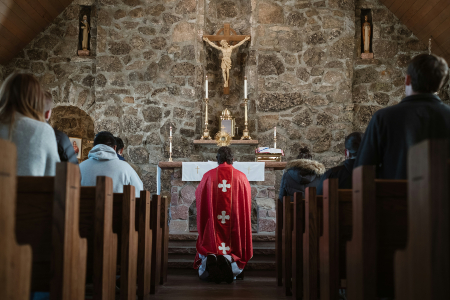
U.S. Catholic Parishes Experience Resurgence of Traditional Practices
-
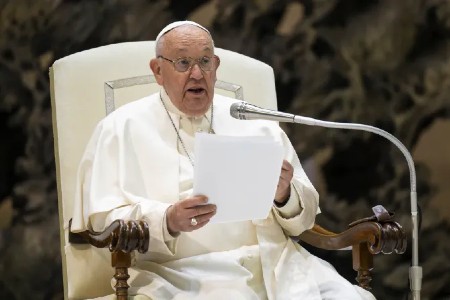
Pope Francis Urges Faith and Prayers for Peace
-
Florida Welcomes Volunteer Chaplains to Public Schools
-
10 Fascinating Details About St. Joseph the Worker: Celebrating His Feast Day - May 1
-
St. Joseph the Worker: Model for Men, Young and Old

Daily Catholic
- Daily Readings for Thursday, May 02, 2024
- St. Athanasius: Saint of the Day for Thursday, May 02, 2024
- The Our Father: Prayer of the Day for Thursday, May 02, 2024
- Daily Readings for Wednesday, May 01, 2024
- St. Marculf: Saint of the Day for Wednesday, May 01, 2024
- To Saint Peregrine: Prayer of the Day for Wednesday, May 01, 2024
 Daily Readings for Thursday, May 02, 2024
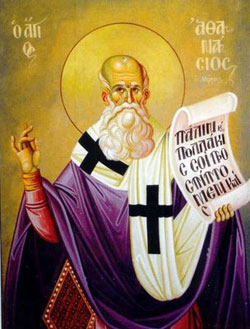 St. Athanasius: Saint of the Day for Thursday, May 02, 2024
 The Our Father: Prayer of the Day for Thursday, May 02, 2024
 Hi readers, it seems you use Catholic Online a lot; that's great! It's a little awkward to ask, but we need your help. If you have already donated, we sincerely thank you. We're not salespeople, but we depend on donations averaging $14.76 and fewer than 1% of readers give. If you donate just $5.00, the price of your coffee, Catholic Online School could keep thriving. Thank you. Help Now >

Copyright 2024 Catholic Online. All materials contained on this site, whether written, audible or visual are the exclusive property of Catholic Online and are protected under U.S. and International copyright laws, © Copyright 2024 Catholic Online. Any unauthorized use, without prior written consent of Catholic Online is strictly forbidden and prohibited.
Catholic Online is a Project of Your Catholic Voice Foundation, a Not-for-Profit Corporation. Your Catholic Voice Foundation has been granted a recognition of tax exemption under Section 501(c)(3) of the Internal Revenue Code. Federal Tax Identification Number: 81-0596847. Your gift is tax-deductible as allowed by law.