We ask you, humbly: don't scroll away.
Hi readers, it seems you use Catholic Online a lot; that's great! It's a little awkward to ask, but we need your help. If you have already donated, we sincerely thank you. We're not salespeople, but we depend on donations averaging $14.76 and fewer than 1% of readers give. If you donate just $5.00, the price of your coffee, Catholic Online School could keep thriving. Thank you.Help Now >
St. Desiderius of Cahors
FREE Catholic Classes
Bishop, b. at Obrege (perhaps Antobroges, name of a Gaulish tribe), on the frontier of the Provincia Narbonnensis, of a noble Frankish family from Aquitaine, which possessed large estates in the territory of Albi ; d. 15 Nov., 655--though Krusch has called this date in question. In his childhood Desiderius was profoundly impressed by the religious atmosphere of his home. His father Salvius was a pious Christian, and his mother Herchenefreda shows herself a woman of serious religious sentiment in three letters to her son, mentioned in his "Vita". With his two brothers, Rusticus and Syagrius, the boy Desiderius came to the court of the Frankish king Chlotar II (584-629; from 613 sovereign of the whole Frankish Empire), and with other boys o noble family received an excellent education at the Merovingian court-school, whence in the seventh century went forth many capable and holy bishops. Rusticus became a priest and finally Bishop of Cahors ; Syagrius became count of the territory of Albi and prefect of the city of Marseilles ; Desiderius stayed on at the court where he held the important office of royal treasurer, an office that he retained under the new king, Dagobert (629-639), whose confidant he was. After the death of Syagrius (629), he is said to have obtained also the prefectship of Marseilles, but this is not certain.
 Hi readers, it seems you use Catholic Online a lot; that's great! It's a little awkward to ask, but we need your help. If you have already donated, we sincerely thank you. We're not salespeople, but we depend on donations averaging $14.76 and fewer than 1% of readers give. If you donate just $5.00, the price of your coffee, Catholic Online School could keep thriving. Thank you. Help Now >
Faithful to the admonitions of his pious mother, Desiderius led at court the serious holy life of a monk, and administered his office with great fidelity. In 630 his brother Resticus, the Bishop of Cahors, was murdered, whereupon the clergy and people of that city requested from the king Desiderius as his successor. By a letter of 8 April, 630, Dagobert made known his consent, and Desiderius was consecrated Bishop of Cahors. His close relations with the Court he used in the interests of his Church. With the most important bishops of his time, many of them educated with him at the royal court, he maintained an active intercourse, as his letters prove. He was a zealous promoter of monastic life and founded a monastery in the vicinity of Cahors, the church of which was dedicated to St. Amantius; later on the convent was called after its founder St. Géry (i.e. Dierius, from Desiderius). He directed also a convent of women, as we see from a letter written by him to the Abbess Aspasia. Under him and with his support was likewise founded in his diocese the monastery of St. Peter of Moissac, later so celebrated. Desiderius was very zealous for Divine service and the perfection of the religious life ; he built three large basilicas in and near Cahors (St. Maria, St. Peter, St. Julian) and an oratory in honour of St. Martin. For the clergy he was a severe disciplinarian, but was himself foremost with the example of a holy life. He also promoted the temporal welfare of the inhabitants of Cahors, built an aqueduct, and erected or restored the walls and towers that protected the city. Desiderius persuaded the nobles of his diocese to endow richly the churches and monasteries. By his testament (649-650) he gave all his possessions to the cathedral, the churches, and the monasteries of his episcopal city. While resident on his estates in the district of Albi he fell ill and died at his villa of Wistrilingo, which he had presented to the monastery of St. Amantius. His body was carried to Cahors and interred in the church of St. Amantius. We possess a "Vita" of Desiderius written shortly after his death, a collection of his letters, also of letters addressed to him, and an account of miracles that took place at his tomb. His feast is celebrated on the 15th of November.


Join the Movement
When you sign up below, you don't just join an email list - you're joining an entire movement for Free world class Catholic education.


-

-
Mysteries of the Rosary
-
St. Faustina Kowalska
-
Litany of the Blessed Virgin Mary
-
Saint of the Day for Wednesday, Oct 4th, 2023
-
Popular Saints
-
St. Francis of Assisi
-
Bible
-
Female / Women Saints
-
7 Morning Prayers you need to get your day started with God
-
Litany of the Blessed Virgin Mary


Sacrifices of Faith: The Pro-Life Legacies of St. Gianna and Jessica Hanna
-
How to love God by caring for our bodies
-
Pope Francis calls for negotiations to End Russia-Ukraine War
-
Pope Francis Contemplates Return to U.S. for United Nations Assembly Address
-
Pope Francis Calls on Faithful to Embrace Faith, Hope, and Charity in New Teaching Series


Daily Catholic
- Daily Readings for Monday, April 29, 2024
- St. Catherine of Siena: Saint of the Day for Monday, April 29, 2024
- Prayer for the Dead # 3: Prayer of the Day for Monday, April 29, 2024
- Daily Readings for Sunday, April 28, 2024
- St. Peter Chanel: Saint of the Day for Sunday, April 28, 2024
- Prayer before a Crucifix: Prayer of the Day for Sunday, April 28, 2024
 Daily Readings for Monday, April 29, 2024
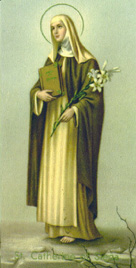 St. Catherine of Siena: Saint of the Day for Monday, April 29, 2024
 Prayer for the Dead # 3: Prayer of the Day for Monday, April 29, 2024
We ask you, humbly: don't scroll away.
Hi readers, it seems you use Catholic Online a lot; that's great! It's a little awkward to ask, but we need your help. If you have already donated, we sincerely thank you. We're not salespeople, but we depend on donations averaging $14.76 and fewer than 1% of readers give. If you donate just $5.00, the price of your coffee, Catholic Online School could keep thriving. Thank you.Help Now >

Copyright 2024 Catholic Online. All materials contained on this site, whether written, audible or visual are the exclusive property of Catholic Online and are protected under U.S. and International copyright laws, © Copyright 2024 Catholic Online. Any unauthorized use, without prior written consent of Catholic Online is strictly forbidden and prohibited.
Catholic Online is a Project of Your Catholic Voice Foundation, a Not-for-Profit Corporation. Your Catholic Voice Foundation has been granted a recognition of tax exemption under Section 501(c)(3) of the Internal Revenue Code. Federal Tax Identification Number: 81-0596847. Your gift is tax-deductible as allowed by law.