We ask you, urgently: don't scroll past this
Dear readers, Catholic Online was de-platformed by Shopify for our pro-life beliefs. They shut down our Catholic Online, Catholic Online School, Prayer Candles, and Catholic Online Learning Resources essential faith tools serving over 1.4 million students and millions of families worldwide. Our founders, now in their 70's, just gave their entire life savings to protect this mission. But fewer than 2% of readers donate. If everyone gave just $5, the cost of a coffee, we could rebuild stronger and keep Catholic education free for all. Stand with us in faith. Thank you.Help Now >
The Abbey of Bury St. Edmund's
FREE Catholic Classes
The first religious foundation there was established by Sigebert, King of the East Angles, who resigned his crown to found a monastery about 537. It became celebrated when the relics of the martyred King Edmund were brought there in 903, after which time the town, till then called Boedericsworth, became known as St. Edmund's Town or St. Edmund's Bury. During the reign of Canute (1016-35) the secular canons were replaced by Benedictines. In 1095 there was a solemn translation of the saint's relics to the new church built by Abbot Baldwin. The shrine grew in fame, wealth, and magnificence till the monastery was considered second only to Glastonbury, but in 1465 a terrible fire caused irreparable loss to the church, from which it never recovered. The abbot had a seat in Parliament and possessed full jurisdiction over the town and neighbourhood. There was accomodation for eighty monks, but more than two hundred persons resided in the Abbey. At the dissolution, the revenues were valued at £2,366, equivalent to more than £20,000 in present money. It was in the abbey church that the memorable meeting of barons took place in the year 1214, when Cardinal Langton, Archbishop of Canterbury, standing at the high altar, read out the proposed Charter of Liberties, which in the form of Magna Charta was signed by King John in 1215. The abbey was finally dissolved by Henry VIII in 1539, when the abbey church and the monastic buildings were in large measure destroyed, the gateway, an ancient bridge, and other scattered ruins alone now remaining. The fate of the saint's relics has never been decided. According to one tradition, they were abstracted by Prince Louis of France in 1217. Relics purporting to be those of the saint were long preserved at Toulouse, until in 1901, Cardinal Vaughan, Archbishop of Westminster, obtained leave to translate them to England. Doubts having been thrown on the authenticity of the relics, a commission of investigation was appointed by the Holy See , but no report has been published. Among the famous monks of the Abbey were Abbot Sampson and his chronicler Jocelin of Brakelond (d. 1211); John Boston de Bury, author and bibliographer (d. 1430); John Lydgate, poet (d. 1446), and Byfield who was burnt for heresy in 1530.

Join the Movement
When you sign up below, you don't just join an email list - you're joining an entire movement for Free world class Catholic education.
-

- Easter / Lent
- Ascension Day
- 7 Morning Prayers
- Mysteries of the Rosary
- Litany of the Bl. Virgin Mary
- Popular Saints
- Popular Prayers
- Female Saints
- Saint Feast Days by Month
- Stations of the Cross
- St. Francis of Assisi
- St. Michael the Archangel
- The Apostles' Creed
- Unfailing Prayer to St. Anthony
- Pray the Rosary


Netanyahu Calls Pope Leo XIV After Deadly Strike on Gaza Church

Syrian Christian Communities Under Attack Amid Sectarian Turmoil

Catholic Online AI Open Letter
Daily Catholic
- Daily Readings for Saturday, July 19, 2025
- St. Arsenius the Great: Saint of the Day for Saturday, July 19, 2025
- A Prayer for Peace of Mind (by Saint Francis Xavier Cabrini): Prayer of the Day for Saturday, July 19, 2025
- Daily Readings for Friday, July 18, 2025
- St. Frederick: Saint of the Day for Friday, July 18, 2025
- Act of Faith: Prayer of the Day for Friday, July 18, 2025
 Daily Readings for Saturday, July 19, 2025
 St. Arsenius the Great: Saint of the Day for Saturday, July 19, 2025
 A Prayer for Peace of Mind (by Saint Francis Xavier Cabrini): Prayer of the Day for Saturday, July 19, 2025
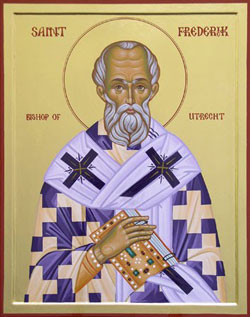 St. Frederick: Saint of the Day for Friday, July 18, 2025



Copyright 2025 Catholic Online. All materials contained on this site, whether written, audible or visual are the exclusive property of Catholic Online and are protected under U.S. and International copyright laws, © Copyright 2025 Catholic Online. Any unauthorized use, without prior written consent of Catholic Online is strictly forbidden and prohibited.
Catholic Online is a Project of Your Catholic Voice Foundation, a Not-for-Profit Corporation. Your Catholic Voice Foundation has been granted a recognition of tax exemption under Section 501(c)(3) of the Internal Revenue Code. Federal Tax Identification Number: 81-0596847. Your gift is tax-deductible as allowed by law.
