 Hi readers, it seems you use Catholic Online a lot; that's great! It's a little awkward to ask, but we need your help. If you have already donated, we sincerely thank you. We're not salespeople, but we depend on donations averaging $14.76 and fewer than 1% of readers give. If you donate just $5.00, the price of your coffee, Catholic Online School could keep thriving. Thank you. Help Now >
Zionists
FREE Catholic Classes
Zionists are followers of the movement to segregate the Jewish people as a nation and to give it a national home either in Palestine or elsewhere. Orthodox Judaism holds to a Zionism pure and simple, the return of the Jews to Palestine, the coming of the Messias, the overthrow of hostile powers by Him, the restoration of the Temple and its worship, the Messianic reign. The Reformed Jews reject this idea of a return to Zion. The conference of rabbis, at Frankfort-on-the-Main, 15-28 July, 1845, deleted from the ritual all prayers for a return to Zion and a restoration of a Jewish state. The Philadelphia conference, 1869, followed the lead of the German rabbis and decreed that the Messianic hope of Israel is "the union of all the children of God in the confession of the unity of God ". The Pittsburg conference, 1885, reiterated this Messianic idea of reformed Judaism.
The practical carrying out of Zionism by orthodox Jews has until recently been attempted only fitfully and very ineffectually, and often with no return to Zion as an objective. In the middle of the sixteenth century Joseph Nasi tried to gather the Portuguese Jews to an island owned by the Republic of Venice. In the seventeenth century Shabbethai Zebi (1626-1676) announced himself as the Messias and gained over many Jews to his side; among these, the philosopher Baruch Spinoza. Jewish settlements were established in the upper Mississippi region by W.D. Robinson, 1819; near Jerusalem, by the American Consul Warder Cresson, a convert to Judaism, 1850; in Prague, by Steinschneider, 1835; and elsewhere. Sir Moses Montefiore tried to colonize Jews in Palestine (1840). Laurence Oliphant failed in a like attempt to bring to Palestine the Jewish proletariat of Poland, Lithuania, Rumania, and the Turkish Empire (1879 and 1882). The man who gave dignity, form, and permanence to the Zionist movement was Theodor Herzl. In 1896 his "Jüdenstaat" appeared in Vienna. He soon won over such Jewish leaders as Israel Zangwill, Max Nordau, Alexander Marmorek, and others. The ideas of "Jüdenstaat" spread throughout the Jewish world. Six successive Zion congresses were held. By 1899 there were more than 100,000 shekel-payers. The Sultan of Turkey removed the ban whereby Jews had been prevented from staying longer than three months in Palestine. The now flourishing colony of Mikweh Israel was established near Jaffa. All attempts failed to get from the sultan for the Jews in Palestine any kind of corporate political existence, and any form of provincial or municipal autonomy. Herzl died on 3 July, 1904. At the next, the seventh, Zionist congress, Max Nordau was elected president (1905). Since then the movement has gone on and has remained true to the first, or Basle, congress platform of Jewish autonomy in the new Jewish state.


We ask you, humbly: don't scroll away.
Hi readers, it seems you use Catholic Online a lot; that's great! It's a little awkward to ask, but we need your help. If you have already donated, we sincerely thank you. We're not salespeople, but we depend on donations averaging $14.76 and fewer than 1% of readers give. If you donate just $5.00, the price of your coffee, Catholic Online School could keep thriving. Thank you.Help Now >
Join the Movement
When you sign up below, you don't just join an email list - you're joining an entire movement for Free world class Catholic education.


-

-
Mysteries of the Rosary
-
St. Faustina Kowalska
-
Litany of the Blessed Virgin Mary
-
Saint of the Day for Wednesday, Oct 4th, 2023
-
Popular Saints
-
St. Francis of Assisi
-
Bible
-
Female / Women Saints
-
7 Morning Prayers you need to get your day started with God
-
Litany of the Blessed Virgin Mary


Sacrifices of Faith: The Pro-Life Legacies of St. Gianna and Jessica Hanna
-
How to love God by caring for our bodies
-
Pope Francis calls for negotiations to End Russia-Ukraine War
-
Pope Francis Contemplates Return to U.S. for United Nations Assembly Address
-
Pope Francis Calls on Faithful to Embrace Faith, Hope, and Charity in New Teaching Series


Daily Catholic
- Daily Readings for Monday, April 29, 2024
- St. Catherine of Siena: Saint of the Day for Monday, April 29, 2024
- Prayer for the Dead # 3: Prayer of the Day for Monday, April 29, 2024
- Daily Readings for Sunday, April 28, 2024
- St. Peter Chanel: Saint of the Day for Sunday, April 28, 2024
- Prayer before a Crucifix: Prayer of the Day for Sunday, April 28, 2024
 Daily Readings for Monday, April 29, 2024
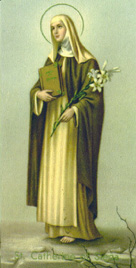 St. Catherine of Siena: Saint of the Day for Monday, April 29, 2024
 Prayer for the Dead # 3: Prayer of the Day for Monday, April 29, 2024
 Hi readers, it seems you use Catholic Online a lot; that's great! It's a little awkward to ask, but we need your help. If you have already donated, we sincerely thank you. We're not salespeople, but we depend on donations averaging $14.76 and fewer than 1% of readers give. If you donate just $5.00, the price of your coffee, Catholic Online School could keep thriving. Thank you. Help Now >

Copyright 2024 Catholic Online. All materials contained on this site, whether written, audible or visual are the exclusive property of Catholic Online and are protected under U.S. and International copyright laws, © Copyright 2024 Catholic Online. Any unauthorized use, without prior written consent of Catholic Online is strictly forbidden and prohibited.
Catholic Online is a Project of Your Catholic Voice Foundation, a Not-for-Profit Corporation. Your Catholic Voice Foundation has been granted a recognition of tax exemption under Section 501(c)(3) of the Internal Revenue Code. Federal Tax Identification Number: 81-0596847. Your gift is tax-deductible as allowed by law.