We ask you, humbly: don't scroll away.
Hi readers, it seems you use Catholic Online a lot; that's great! It's a little awkward to ask, but we need your help. If you have already donated, we sincerely thank you. We're not salespeople, but we depend on donations averaging $14.76 and fewer than 1% of readers give. If you donate just $5.00, the price of your coffee, Catholic Online School could keep thriving. Thank you.Help Now >
St. Vergilius of Salzburg
FREE Catholic Classes
Irish missionary and astronomer, of the eighth century. Vergilius (or Virgilius, in Irish Fergal, Ferghil , or Feirghil ) is said to have been a descendant of Niall of the Nine Hostages. In the "Annals of the Four Masters" and the "Annals of Ulster" he is mentioned as Abbot of Aghaboe, in Queen's County. About 745 he left Ireland, intending to visit the Holy land, but, like many of his countrymen, who seemed to have adopted this practice as a work of piety, he settled down in France, where he was received with great favour by Pepin, then mayor of the Palace under Childeric III. After spending two years at Cressy, near Compiegne, he went to Bavaria, at the invitation of Duke Otilo, and within a year or two was made Abbot of St. Peter's at Salzburg. Out of humility, he "concealed his orders", and had a bishop named Dobdagrecus, a fellow countryman, appointed to perform his episcopal functions for him. It was while Abbot of St. Peter's that he came into collision with St. Boniface. A priest having, through ignorance, conferred the Sacrament of Baptism using, in place of the correct formula, the words Baptizo te in nomine patria et filia et spiritu sancta", Vergilius held that the sacrament had been validly conferred. Boniface complained to Pope Zachary. The latter, however, decided in favour of Vergilius. Later on, St. Boniface accused Vergilius of teaching a doctrine in regard to the rotundity of the earth, which was "contrary to the Scriptures ". Pope Zachary's decision in this case was that "if it be proved that he held the said doctrine, a council be held, and Vergilius expelled from the Church and deprived of his priestly dignity" (Jaffe, "Biblioth. rerum germ.", III, 191). Unfortunately we no longer possess the treatise in which Vergilius expounded his doctrine. Two things, however, are certain: first, that there was involved the problem of original sin and the universality of redemption ; secondly, that Vergilius succeeded in freeing himself from the charge of teaching a doctrine contrary to Scripture. It is likely that Boniface misunderstood him, taking it for granted, perhaps, that if there are antipodes, the "other race of men" are not descendants of Adam and were not redeemed by Christ. Vergilius, no doubt, had little difficulty in showing that his doctrine did not involve consequences of that kind. (See ANTIPODES.)

After the martyrdom of St. Boniface, Vergilius was made Bishop of Salzburg (766 or 767) and laboured successfully for the upbuilding of his diocese as well as for the spread of the Faith in neighbouring heathen countries, especially in Carinthia. He died at Salzburg, 27 November, 789. In 1233 he was canonized by Gregory IX. His doctrine that the earth is a sphere was derived from the teaching of ancient geographers, and his belief in the existence of the antipodes was probably influenced by the accounts which the ancient Irish voyagers gave of their journeys. This, at least, is the opinion of Rettberg ("Kirchengesch. Deutschlands", II, 236).


Join the Movement
When you sign up below, you don't just join an email list - you're joining an entire movement for Free world class Catholic education.


-

-
Mysteries of the Rosary
-
St. Faustina Kowalska
-
Litany of the Blessed Virgin Mary
-
Saint of the Day for Wednesday, Oct 4th, 2023
-
Popular Saints
-
St. Francis of Assisi
-
Bible
-
Female / Women Saints
-
7 Morning Prayers you need to get your day started with God
-
Litany of the Blessed Virgin Mary


Sacrifices of Faith: The Pro-Life Legacies of St. Gianna and Jessica Hanna
-
How to love God by caring for our bodies
-
Pope Francis calls for negotiations to End Russia-Ukraine War
-
Pope Francis Contemplates Return to U.S. for United Nations Assembly Address
-
Pope Francis Calls on Faithful to Embrace Faith, Hope, and Charity in New Teaching Series


Daily Catholic
- Daily Readings for Monday, April 29, 2024
- St. Catherine of Siena: Saint of the Day for Monday, April 29, 2024
- Prayer for the Dead # 3: Prayer of the Day for Monday, April 29, 2024
- Daily Readings for Sunday, April 28, 2024
- St. Peter Chanel: Saint of the Day for Sunday, April 28, 2024
- Prayer before a Crucifix: Prayer of the Day for Sunday, April 28, 2024
 Daily Readings for Monday, April 29, 2024
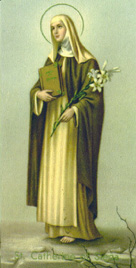 St. Catherine of Siena: Saint of the Day for Monday, April 29, 2024
 Prayer for the Dead # 3: Prayer of the Day for Monday, April 29, 2024
We ask you, humbly: don't scroll away.
Hi readers, it seems you use Catholic Online a lot; that's great! It's a little awkward to ask, but we need your help. If you have already donated, we sincerely thank you. We're not salespeople, but we depend on donations averaging $14.76 and fewer than 1% of readers give. If you donate just $5.00, the price of your coffee, Catholic Online School could keep thriving. Thank you.Help Now >

Copyright 2024 Catholic Online. All materials contained on this site, whether written, audible or visual are the exclusive property of Catholic Online and are protected under U.S. and International copyright laws, © Copyright 2024 Catholic Online. Any unauthorized use, without prior written consent of Catholic Online is strictly forbidden and prohibited.
Catholic Online is a Project of Your Catholic Voice Foundation, a Not-for-Profit Corporation. Your Catholic Voice Foundation has been granted a recognition of tax exemption under Section 501(c)(3) of the Internal Revenue Code. Federal Tax Identification Number: 81-0596847. Your gift is tax-deductible as allowed by law.