 Hi readers, it seems you use Catholic Online a lot; that's great! It's a little awkward to ask, but we need your help. If you have already donated, we sincerely thank you. We're not salespeople, but we depend on donations averaging $14.76 and fewer than 1% of readers give. If you donate just $5.00, the price of your coffee, Catholic Online School could keep thriving. Thank you. Help Now >
Aloysius Taparelli
FREE Catholic Classes
(D'AZEGLIO, christened PROSPERO)
Philosopher and writer on sociological subjects, born at Turin, 24 Nov., 1793; died at Rome, 20 Sept., 1862; interred near the altar of St. Aloysius in the Church of St. Ignatius.
His father, Cesare, was at one time ambassador of Victor Emmanuel I of Sardinia to the Holy See, and his brother, Massimo, was one of the Italian ministers of State. He was educated under the Calasanctians at Senis and in the Atheneo of Turin. He attended the military school of St-Cyr at Paris for some months, but he was not destined to be a soldier. He entered the Society of Jesus at Rome, 12 Nov., 1814. In his youth he displayed a bent for mechanics, painting, and music, and later invented a musical instrument which he called the violicembolo (highly praised by Liszt and afterwards at his suggestion named the symphonium ), and which was exhibited at the London Exhibition. He was the first rector of the Roman College after its restoration to the Jesuits by Leo XII. He taught philosophy for sixteen years at Palermo, and for many years afterwards was attached to the editorial staff of the "Civiltà Cattolica". His chief work, "Saggio teoretico di diritto naturale appogiato sul fatto", i.e. "A Theoretical Essay on Natural Right from an Historical Standpoint" (2 vols., 7th ed., Rome, 1883), was in a way the beginning of modern sociology. It was translated into German (Ratisbon, 1845) and twice into French (Tournai, 1851; Paris, 1896). Herein was developed the position, at once widely accepted in conservative circles on the Continent, that the normal origin of civil government was by extension of paternal power through the patriarchal head of a group of families. This essay was later abridged into "An Elementary Course in Natural Right" (6th ed., Naples, 1860; also in French, Tournai, 1864; and in Spanish Paris, 1875), which was in use as a text-book in the University of Modena. Next in importance is his "Esame critico degli ordini rappresentativi nella società moderna", i.e. "Critical Examination of Representative Government in Modern Society" (2 vols., Rome, 1854; in Spanish Madrid, 1867). Besides his striking monographs on "Nationality" (Rome, 1847), "Sovereignty of the People" (Palermo, 1848; Florence, 1849), and "The Grounds of War" (Genoa, 1847) he left a long list of articles in the "Civiltà Cattolica" chiefly on subjects in political economy and social right, as well as an equally long list of book reviews on kindred topics, which were acute and penetrating essays.
We ask you, humbly: don't scroll away.
Hi readers, it seems you use Catholic Online a lot; that's great! It's a little awkward to ask, but we need your help. If you have already donated, we sincerely thank you. We're not salespeople, but we depend on donations averaging $14.76 and fewer than 1% of readers give. If you donate just $5.00, the price of your coffee, Catholic Online School could keep thriving. Thank you.Help Now >
We ask you, humbly: don't scroll away.
Hi readers, it seems you use Catholic Online a lot; that's great! It's a little awkward to ask, but we need your help. If you have already donated, we sincerely thank you. We're not salespeople, but we depend on donations averaging $14.76 and fewer than 1% of readers give. If you donate just $5.00, the price of your coffee, Catholic Online School could keep thriving. Thank you.Help Now >
Join the Movement
When you sign up below, you don't just join an email list - you're joining an entire movement for Free world class Catholic education.


-

-
Mysteries of the Rosary
-
St. Faustina Kowalska
-
Litany of the Blessed Virgin Mary
-
Saint of the Day for Wednesday, Oct 4th, 2023
-
Popular Saints
-
St. Francis of Assisi
-
Bible
-
Female / Women Saints
-
7 Morning Prayers you need to get your day started with God
-
Litany of the Blessed Virgin Mary


Sacrifices of Faith: The Pro-Life Legacies of St. Gianna and Jessica Hanna
-
How to love God by caring for our bodies
-
Pope Francis calls for negotiations to End Russia-Ukraine War
-
Pope Francis Contemplates Return to U.S. for United Nations Assembly Address
-
Pope Francis Calls on Faithful to Embrace Faith, Hope, and Charity in New Teaching Series


Daily Catholic
- Daily Readings for Monday, April 29, 2024
- St. Catherine of Siena: Saint of the Day for Monday, April 29, 2024
- Prayer for the Dead # 3: Prayer of the Day for Monday, April 29, 2024
- Daily Readings for Sunday, April 28, 2024
- St. Peter Chanel: Saint of the Day for Sunday, April 28, 2024
- Prayer before a Crucifix: Prayer of the Day for Sunday, April 28, 2024
 Daily Readings for Monday, April 29, 2024
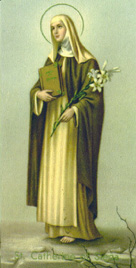 St. Catherine of Siena: Saint of the Day for Monday, April 29, 2024
 Prayer for the Dead # 3: Prayer of the Day for Monday, April 29, 2024


Copyright 2024 Catholic Online. All materials contained on this site, whether written, audible or visual are the exclusive property of Catholic Online and are protected under U.S. and International copyright laws, © Copyright 2024 Catholic Online. Any unauthorized use, without prior written consent of Catholic Online is strictly forbidden and prohibited.
Catholic Online is a Project of Your Catholic Voice Foundation, a Not-for-Profit Corporation. Your Catholic Voice Foundation has been granted a recognition of tax exemption under Section 501(c)(3) of the Internal Revenue Code. Federal Tax Identification Number: 81-0596847. Your gift is tax-deductible as allowed by law.