Nun lives ‘on the margins’ in Appalachia
RICHMOND, Va. (The Catholic Virginian) - The old man wistfully looked out from his front porch in St. Charles, Virginia, an Appalachian community eviscerated by decades of coal production.
AIDING RECOVERY - Sister Beth Davies stands at the New Beginnings residential treatment center in Dryden with Larry Lavendar, director of the center. She is on the staff with him in addition to running the Addiction Education Center in Pennington Gap.
He paused when his eyes suddenly welled with tears that rolled down his face. His voice quavered, “But now they have even taken our mountains.”
Sister Beth Davies sat and wept with him over the latest insult to the Appalachian ecology — “mountaintop removal.”
Coal companies have come and gone and come back again to the region, repeatedly promising economic opportunity but often bringing with it heavy environmental and social fallout.
The lament of the old man on his porch, Sister Beth noted, illustrates that the people of Appalachia “understand very well: what you do to our land, you do to us.”
Standing side by side
For more than 35 years Sister Beth, a nun of the Congregation of Notre Dame, has lived with the people in Virginia’s coalfields, walking their walk as they’ve struggled against exploitation and impoverishment in their beloved, magnificent mountains.
She has stood in picket lines with striking miners and their families when the local coal company tried to take away their benefits.
She helped the long underserved community develop a network of medical clinics.
She worked for environmental protection including legislation to restrict strip mining.
She fought the intrusion of maximum-security prisons as an economic development strategy.
Primarily she has worked to build effective programs and facilities to treat substance abuse and addiction, for which the depressed region is prime breeding ground.
Having arrived in Lee County in 1972, Sister Beth is quick to point out that she is just one among many who have come to Appalachia to join the region’s struggle.
Collaboration in ministry
More than 40 women religious have served in the segment of the region that lies within the Diocese of Richmond. They have labored for the cause alongside numerous priests and lay people including social service providers, doctors and other health care professionals and community organizers.
Mostly, though, they have labored with the local people whose roots run deep in the mountain region that stretches across 15 states.
Sister Beth said she learned early on that “whatever gifts I bring are useful only in collaboration with those that are already here, because we can only be effective when the whole community is working together.”
She was first drawn to Appalachia by the poverty she had witnessed during a visit to the region in 1971. At the time she had been principal of a Catholic high school in Connecticut.
But her vows with a religious community that espoused “living provisionally,” that is in trust that God will provide what is needed, called her to something more that “had been going on inside of me for some time.”
Now, looking back, she realizes that her desire to “live on the margins” with the people in Lee County led her to an ever-deepening understanding of the Christian Gospel.
“The closer you get to the living experience of people ‘on the fringes,’ the better perspective you get of the core of our society,” she said.
“What the Gospel is saying to us on every issue is that Jesus was never exclusive. Everyone was invited to his table. That’s why he was so railed against by the privileged, because he embraced those on the margins, those who were exploited.”
Early rejection
Being “on the margins” had an unexpected connotation for Sister Beth and her two fellow CNDs when they first arrived in St. Charles.
She and Sisters Barbara Topazio and Claudette LaBrie faced serious discrimination from the community for two reasons: they were “Yankees,” and they were Catholic.
Gradually, though, they got to know the local residents and were accepted in the community.
Two Glenmary priests were instrumental in bringing the sisters and introducing them to the community. Father Frank Korcinek and Father Les Schmidt had been ministering in the region for years and had long desired a “Catholic presence” in Lee County.
The sisters, Benedictine Father Tim Welsh, who was at Sacred Heart Church in Big Stone Gap, and Brother Peter, a member of the Little Brothers of the Gospel who came to work with the people in the coal mines, formed a community of support that met weekly for many years and “grounded us spiritually,” Sister Beth explained.
Typical of women religious who came to the area at the time, the sisters didn’t have a specific assigned task when they arrived.
Sister Beth noted that in 1972 federal government money was coming into the county through the War on Poverty program and a local leader, Jim Fulks, was coordinating much of the area’s social services through the Lonesome Pine Development ...
Rate This Article
1 - 1 of 1 Comments
Leave a Comment
More Diocese News
- Newman Centers are anchor of faith at public colleges
- A Pinprick to Revive Devotion
- Family celebration: Utah women travel to India to meet with sponsored children
- Deportation of Wis. eighth-grader reveals immigration policy's painful side to class
- Mandatory drug testing to be implemented in Oklahoma City Catholic high schools
- Catechesis of the Good Shepherd ‘hands-on’ religious education gets a look in Texas
- Food versus fuel: Is biofuel production to blame for our present food shortage?
- Spirituality key to the dying patient’s ‘quality of life,’ says Catholic doctor
- Bioethics battle is between contrary visions of the human person, says Rome professor
Featured News
- Fr. Paul Schenck: Finding Living Faith on Catechetical Sunday
- The Movie Yellow: Incest as 'Normal' and Cassavates's Slides Into the World of Woes
- The Chicago School Teachers Strike Reveals the Need For School Choice
- The Sexual Barbarians and the Dissolution of Culture
- The Happy Priest Challenges Us to Ask: Who is Jesus to Me?
- Michael Coren on Canadian Public Schools: Teachers, leave those kids alone
- We Cannot Ignore Our Consciences: Cardinal Dolan On Religious Liberty
- In the Face of Danger, Successor of Peter Travels to Lebanon as a Messenger of Peace
- Reflections on the Dignity and Vocation of Women: Who or What?
Most Popular
There's the problem! Americans are out of touch with scientific consensus on climate change Read More
Sex In Uniform: Why the Increase in Sexual Assaults in the Military? Read More
Culture of Corruption: Why Obama's misuse of Marines is wrong Read More
Bill Donohue, Catholic League, Disclose Fight with the IRS, Demonstrate Courage Read More
Pope Francis Shakes up the Ambassadors Meeting and Addresses Economic Issues Read More
Daily Readings
Reading 1, Sirach 5:1-8
Do not put your confidence in your money or say, 'With this I ... Read More
Psalm, Psalms 1:1-2, 3-4, 6
How blessed is anyone who rejects the advice of the wicked and ... Read More
Gospel, Mark 9:41-50
'If anyone gives you a cup of water to drink because you belong ... Read More
Saint of the Day
St. John Baptist Rossi
May 23: This holy priest was born in 1698 at the village of Voltaggio in ... Read More
Latest Videos
Kevin Durant Meets With Volunteers and Families Affected by Tornadoes View Video
American appointed to head Order of Friars Minor View Video
"Family Consecration to the Holy Family" Dr Scott Hahn View Video
May 23 - Homily: Your Mission To Preach View Video
May 23 - Homily: Conversion from Sin View Video
Marketplace
The Great Battle Has Begun
From the best-selling author of The Secrets, Chastisement, and ... Read More


Print


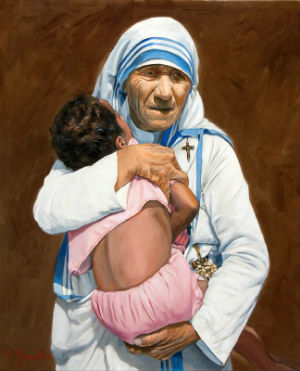
OK, I know this article is old, but that's not Sr. Beth in the picture. It's Sr. Dorothy Stang, S.N.D.de N. (Sister of Notre Dame de Namur). The one who was killed in the Brazilian Amazon defending the rights of the poor. Maybe the links have gotten messed up in the interim?