 Millions of people turn to Catholic Online for prayers, Daily Readings, saints, Catholic education and answers about their Faith. Most will never donate. But if Catholic Online has given you more than $5 worth of value this year, we're asking you to do something very simple: Give $5 today.
Your Catholic Voice Foundation also supports Catholic Online School, which has served 2.2 million student enrollments in 193 countries. We don't believe a family's ability to pay should determine whether a child can receive a Catholic education. If we've given you something of value, please give something back.
DONATE TODAY >>Transformed by Easter
Paragraph 2. On the Third Day He Rose from the Dead
638 "We bring you the good news that what God promised to the fathers, this day he has fulfilled to us their children by raising Jesus." 489 The Resurrection of Jesus is the crowning truth of our faith in Christ, a faith believed and lived as the central truth by the first Christian community; handed on as fundamental by Tradition; established by the documents of the New Testament; and preached as an essential part of the Paschal mystery along with the cross:
Christ is risen from the dead!
Dying, he conquered death;
To the dead, he has given life.
490
I. THE HISTORICAL AND TRANSCENDENT EVENT
639 The mystery of Christ's resurrection is a real event, with manifestations that were historically verified, as the New Testament bears witness. In about A.D. 56 St. Paul could already write to the Corinthians: "I delivered to you as of first importance what I also received, that Christ died for our sins in accordance with the scriptures, and that he was buried, that he was raised on the third day in accordance with the scriptures, and that he appeared to Cephas, then to the Twelve. . ." 491 The Apostle speaks here of the living tradition of the Resurrection which he had learned after his conversion at the gates of Damascus. 492
The empty tomb
640 "Why do you seek the living among the dead? He is not here, but has risen." 493 The first element we encounter in the framework of the Easter events is the empty tomb. In itself it is not a direct proof of Resurrection; the absence of Christ's body from the tomb could be explained otherwise. 494 Nonetheless the empty tomb was still an essential sign for all. Its discovery by the disciples was the first step toward recognizing the very fact of the Resurrection. This was the case, first with the holy women, and then with Peter. 495 The disciple "whom Jesus loved" affirmed that when he entered the empty tomb and discovered "the linen cloths lying there", "he saw and believed". 496 This suggests that he realized from the empty tomb's condition that the absence of Jesus' body could not have been of human doing and that Jesus had not simply returned to earthly life as had been the case with Lazarus. 497
The appearances of the Risen One
 641 Mary Magdalene and the holy women who came to finish anointing the body of Jesus, which had been buried in haste because the Sabbath began on the evening of Good Friday, were the first to encounter the Risen One. 498 Thus the women were the first messengers of Christ's Resurrection for the apostles themselves. 499 They were the next to whom Jesus appears: first Peter, then the Twelve. Peter had been called to strengthen the faith of his brothers, 500 and so sees the Risen One before them; it is on the basis of his testimony that the community exclaims: "The Lord has risen indeed, and has appeared to Simon!" 501
642 Everything that happened during those Paschal days involves each of the apostles - and Peter in particular - in the building of the new era begun on Easter morning. As witnesses of the Risen One, they remain the foundation stones of his Church. The faith of the first community of believers is based on the witness of concrete men known to the Christians and for the most part still living among them. Peter and the Twelve are the primary "witnesses to his Resurrection", but they are not the only ones - Paul speaks clearly of more than five hundred persons to whom Jesus appeared on a single occasion and also of James and of all the apostles. 502
643 Given all these testimonies, Christ's Resurrection cannot be interpreted as something outside the physical order, and it is impossible not to acknowledge it as an historical fact. It is clear from the facts that the disciples' faith was drastically put to the test by their master's Passion and death on the cross, which he had foretold. 503 The shock provoked by the Passion was so great that at least some of the disciples did not at once believe in the news of the Resurrection. Far from showing us a community seized by a mystical exaltation, the Gospels present us with disciples demoralized ("looking sad" 504) and frightened. For they had not believed the holy women returning from the tomb and had regarded their words as an "idle tale".505 When Jesus reveals himself to the Eleven on Easter evening, "he upbraided them for their unbelief and hardness of heart, because they had not believed those who saw him after he had risen." 506
644 Even when faced with the reality of the risen Jesus the disciples are still doubtful, so impossible did the thing seem: they thought they were seeing a ghost. "In their joy they were still disbelieving and still wondering." 507 Thomas will also experience the test of doubt and St. Matthew relates that during the risen Lord's last appearance in Galilee "some doubted." 508 Therefore the hypothesis that the Resurrection was produced by the apostles' faith (or credulity) will not hold up. On the contrary their faith in the Resurrection was born, under the action of divine grace, from their direct experience of the reality of the risen Jesus.
The condition of Christ's risen humanity
645 By means of touch and the sharing of a meal, the risen Jesus establishes direct contact with his disciples. He invites them in this way to recognize that he is not a ghost and above all to verify that the risen body in which he appears to them is the same body that had been tortured and crucified, for it still bears the traces of his Passion. 509 Yet at the same time this authentic, real body possesses the new properties of a glorious body: not limited by space and time but able to be present how and when he wills; for Christ's humanity can no longer be confined to earth, and belongs henceforth only to the Father's divine realm. 510 For this reason too the risen Jesus enjoys the sovereign freedom of appearing as he wishes: in the guise of a gardener or in other forms familiar to his disciples, precisely to awaken their faith. 511
646 Christ's Resurrection was not a return to earthly life, as was the case with the raisings from the dead that he had performed before Easter: Jairus' daughter, the young man of Naim, Lazarus. These actions were miraculous events, but the persons miraculously raised returned by Jesus' power to ordinary earthly life. At some particular moment they would die again. Christ's Resurrection is essentially different. In his risen body he passes from the state of death to another life beyond time and space. At Jesus' Resurrection his body is filled with the power of the Holy Spirit: he shares the divine life in his glorious state, so that St. Paul can say that Christ is "the man of heaven". 512
The Resurrection as transcendent event
647 O truly blessed Night, sings the Exultet of the Easter Vigil, which alone deserved to know the time and the hour when Christ rose from the realm of the dead! 513 But no one was an eyewitness to Christ's Resurrection and no evangelist describes it. No one can say how it came about physically. Still less was its innermost essence, his passing over to another life, perceptible to the senses. Although the Resurrection was an historical event that could be verified by the sign of the empty tomb and by the reality of the apostles' encounters with the risen Christ, still it remains at the very heart of the mystery of faith as something that transcends and surpasses history. This is why the risen Christ does not reveal himself to the world, but to his disciples, "to those who came up with him from Galilee to Jerusalem, who are now his witnesses to the people." 514

II. THE RESURRECTION - A WORK OF THE HOLY TRINITY
648 Christ's Resurrection is an object of faith in that it is a transcendent intervention of God himself in creation and history. In it the three divine persons act together as one, and manifest their own proper characteristics. The Father's power "raised up" Christ his Son and by doing so perfectly introduced his Son's humanity, including his body, into the Trinity. Jesus is conclusively revealed as "Son of God in power according to the Spirit of holiness by his Resurrection from the dead". 515 St. Paul insists on the manifestation of God's power 516 through the working of the Spirit who gave life to Jesus' dead humanity and called it to the glorious state of Lordship.
649 As for the Son, he effects his own Resurrection by virtue of his divine power. Jesus announces that the Son of man will have to suffer much, die, and then rise. 517 Elsewhere he affirms explicitly: "I lay down my life, that I may take it again. . . I have power to lay it down, and I have power to take it again." 518 "We believe that Jesus died and rose again." 519
650 The Fathers contemplate the Resurrection from the perspective of the divine person of Christ who remained united to his soul and body, even when these were separated from each other by death: "By the unity of the divine nature, which remains present in each of the two components of man, these are reunited. For as death is produced by the separation of the human components, so Resurrection is achieved by the union of the two." 520
III. THE MEANING AND SAVING SIGNIFICANCE OF THE RESURRECTION
651 "If Christ has not been raised, then our preaching is in vain and your faith is in vain." 521 The Resurrection above all constitutes the confirmation of all Christ's works and teachings. All truths, even those most inaccessible to human reason, find their justification if Christ by his Resurrection has given the definitive proof of his divine authority, which he had promised.
652 Christ's Resurrection is the fulfillment of the promises both of the Old Testament and of Jesus himself during his earthly life. 522 The phrase "in accordance with the Scriptures" 523 indicates that Christ's Resurrection fulfilled these predictions.
653 The truth of Jesus' divinity is confirmed by his Resurrection. He had said: "When you have lifted up the Son of man, then you will know that I am he." 524 The Resurrection of the crucified one shows that he was truly "I AM", the Son of God and God himself. So St. Paul could declare to the Jews: "What God promised to the fathers, this he has fulfilled to us their children by raising Jesus; as also it is written in the second psalm, 'You are my Son, today I have begotten you.'" 525 Christ's Resurrection is closely linked to the Incarnation of God's Son, and is its fulfillment in accordance with God's eternal plan.

654 The Paschal mystery has two aspects: by his death, Christ liberates us from sin; by his Resurrection, he opens for us the way to a new life. This new life is above all justification that reinstates us in God's grace, "so that as Christ was raised from the dead by the glory of the Father, we too might walk in newness of life." 526 Justification consists in both victory over the death caused by sin and a new participation in grace. 527 It brings about filial adoption so that men become Christ's brethren, as Jesus himself called his disciples after his Resurrection: "Go and tell my brethren." 528 We are brethren not by nature, but by the gift of grace, because that adoptive filiation gains us a real share in the life of the only Son, which was fully revealed in his Resurrection.
655 Finally, Christ's Resurrection - and the risen Christ himself is the principle and source of our future resurrection: "Christ has been raised from the dead, the first fruits of those who have fallen asleep. . . For as in Adam all die, so also in Christ shall all be made alive." 529 The risen Christ lives in the hearts of his faithful while they await that fulfillment . In Christ, Christians "have tasted. . . the powers of the age to come"530 and their lives are swept up by Christ into the heart of divine life, so that they may "live no longer for themselves but for him who for their sake died and was raised." 530
IN BRIEF
656 Faith in the Resurrection has as its object an event which as historically attested to by the disciples, who really encountered the Risen One. At the same time, this event is mysteriously transcendent insofar as it is the entry of Christ's humanity into the glory of God.
657 The empty tomb and the linen cloths lying there signify in themselves that by God's power Christ's body had escaped the bonds of death and corruption. They prepared the disciples to encounter the Risen Lord.
658 Christ, "the first-born from the dead" (Col 1:18), is the principle of our own resurrection, even now by the justification of our souls (cf. Rom 6:4), and one day by the new life he will impart to our bodies (cf.: Rom 8:11).
More Lent & Easter
Catholic Online Is Free. But We Need Your Help.
Please Watch

Easter 2026 / Lent 2026
Begins on Wednesday February 18th, 2026
Ends on Thursday April 2nd, 2026
'So it is written that the Christ would suffer and on the third day rise from the dead'

Lent Event
Importance
Stations of the Cross
Every Friday
 Stations of the Cross refers to the depiction of the final hours (or Passion) of Jesus, and the devotion commemorating the Passion... continue reading
Living Lent
February 18th, 2026 - April 2nd, 2026
 Commit to your faith and choose to 'live' Lent. Join our 40-day challenge to authentically live the Lenten season. Get inspired, don't just observe Lent, live it!... continue reading
Mardi Gras / Fat Tuesday
February 17th, 2026
 In France, the people feasted on foods that would be given up during the forty days of Lent. Meats, eggs, and milk were finished off in one day, giving the holiday its French title of 'Mardi Gras' which means Fat Tuesday... continue reading
Ash Wednesday
February 18th, 2026
 Ash Wednesday marks the beginning of the Season of Lent. It takes place 46 days before Easter Sunday. It is a season of penance, reflection, and fasting... continue reading

Palm Sunday
March 29th, 2026
 Palm Sunday, the Sunday before Easter, commemorates Jesus' triumphal entry into Jerusalem, an event mentioned in all four canonical Gospels... continue reading
Holy Week
March 29th, 2026 – April 4th, 2026
 On Palm Sunday, we celebrate the first joy of the season, as we celebrate Our Lord's triumphant entrance into Jerusalem where he was welcomed by... continue reading
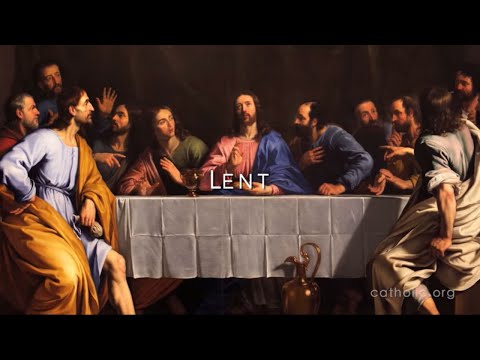
Holy Thursday / Last Supper
April 2nd, 2026
 Holy Thursday is the most complex and profound of all religious observances. It celebrates his last supper with the disciples, a celebration of Passover... continue reading
Good Friday
April 3rd, 2026
 On Good Friday, each member of the Church tries to understand at what cost Christ has won our redemption. In the solemn ceremonies of Holy Week... continue reading
Easter Sunday
April 5th, 2026
 Easter is the principal feast of the ecclesiastical year. Leo I calls it the greatest feast, and says that Christmas is celebrated only in preparation for Easter... continue reading
FREE Online Lent / Easter Classes Enroll Now
Ascension of Our Lord
Thursday May 14th, 2026
 The Ascension of Our Lord, a Holy Day of Obligation, celebrates the day that Christ, in the presence of His apostles, ascended bodily into Heaven. The Ascension occurred on the 40th day of Easter, a Thursday... continue reading
Pentecost
Sunday May 24th, 2026
 Pentecost Sunday is one of the most ancient feasts of the Church, celebrated early enough to be mentioned in the Acts of the Apostles (20:16) and Corinthians (16:8)... continue reading
Fasting and Abstinence
Every Friday
 For most people the easiest practice to consistently fulfill will be the traditional one, to abstain from meat on all Fridays of the year. During Lent abstinence from meat on Fridays is obligatory in the... continue reading
What did you give up for Lent?
All of Lent
 From the humorous to the bizarre, people have had interesting Lenten experiences. Tell us about what you are going to give up for this Lenten Year... continue reading
 Everything answered from when does lent end, ashes, giving something up, stations of the cross and blessed palms. The key to understanding the meaning of Lent is simple... continue reading
The Resurrection of Jesus is the crowning truth of our faith in Christ, a faith believed and lived as the central truth by the first Christian community... continue reading
 The Easter Bunny is a symbol of Easter that is popular in western culture, especially with children. According to folklore, the Easter Bunny hides Easter eggs for children to find on Easter morning... continue reading

 He is not here, for he has been raised just as he said. - Matthew 28:6. Learn more about the Post-Resurrection Appearances of Jesus Christ... continue reading
 Catholic Online Shopping offers a variety of Easter gifts & Easter treats for all ages! Choose a gift for someone special and celebrate the joy of Easter... continue reading
Easter / Lent News
5 Beautiful scriptures to remind you what Easter is all about Watch

This Easter, make sure to take a moment with your family to thank Jesus for his amazing sacrifice. LOS ANGELES, CA (Catholic Online) - Turn ... continue reading
Good Friday: The Crucifixion of Jesus Christ, the Church and the Sacraments Watch
We will soon commemorate Good Friday. This is the day when the whole world stands still. We will recall the great Sacrifice offered on the ... continue reading

The surprising origins of the Easter Bunny -- it's not what you think! Watch

The Easter Bunny is a symbol of Easter that is popular in western culture, especially with children. According to folklore, the Easter ... continue reading
The Sacred Triduum: Holy Thursday, Good Friday and Easter. The Mystery of Faith Watch
"Beginning with the Easter Triduum as its source of light, the new age of the Resurrection fills the whole liturgical year with its ... continue reading
Footwashing, the Holy Thursday Mandatum: God is Love and Love is a Verb Watch

As we enter into these three days, the one day, we make this mystery our own. No mere spectators in this Act of Love we become ... continue reading

Come Grow With Us
Sign up and walk the Catholic journey with millions around the world.
Receive inspiring emails on saints, daily readings, and free faith-building resources—no cost, ever.
Catholic Online Is Free. But We Need Your Help.
Please Watch
- 7 Morning Prayers
- Mysteries of the Rosary
- Litany of the Bl. Virgin Mary
- Popular Saints
- Popular Prayers
- Female Saints
- Saint Feast Days by Month
- Stations of the Cross
- St. Francis of Assisi
- St. Michael the Archangel
- The Apostles' Creed
- Unfailing Prayer to St. Anthony
- Pray the Rosary









Copyright 2026 Catholic Online. All materials contained on this site, whether written, audible or visual are the exclusive property of Catholic Online and are protected under U.S. and International copyright laws, © Copyright 2026 Catholic Online. Any unauthorized use, without prior written consent of Catholic Online is strictly forbidden and prohibited.
Catholic Online is a Project of Your Catholic Voice Foundation, a Not-for-Profit Corporation. Your Catholic Voice Foundation has been granted a recognition of tax exemption under Section 501(c)(3) of the Internal Revenue Code. Federal Tax Identification Number: 81-0596847. Your gift is tax-deductible as allowed by law.