 Millions of people turn to Catholic Online for prayers, Daily Readings, saints, Catholic education and answers about their Faith. Most will never donate. But if Catholic Online has given you more than $5 worth of value this year, we're asking you to do something very simple: Give $5 today.
Your Catholic Voice Foundation also supports Catholic Online School, which has served 2.2 million student enrollments in 193 countries. We don't believe a family's ability to pay should determine whether a child can receive a Catholic education. If we've given you something of value, please give something back.
DONATE TODAY >>Seven Deadly Sins: Envy
The Kingdom of God is not a zero-sum game in which we compete for limited love and respect. Each member of the Body of Christ is of infinite and unique importance (Rom12:3-8).
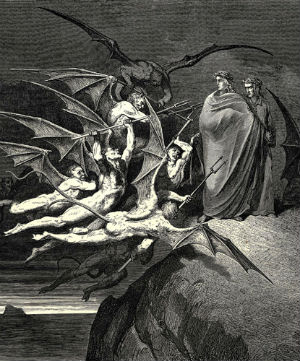
Cain, for example, envied his brother Abel. Because they were brothers, and in his mind equal petitioners for God's favor, Cain presumed that God would treat their offerings the same. Blinded by his envy, he missed his chance to bring forth his best and instead killed his competitor, his brother.
Highlights
Catholic Online (https://www.catholic.org)
3/29/2017 (9 years ago)
Published in Lent / Easter
WICHITA, Kansas (Catholic Online) - Envy is the most joyless of the Seven Deadly Sins, and trying to get to the bottom of it is like wrestling with a shadow. The glutton enjoys his banana split, at least for a moment, but the envious appears to derive only a gnawing sense of comparison, competition, and injustice from his secret sin. At its best, envy remains a hidden pool of ingratitude and resentment, secretly applauding the downfall and sorrow of others.
The envious resents the perceived preferential treatment of his peers. Questions fester in his mind, like "Why am I less popular, when I'm just as attractive?" Or "Why don't people seek me out, ask my advice?" "Why was I laid off, or overlooked for promotion, when I'm a more productive worker?" "Why do I earn less for my work, when I am just as creative and intelligent?"
At its worst, envy strikes others through slander or gossip or actively tries to cause them to fail. Envy brings tension and conflict into families, schools, offices, parishes, and society. Ultimately, envy pits the person against God's will for his life.
Envy not only draws comparisons but is deeply competitive. Cain, for example, envied his brother Abel. Because they were brothers, and in his mind equal petitioners for God's favor, Cain presumed that God would treat their offerings the same. Yet he failed to distinguish between his brother's offering of his choicest fruits and his own offering. Blinded by his envy, he missed his chance to bring forth his best and instead killed his competitor, his brother (Gen 4).
Unfortunately, our culture is deeply implicated in accentuating the habits of comparison and competition. Parents sometimes compare one sibling to another, as though only one set of gifts were worthy. In school, children are taught to measure their worth against that of others. This does not refer to the innocent game of kick ball in the school yard, in which kids take turns at winning and losing, but to the kind of comparison that pegs their worth as persons on a scale of one to ten. As they go through life, people are continually measured by how well they can stand up to the competition and secretly grow to envy those who seem to have had an easier path to success.
St. John's gospel shares an interesting exchange between the Risen Lord and St. Peter. St. Peter has just reaffirmed his love for Jesus. Jesus calls him to shepherd the Church and tells him what kind of death he will undergo for the glory of God. "Follow me," He concludes. Instead of immediately saying "Yes," St. Peter turns, sees St. John, the beloved disciple, and asks Jesus, "Lord, what about him?"
It is unlikely that envy had a place in so generous a soul as St. Peter's. More likely, the exchange was included for us, the hearers of the Gospel. Jesus answers with a question and a directive. "What if I want him to remain until I come? What concern is it of yours? You follow me." (John 21:15-23) Oddly enough, this is liberating. We are free to be what God wants us to be, without looking over our shoulders at others.
God's creation is infinitely diverse, in which all the different parts fit together into a beautiful whole and in which each person has a unique place. Our gifts are like great pearls buried in the homely soil of our own souls. Unearthing them, polishing them and offering them to the Lord and to others is the most joyful adventure imaginable and well worth the effort.
The Kingdom of God is not a zero-sum game in which we compete for limited love and respect. Rather, the whole is greater than the sum of the parts, and each member of the Body of Christ is of infinite and unique importance (Rom12:3-8).
The Giver of gifts knows us better than we know ourselves. His gifts are more perfectly suited to us than any we could choose for ourselves. Only when we accept our appointed place in this great chorus of praise to God, will the joy of true fulfillment in Him disperse the clouds of envy from our hearts.
-----------
Jeri Holladay writes from Wichita, Kansas, where she has been Director of Adult Education at the Spiritual Life Center of the Diocese of Wichita, Associate Professor of Theology, Chairman of the Theology Department and founding Director of the Bishop Eugene Gerber Institute of Catholic Studies at Newman University. She teaches moral theology and church history and is a contributing writer for Catholic Online.
---'Help Give every Student and Teacher FREE resources for a world-class Moral Catholic Education'
Copyright 2021 - Distributed by Catholic Online

Come Grow With Us
Sign up and walk the Catholic journey with millions around the world.
Receive inspiring emails on saints, daily readings, and free faith-building resources—no cost, ever.
What if your child could learn the Catholic Faith for FREE?
Please Watch

- 7 Morning Prayers
- Mysteries of the Rosary
- Litany of the Bl. Virgin Mary
- Popular Saints
- Popular Prayers
- Female Saints
- Saint Feast Days by Month
- Stations of the Cross
- St. Francis of Assisi
- St. Michael the Archangel
- The Apostles' Creed
- Unfailing Prayer to St. Anthony
- Pray the Rosary







Copyright 2026 Catholic Online. All materials contained on this site, whether written, audible or visual are the exclusive property of Catholic Online and are protected under U.S. and International copyright laws, © Copyright 2026 Catholic Online. Any unauthorized use, without prior written consent of Catholic Online is strictly forbidden and prohibited.
Catholic Online is a Project of Your Catholic Voice Foundation, a Not-for-Profit Corporation. Your Catholic Voice Foundation has been granted a recognition of tax exemption under Section 501(c)(3) of the Internal Revenue Code. Federal Tax Identification Number: 81-0596847. Your gift is tax-deductible as allowed by law.