We have one question for you.
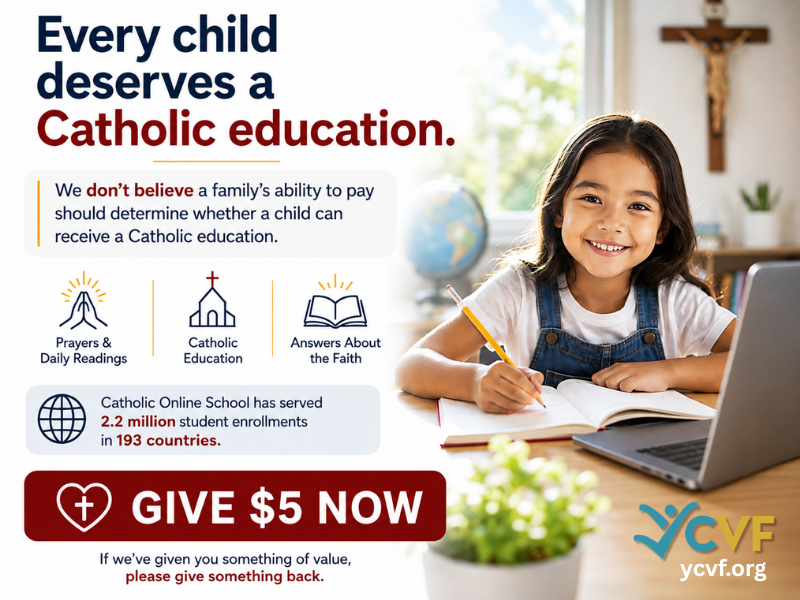
Has Catholic Online given you $5 worth of value this year? Maybe you came here for a prayer. Maybe you read today's Mass readings. Maybe you researched a saint. Maybe you needed an answer about the Catholic Faith. Maybe your child used Catholic Online School. If the answer is no, you don't owe us anything. Keep using Catholic Online. But if the answer is yes, we're asking you to give $5 today.
Catholic Online School has served 2.2 million student enrollments in 193 countries, and we continue working to make Catholic education available regardless of a family's financial circumstances. We don't need every reader to give. We need the readers who recognize the value of what they've received to stand behind it. Is Catholic Online worth $5 to you?
GIVE TODAY >>Relationship Between Science and Religion Topic of Public Lecture at the University of Dallas
FREE Catholic Classes
February 06, 2008 - 6:59 PST
FOR IMMEDIATE RELEASE
MEDIA ADVISORY
IRVING, TX (FEBRUARY 6, 2006) - The University of Dallas will sponsor a public lecture by Guy Consolmagno, S.J., distinguished scientist and major interpreter of the relationship between science and religion, on Thursday, March 6, 2008. The lecture, "How Scientists Think About Religion," will be held from 3:30 - 5 p.m. in the Gorman Lecture Center, Room A, on the University's Irving campus located at 1845 E. Northgate Dr. in Irving. The lecture is free and seating is limited.
"Bro. Guy is both a first rate scientist and a man committed to living the faithful, reflective, religious life of a Jesuit brother," said Dr. William Frank, professor of philosophy at UD and lecture organizer. "He is a living witness of the compatibility of scientific inquiry and Christian faith. It is an important part of wisdom to understand that compatibility of faith and reason."
Consolmagno has been an astronomer at the Vatican Observatory since 1993 and is currently the curator of the Vatican meteorite collection in Castel Gandolfo, one of the largest in the world. He has coauthored five astronomy books: Turn Left at Orion (Cambridge University Press, 1989); Worlds Apart (Prentice Hall, 1993); The Way to the Dwelling of Light (U of Notre Dame Press, 1998); Brother Astronomer (McGraw Hill, 2000); and God's Mechanics: How Scientists and Engineers Make Sense of Religion (Jossey-Bass, 2007). He has also published more than 100 scientific papers.
Consolmagno obtained his bachelor's and master's degrees in Earth and Planetary Sciences from the Massachusetts Institute of Technology, and his Ph.D. in Planetary Science from the University of Arizona. After taking his vows as a Jesuit brother, he studied philosophy, theology, and physics before his assignment to the Vatican Observatory.
The public lecture by Consolmagno, sponsored by the University of Dallas Departments of Physics, Philosophy, and Theology, is part of a three-day visit to the University of Dallas. In addition to the lecture, he will be leading discussions in selected classes and meeting with students and faculty.
About the University of Dallas
The University of Dallas is a Catholic, co-educational, liberal arts university with more than 3,000 students enrolled in undergraduate and graduate programs through the Constantin College of Liberal Arts, the College of Business, the Graduate School of Management, the Braniff Graduate School of Liberal Arts, and the School of Ministry.
UD is the youngest university in the 20th century to be granted a Phi Beta Kappa chapter and 16 students have received Fulbright awards since 1994. The fall 2007 freshman class is the largest in the University's history; the MBA program is the largest in the southwestern United States, based on the number of students enrolled; Braniff offers the only Ph.D. program in the United States with a core curriculum in the great books; and the School of Ministry is the fastest growing graduate school in its field in the United States.
The University of Dallas has its main campus in Irving, Texas, an international campus near Rome, Italy, and satellite campuses in North Richland Hills and Frisco, Texas.
For more information about the University of Dallas, go to www.udallas.edu.
###
Contact
University of Dallas
http://www.udallas.edu
TX, US
Rebecca Jackson - Director of Marketing and Communications, 972 721-5194
Keywords
University of Dallas
Category
Catholic Organizations
More Catholic PRWire
Showing 1 - 50 of 7,176
When Pope Francis Arrives in North America, There is Only One Network to Watch: EWTN Global Catholic
EWTN Global Catholic Network
September 16, 2015 - 5:17 PDT
GHIRELLI'S WORLD MEETING OF FAMILIES ROSARIES NOW AVAILABLE
The Word Out | Marketing For Catholics
September 11, 2015 - 11:44 PDT
The Synod on the Family: Addressing the Instrumentum Laboris
Franciscan University of Steubenville
September 11, 2015 - 10:26 PDT
OCP Artist, Pedro Rubalcava, Writes Song for Pope Francis' Visit
OCP (Oregon Catholic Press)
September 10, 2015 - 2:50 PDT
Pre-Synod Conference unites Cardinals and men and women living with homosexual tendencies
September 09, 2015 - 2:58 PDT
The Rigging of a Vatican Synod
September 02, 2015 - 3:44 PDT
17 Cardinals and Counting
August 31, 2015 - 3:38 PDT
19th Annual Carnival Announced for St. Ann's Parish
August 28, 2015 - 9:20 PDT
The John Paul II International Film Festival Marks Its Five-Year Anniversary
August 27, 2015 - 6:09 PDT
OCP Pledges to Support the V Encuentro
OCP (Oregon Catholic Press)
August 27, 2015 - 2:51 PDT
Thu, Sept 24, 2015- Mass & Healing Service with Fr. Angelos Sebastian Our Lady of Grace Catholic Chu
August 26, 2015 - 4:03 PDT
Grief, Death, Eternal Life Explored in New Catholic Title by PBM
Pauline Books & Media
August 25, 2015 - 3:55 PDT
How do we live the truth in love when the culture says we're haters?
August 25, 2015 - 9:52 PDT
Right Next to Disneyland: Theater Meets Faith
Saint Luke Productions
August 19, 2015 - 1:29 PDT
OCP Parish Grant Program to Distribute $200,000 to U.S. Parishes
OCP (Oregon Catholic Press)
August 18, 2015 - 1:23 PDT
Franciscan University Joins With UK School to Offer Online Master of Catechetics Degree
Franciscan University of Steubenville
August 05, 2015 - 2:20 PDT
CONOR GALLAGHER NAMED PUBLISHER OF TAN BOOKS AND SAINT BENEDICT PRESS
Saint Benedict Press & TAN Books
July 20, 2015 - 12:49 PDT
Thérèse Drama Surprises Audiences
Saint Luke Productions
July 16, 2015 - 12:35 PDT
Catholic Press Association Honors Liguori
Liguori Publications
July 10, 2015 - 8:29 PDT
Crosier Order elects master general and councilors
June 26, 2015 - 2:06 PDT
World Library Publications Honored With Three Paul Revere Awards
World Library Publications
June 23, 2015 - 4:11 PDT
Indie Catholic Authors June Ebook Sale Offers the Faithful 17 Books Outside the Mainstream
Four Waters press
June 23, 2015 - 12:10 PDT
Limitless Love in Action: First Steubenville Youth Conference Inspires Teens to Bring the Fire Home
Franciscan University of Steubenville
June 18, 2015 - 2:03 PDT
Franciscan University of Steubenville Athletic Director Enshrined in Sports Faith Hall of Fame
Franciscan University of Steubenville
May 29, 2015 - 1:53 PDT
AWARD-WINNING CATHOLIC AUTHORS TEAM-UP TO PROMOTE HEALING THROUGH FORGIVENESS
Pauline Books & Media
May 27, 2015 - 12:32 PDT
NY CONCERT FOR NEPAL 5/31
May 27, 2015 - 1:22 PDT
Who's responsible for designing the designer?
May 19, 2015 - 11:12 PDT
Thu, Jun 11, 2015- Mass & Healing Service with Fr. Bill Adams at Our Lady of Grace Catholic Church
May 13, 2015 - 4:21 PDT
Your search for true happiness is over
May 05, 2015 - 1:22 PDT
ValLimar Jansen's latest album "a soulful experience"
OCP (Oregon Catholic Press)
April 30, 2015 - 1:33 PDT
Uncovering the roots (and branches) of the greatest revolution in the American Catholic Church
April 28, 2015 - 9:45 PDT
NYC May 8, 2015 Spring Fling Catholic Singles Mingle Fundraiser
The Catholic Fellowship
April 18, 2015 - 9:07 PDT
Thank A Nun Day
Image Books/Random House
April 15, 2015 - 12:32 PDT
#TweetingwGod dares young people to believe
April 14, 2015 - 9:54 PDT
Experience Beloved: Finding happiness in marriage
April 13, 2015 - 1:27 PDT
Archbishop Aquila, Dr. Edward Sri and other experts to participate in 'Beloved' telepress conference
April 07, 2015 - 4:51 PDT
Nobis Media, Marketing & Web Development Company
April 01, 2015 - 5:49 PDT
Catholic toymaker puts Faith in hands and mouths of babies: Pope Francis doll added to line of toys
The Word Out | Marketing For Catholics
April 01, 2015 - 3:48 PDT
Concert Series Concludes with Winthrop University World Percussion Ensemble
April 01, 2015 - 2:48 PDT
Birth Choice Health Clinics Announces Transition to Obria Medical Clinics and Plans for Expansion
March 28, 2015 - 10:43 PDT
OCP releases expanded edition of Mass of the Sacred Heart
OCP (Oregon Catholic Press)
March 24, 2015 - 4:43 PDT
Archbishop Aquila, Dr. Edward Sri and other experts participate in 'Beloved' tele-press conference
March 21, 2015 - 11:57 PDT
Priest and Seminarian Join National Three-Point Contest to Benefit Marriage Ministry
Paradisus Dei
March 13, 2015 - 10:20 PDT
Shroud of Turin Exhibit At Holy Spirit Brighton
Holy Spirit Catholic Church and School
March 12, 2015 - 3:58 PDT
Flor y Canto campaign invites the Hispanic community to share their stories
OCP (Oregon Catholic Press)
March 11, 2015 - 4:40 PDT
Crisis Pregnancy Center Dream Becoming Reality
TRFC Inc.
March 10, 2015 - 6:36 PDT
Crisis Pregnancy Center Dream Becoming Reality
TRFC Inc.
March 09, 2015 - 7:04 PDT
Join RealOptions 2015 Walk for Life and 5K Run!
RealOptions Pregnancy Medical Clinics
March 09, 2015 - 2:40 PDT
New Orchestra Comes to Mary's Nativity Church
March 09, 2015 - 12:06 PDT
Paradisus Dei Offers New Marriage Program to Churches at No Cost
Paradisus Dei
March 05, 2015 - 6:25 PST
Come Grow With Us
Sign up and walk the Catholic journey with millions around the world.
Receive inspiring emails on saints, daily readings, and free faith-building resources—no cost, ever.
Catholic Online Is Free. But We Need Your Help.
Please Watch
- 7 Morning Prayers
- Mysteries of the Rosary
- Litany of the Bl. Virgin Mary
- Popular Saints
- Popular Prayers
- Female Saints
- Saint Feast Days by Month
- Stations of the Cross
- St. Francis of Assisi
- St. Michael the Archangel
- The Apostles' Creed
- Unfailing Prayer to St. Anthony
- Pray the Rosary






Copyright 2026 Catholic Online. All materials contained on this site, whether written, audible or visual are the exclusive property of Catholic Online and are protected under U.S. and International copyright laws, © Copyright 2026 Catholic Online. Any unauthorized use, without prior written consent of Catholic Online is strictly forbidden and prohibited.
Catholic Online is a Project of Your Catholic Voice Foundation, a Not-for-Profit Corporation. Your Catholic Voice Foundation has been granted a recognition of tax exemption under Section 501(c)(3) of the Internal Revenue Code. Federal Tax Identification Number: 81-0596847. Your gift is tax-deductible as allowed by law.