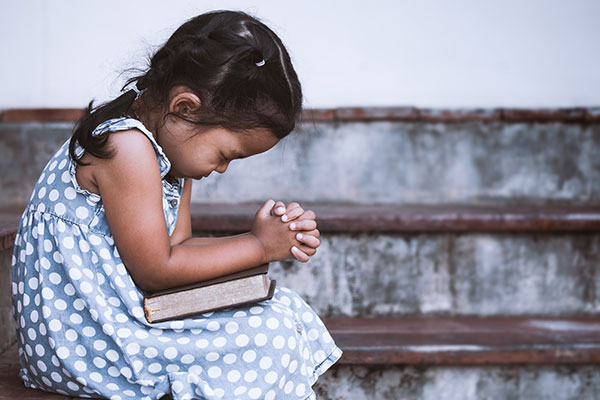
 Millions of people turn to Catholic Online for prayers, Daily Readings, saints, Catholic education and answers about their Faith. Most will never donate. But if Catholic Online has given you more than $5 worth of value this year, we're asking you to do something very simple: Give $5 today.
Your Catholic Voice Foundation also supports Catholic Online School, which has served 2.2 million student enrollments in 193 countries. We don't believe a family's ability to pay should determine whether a child can receive a Catholic education. If we've given you something of value, please give something back.
DONATE TODAY >>A Life-and-Death Document From Britain
FREE Catholic Classes
Bishops' Text Takes On Bioethical and Family Issues
LONDON, JUNE 13, 2004 (Zenit) - The Catholic bishops of England and Wales recently published a lengthy document on bioethical and family issues, called "Cherishing Life." At the May 26 press conference that launched the document, Bishop Christopher Budd of Plymouth, one of the text's writers, said: "The multiplicity of issues underlines the complexity of living in our present world."
He noted: "The clear articulation of principles and values seeks to show the importance of a principled approach to moral questions."
In its foreword, the document says that living in a society that enables us to flourish "require(s) the building of an ethos of life that protects persons from womb to tomb, especially the most vulnerable." Yet, the document perceives "signs of a culture of death," in such factors as abortion, pressure for euthanasia, diminishing respect for the elderly and a lack of protection for marriage and the family.
Rise of relativism
After a brief section explaining the context of modern society, the document lays out the factors that should guide moral decisions. Human beings, explains the document, "have a unique kind of life with the possibility of understanding themselves and living responsibly." This life is endowed with "an inherent dignity shared by all human beings," which in turn forms the basis for an objective moral order and universal human rights.
The bishops observe that a number of attempts have been made to codify human rights, among others by the United Nations and the European Union. But the concept of rights used in these declarations should be examined carefully, the prelates warn: "Personal autonomy is not the only human good, and an adequate theory of rights will place the need for individual freedoms in the context of the common good."
"Cherishing Life" also warns against false modes of reasoning in determining moral choices. Basing decisions on utilitarian grounds of maximizing the happiness of the greatest number of people not only ignores that there are some acts morally wrong in themselves, but can easily lead to discrimination against minorities.
Equally wrong is the tendency to base a moral decision on personal feelings, or to maintain that it is a purely private matter, as in "'I feel this is wrong, but I can't impose my moral views on others.'" Not only is such reasoning often applied inconsistently, but also "moral relativism is harmful if it leads people to remain silent in the face of injustice," warns the document.
For its part the Church offers guidance on moral matters based not only on rational argument, but also on Scripture and Christian tradition. From the mystery of the Trinity the Church draws its truth for personal relationships: "Treating people morally and respectfully involves recognizing them as persons." And to the question of who is to be recognized as a person the English and Welsh bishops refer to the parable of the Good Samaritan, arguing that the concept of neighbor should "be used in a wide and inclusive sense."
After explaining the part each person's character and conscience play in making moral decisions the document goes on to deal with the Church's role in teaching morality. "Cherishing Life" acknowledges that some Catholics have difficulty in accepting certain teachings. "Yet Catholics have a right to receive the fullness of the Church's teaching and they have a corresponding duty to adhere to that teaching," the document says. At the same time the Church is called upon to help those "who struggle in the moral life, offering compassion and understanding to those who fail to discern and to live out God's loving will."
The document here specifically refers to conflicts that can arise on the issue of the right to life of the unborn. The Christian position on this can even be at odds with the law, and individuals may suffer discrimination because of their faithfulness to moral principles: "Here the Christian bears witness to the dignity of human life, to the inviolability of the moral order, and to the holiness of God's law."
The end?
"Cherishing Life" then deals with a variety of subjects.
-- When does life begin? "Each embryo is a living being," and even though the distinctive human qualities may not appear until later, "we should not judge things only by how they appear at one particular time; we must also consider what they have in them to become." This teaching has a long history, notes the document. In fact, from the first century Christians held that the life in the womb was sacred and inviolable.
-- When does life end? Traditionally, Christians held death to occur when body and soul are separated. Modern medicine has made the diagnosis of death more difficult, but the document refers to what John Paul II said in August 2000, when he referred to "the complete and irreversible cessation of all brain activity." Further thought needs to be given on this issue, and the bishops warn against a definition offered by the British government. "Death must not be redefined so that it includes patients who are alive but who are judged to be 'as good as dead.'"
-- Sexuality. The bishops explain that the human body is seen as part of the goodness of creation. The body then has value and significance and sexual activity "needs to be expressed and integrated in a fully human way." This is done when sexual intercourse takes place within the context of "genuine, exclusive and committed love." To help guide their sexual desires, Christians, both single and married, are called upon to develop the virtue of chastity.
-- Homosexuality. The Church rejects unjust discrimination, violence or abuse against homosexuals. However, the document also clearly distinguishes between a homosexual orientation and the sexual expression of such an orientation. Sexual activity is licit only in the context of a marital relationship between a man and a woman. The bishops also reject the attempt to extend the concept of marriage to include homosexual unions.
-- Married life. "Married life has great value and importance as a special form of personal relationship." The Church also teaches that marriage is a gift from God and a vocation in which the couple is joined together by God. The Church holds, following Jesus, that marriage is indissoluble. The document calls for greater support for marriage and family life, and for better preparation of couples before marriage.
-- Infertility. The bishops observe that many couples have been able to have children through techniques such as in vitro fertilization. However these methods have a "darker side." The drawbacks include discarding human embryos considered as unfit, treating children as a commodity, and undermining the sense of biological parenthood through sperm donation or surrogate mothers.

-- Acting justly. "Cherishing Life" also has a section on matters related to justice. This is not just a question of recognizing the equal dignity of all human beings, explains the document, "but also of seeing in them what God is calling them to be, as fellow heirs of the kingdom of heaven." This section touches on issues such as the allocation of health-care resources, scientific research, abortion, genetic research and questions regarding war and peace.
Each of us, notes the document toward the end, "has a common responsibility to help build a culture that upholds the worth of every human life, especially that of the most vulnerable."
Contact
Catholic Online
https://www.catholic.org
CA, US
Catholic Online - Publisher, 661 869-1000
info@yourcatholicvoice.org
Keywords
Family, Life, Church, Bioethics, Bishops
More Catholic PRWire
Showing 1 - 50 of 4,716
A Recession Antidote
Randy Hain
Monaco & The Vatican: Monaco's Grace Kelly Exhibit to Rome--A Review of Monegasque-Holy See Diplomatic History
Dna. Maria St. Catherine Sharpe, t.o.s.m., T.O.SS.T.
The Why of Jesus' Death: A Pauline Perspective
Jerom Paul
A Royal Betrayal: Catholic Monaco Liberalizes Abortion
Dna. Maria St.Catherine De Grace Sharpe, t.o.s.m., T.O.SS.T.
Embrace every moment as sacred time
Mary Regina Morrell
My Dad
JoMarie Grinkiewicz
Letting go is simple wisdom with divine potential
Mary Regina Morrell
Father Lombardi's Address on Catholic Media
Catholic Online
Pope's Words to Pontifical Latin American College
Catholic Online
Prelate: Genetics Needs a Conscience
Catholic Online
State Aid for Catholic Schools: Help or Hindrance?
Catholic Online
Scorsese Planning Movie on Japanese Martyrs
Catholic Online
2 Nuns Kidnapped in Kenya Set Free
Catholic Online
Holy See-Israel Negotiation Moves Forward
Catholic Online
Franchising to Evangelize
Catholic Online
Catholics Decry Anti-Christianity in Israel
Catholic Online
Pope and Gordon Brown Meet About Development Aid
Catholic Online
Pontiff Backs Latin America's Continental Mission
Catholic Online
Cardinal Warns Against Anti-Catholic Education
Catholic Online
Full Circle
Robert Gieb
Three words to a deeper faith
Paul Sposite
Relections for Lent 2009
chris anthony
Wisdom lies beyond the surface of life
Mary Regina Morrell
World Food Program Director on Lent
Catholic Online
Moral Clarity
DAN SHEA
Pope's Lenten Message for 2009
Catholic Online
A Prayer for Monaco: Remembering the Faith Legacy of Prince Rainier III & Princess Grace and Contemplating the Moral Challenges of Prince Albert II
Dna. Maria St. Catherine Sharpe
Keeping a Lid on Permissiveness
Sally Connolly
Glimpse of Me
Sarah Reinhard
The 3 stages of life
Michele Szekely
Sex and the Married Woman
Cheryl Dickow
A Catholic Woman Returns to the Church
Cheryl Dickow
Modernity & Morality
Dan Shea
Just a Minute
Sarah Reinhard
Catholic identity ... triumphant reemergence!
Hugh McNichol
Edging God Out
Paul Sposite
Burying a St. Joseph Statue
Cheryl Dickow
George Bush Speaks on Papal Visit
Catholic Online
Sometimes moving forward means moving the canoe
Mary Regina Morrell
Action Changes Things: Teaching our Kids about Community Service
Lisa Hendey
Easter... A Way of Life
Paul Spoisite
Papal initiative...peace and harmony!
Hugh McNichol
Proclaim the mysteries of the Resurrection!
Hugh McNichol
Jerusalem Patriarch's Easter Message
Catholic Online
Good Friday Sermon of Father Cantalamessa
Catholic Online
Papal Address at the End of the Way of the Cross
Catholic Online
Cardinal Zen's Meditations for Via Crucis
Catholic Online
Interview With Vatican Aide on Jewish-Catholic Relations
Catholic Online
Pope Benedict XVI On the Easter Triduum
Catholic Online
Holy Saturday...anticipation!
Hugh McNichol
Come Grow With Us
Sign up and walk the Catholic journey with millions around the world.
Receive inspiring emails on saints, daily readings, and free faith-building resources—no cost, ever.
Catholic Online Is Free. But We Need Your Help.
Please Watch
- 7 Morning Prayers
- Mysteries of the Rosary
- Litany of the Bl. Virgin Mary
- Popular Saints
- Popular Prayers
- Female Saints
- Saint Feast Days by Month
- Stations of the Cross
- St. Francis of Assisi
- St. Michael the Archangel
- The Apostles' Creed
- Unfailing Prayer to St. Anthony
- Pray the Rosary








Copyright 2026 Catholic Online. All materials contained on this site, whether written, audible or visual are the exclusive property of Catholic Online and are protected under U.S. and International copyright laws, © Copyright 2026 Catholic Online. Any unauthorized use, without prior written consent of Catholic Online is strictly forbidden and prohibited.
Catholic Online is a Project of Your Catholic Voice Foundation, a Not-for-Profit Corporation. Your Catholic Voice Foundation has been granted a recognition of tax exemption under Section 501(c)(3) of the Internal Revenue Code. Federal Tax Identification Number: 81-0596847. Your gift is tax-deductible as allowed by law.