 Hi readers, it seems you use Catholic Online a lot; that's great! It's a little awkward to ask, but we need your help. If you have already donated, we sincerely thank you. We're not salespeople, but we depend on donations averaging $14.76 and fewer than 1% of readers give. If you donate just $5.00, the price of your coffee, Catholic Online School could keep thriving. Thank you. Help Now >
Augustine Moreto y Cabaña
FREE Catholic Classes
Spanish dramatist; b. at Madrid, 9 April, 1618, d. at Toledo, 28 Octoher, 1669. He received what little academic training he had at the University of Alcalá de Henares and graduated Licentiate in Arts in 1639. From a very early age he began to write for the stage, and it is known that from 1640, probably through his friendship with Calderón, his plays began to be produced. The Spanish drama had reached the height of its success during Moreto's boyhood, and a gradual decline had set in. The clergy began to preach against plays as they were then given, and in 1644 the Royal Council instituted radical reforms by reducing the number of dramatic companies, modifying stage costumes, and establishing a strict censorship. It was furthermore ordered that, thenceforth no comedies were to be played but those of an historical nature, or those dealing with the lives of the saints. This accounts for the fact that for a time, Moreto devoted himself to this kind of drama. Like many famous writers of his time, Moreto received Holy orders toward the end of his life, though it is not known exactly when he did so. He entered the household of the Cardinal Archbishop of Toledo, Don Baltasar de Moscoso, and in 1659 joined the Brotherhood of St. Peter.

In 1654 twelve of his plays were published in one volume under the title of "First Part of the Comedies of Moreto". Among them may be mentioned "El lindo Don Diego", "Los jueces de Castilla" dealing with the life of Peter the Cruel, "San Franco de Sena", and "Trampa Adelante".
As a writer, Moreto lacked the creative genius of some of his contemporaries, but he excelled them all in knowledge of stagecraft, in the power of coming quickly to the point in evolving his plots. He also excelled in the variety of his characters and in depicting human passions, while at character drawing he was a master surpassed by none. He handles a humorous situation with great delicacy of touch, and is at his best in comedies of the lighter and gayer sort. His best play "El desdén con el desdén" (Disdain met with Disdain), published at Valencia in 1676, is borrowed from Lope de Vega's "Milagros del desprecio" (Scorn works Wonders), and is generally conceded to be better than the original. Molière, in his "Princesse d'Elide", tried to repeat Moreto's success, but fell far short of his model. The "Biblioteca de Autores Españoles", XXXIX (Madrid, 1856) contains a collection of Moreto's plays with a biography of the author by Luis Fernandez Guerra.
Hi readers, it seems you use Catholic Online a lot; that's great! It's a little awkward to ask, but we need your help. If you have already donated, we sincerely thank you. We're not salespeople, but we depend on donations averaging $14.76 and fewer than 1% of readers give. If you donate just $5.00, the price of your coffee, Catholic Online School could keep thriving. Thank you. Help Now >
We ask you, humbly: don't scroll away.
Hi readers, it seems you use Catholic Online a lot; that's great! It's a little awkward to ask, but we need your help. If you have already donated, we sincerely thank you. We're not salespeople, but we depend on donations averaging $14.76 and fewer than 1% of readers give. If you donate just $5.00, the price of your coffee, Catholic Online School could keep thriving. Thank you.Help Now >
Join the Movement
When you sign up below, you don't just join an email list - you're joining an entire movement for Free world class Catholic education.


-

-
Mysteries of the Rosary
-
St. Faustina Kowalska
-
Litany of the Blessed Virgin Mary
-
Saint of the Day for Wednesday, Oct 4th, 2023
-
Popular Saints
-
St. Francis of Assisi
-
Bible
-
Female / Women Saints
-
7 Morning Prayers you need to get your day started with God
-
Litany of the Blessed Virgin Mary


Sacrifices of Faith: The Pro-Life Legacies of St. Gianna and Jessica Hanna
-
How to love God by caring for our bodies
-
Pope Francis calls for negotiations to End Russia-Ukraine War
-
Pope Francis Contemplates Return to U.S. for United Nations Assembly Address
-
Pope Francis Calls on Faithful to Embrace Faith, Hope, and Charity in New Teaching Series


Daily Catholic
- Daily Readings for Monday, April 29, 2024
- St. Catherine of Siena: Saint of the Day for Monday, April 29, 2024
- Prayer for the Dead # 3: Prayer of the Day for Monday, April 29, 2024
- Daily Readings for Sunday, April 28, 2024
- St. Peter Chanel: Saint of the Day for Sunday, April 28, 2024
- Prayer before a Crucifix: Prayer of the Day for Sunday, April 28, 2024
 Daily Readings for Monday, April 29, 2024
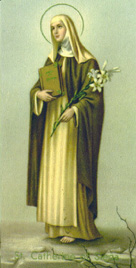 St. Catherine of Siena: Saint of the Day for Monday, April 29, 2024
 Prayer for the Dead # 3: Prayer of the Day for Monday, April 29, 2024


Copyright 2024 Catholic Online. All materials contained on this site, whether written, audible or visual are the exclusive property of Catholic Online and are protected under U.S. and International copyright laws, © Copyright 2024 Catholic Online. Any unauthorized use, without prior written consent of Catholic Online is strictly forbidden and prohibited.
Catholic Online is a Project of Your Catholic Voice Foundation, a Not-for-Profit Corporation. Your Catholic Voice Foundation has been granted a recognition of tax exemption under Section 501(c)(3) of the Internal Revenue Code. Federal Tax Identification Number: 81-0596847. Your gift is tax-deductible as allowed by law.