We ask you, humbly: don't scroll away.
Hi readers, it seems you use Catholic Online a lot; that's great! It's a little awkward to ask, but we need your help. If you have already donated, we sincerely thank you. We're not salespeople, but we depend on donations averaging $14.76 and fewer than 1% of readers give. If you donate just $5.00, the price of your coffee, Catholic Online School could keep thriving. Thank you.Help Now >
Claudio Monteverde
FREE Catholic Classes
A distinguished musician, born at Cremona, May, 1567; died at Venice, 29 Nov., 1643. He studied under Ingegneri (composer of the "Responsoria", that until recently were regarded as by Palestrina ), and at the age of sixteen he published a book of canzonets, followed by four volumes of madrigals. Although the majority of his early works show little trace of the inventive genius which afterwards revolutionized the prevalent system of harmony, one of his madrigals, printed in 1592, is remarkable for its many suspensions of the dominant seventh, and its inversion, as also suspended ninths. He was appointed Maestro di Cappella to the Duke of Mantua in 1602 and in 1613, was elected Maestro at Venice in succession to Martinengo, at a salary of three hundred ducats a year. So highly was he appreciated at St. Mark's that in 1616, the Procuratori increased his salary to five hundred ducats. From that date until his death he produced numerous choral compositions, as also operas, cantatas, ballets, most of which cannot now be traced. Fortunately, the score of his opera "Orfeo", printed in 1609, has come down to us, and is quite sufficient to indicate the inventive powers of a musician who broke away from the trammels of the older school and created a school of his own.

Monteverde not only showed his genius in his dramatic writing but in the employment of new instrumental effects, and the combination of instruments in the theatre band. In his interlude written for the festival at the palace of Girolamo Mocenigo, he employed the device of an instrumental tremolo, till then unknown. Another novel effect was his employment of trombones to accompany the "Gloria" and "Credo" of a Mass, in 1631. At this date he was studying for the priesthood, and he was ordained in 1633. Six years later he composed an opera "Atone" for the opera house of San Cassiano, followed by two others, and a ballet for the carnival at Piacenza, in 1641. His enduring fame consists in his use of unprepared discords, his improvement of recitative, his development of orchestral resources and his revolution of instrumentation. He may justly be claimed as the founder of dramatic music, as we now understand it, and he anticipated Wagner in the employment of Leitmotiv .

 Hi readers, it seems you use Catholic Online a lot; that's great! It's a little awkward to ask, but we need your help. If you have already donated, we sincerely thank you. We're not salespeople, but we depend on donations averaging $14.76 and fewer than 1% of readers give. If you donate just $5.00, the price of your coffee, Catholic Online School could keep thriving. Thank you. Help Now >
Join the Movement
When you sign up below, you don't just join an email list - you're joining an entire movement for Free world class Catholic education.


-

-
Mysteries of the Rosary
-
St. Faustina Kowalska
-
Litany of the Blessed Virgin Mary
-
Saint of the Day for Wednesday, Oct 4th, 2023
-
Popular Saints
-
St. Francis of Assisi
-
Bible
-
Female / Women Saints
-
7 Morning Prayers you need to get your day started with God
-
Litany of the Blessed Virgin Mary


Sacrifices of Faith: The Pro-Life Legacies of St. Gianna and Jessica Hanna
-
How to love God by caring for our bodies
-
Pope Francis calls for negotiations to End Russia-Ukraine War
-
Pope Francis Contemplates Return to U.S. for United Nations Assembly Address
-
Pope Francis Calls on Faithful to Embrace Faith, Hope, and Charity in New Teaching Series


Daily Catholic
- Daily Readings for Monday, April 29, 2024
- St. Catherine of Siena: Saint of the Day for Monday, April 29, 2024
- Prayer for the Dead # 3: Prayer of the Day for Monday, April 29, 2024
- Daily Readings for Sunday, April 28, 2024
- St. Peter Chanel: Saint of the Day for Sunday, April 28, 2024
- Prayer before a Crucifix: Prayer of the Day for Sunday, April 28, 2024
 Daily Readings for Monday, April 29, 2024
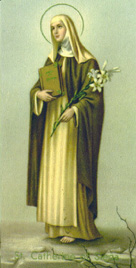 St. Catherine of Siena: Saint of the Day for Monday, April 29, 2024
 Prayer for the Dead # 3: Prayer of the Day for Monday, April 29, 2024

We ask you, humbly: don't scroll away.
Hi readers, it seems you use Catholic Online a lot; that's great! It's a little awkward to ask, but we need your help. If you have already donated, we sincerely thank you. We're not salespeople, but we depend on donations averaging $14.76 and fewer than 1% of readers give. If you donate just $5.00, the price of your coffee, Catholic Online School could keep thriving. Thank you.Help Now >

Copyright 2024 Catholic Online. All materials contained on this site, whether written, audible or visual are the exclusive property of Catholic Online and are protected under U.S. and International copyright laws, © Copyright 2024 Catholic Online. Any unauthorized use, without prior written consent of Catholic Online is strictly forbidden and prohibited.
Catholic Online is a Project of Your Catholic Voice Foundation, a Not-for-Profit Corporation. Your Catholic Voice Foundation has been granted a recognition of tax exemption under Section 501(c)(3) of the Internal Revenue Code. Federal Tax Identification Number: 81-0596847. Your gift is tax-deductible as allowed by law.