We ask you, humbly: don't scroll away.
Hi readers, it seems you use Catholic Online a lot; that's great! It's a little awkward to ask, but we need your help. If you have already donated, we sincerely thank you. We're not salespeople, but we depend on donations averaging $14.76 and fewer than 1% of readers give. If you donate just $5.00, the price of your coffee, Catholic Online School could keep thriving. Thank you.Help Now >
Ausonio Franchi
FREE Catholic Classes
The pseudonym of CRISTOFORO BONAVINO, philosopher ; b. 24 February, 1821, at Pegli, province of Genoa ; d. 12 September, 1895, at Genoa. He entered the ecclesiastical state, and some time after his ordination to the priesthood, was appointed director of an institution for secondary education at Genoa. Soon, however, he became imbued with the doctrines of French positivism and German criticism. Doubts arose in his mind, followed by an internal struggle which he describes in his work on the philosophy of the Italian schools. At the same time, important political events were taking place in Italy, culminating in the revolution of 1848. Misled, as he later says of himself, by a political passion, and also by a kind of philosophical passion, Franchi abandoned the priest's habit and office in 1849, and assumed the name of Ausonio Franchi (i.e. free Italian), indicating thereby his break with his own past and his new aspirations. Henceforth all his talents were devoted to the cause of intellectual and political liberty. The dogmatic authority of the Church and the despotic authority of the State are the objects of his incessant attacks. Combining Kant's phenomenalism and Comte's positivism, he falls into a sort of relativism and agnosticism. For him, religious truth and reason, Catholicism and freedom, are irreconcilable, and Franchi does not hesitate in his choice.
In 1854 he founded the "Ragione", a religious, political, and social weekly which was a means of propagating these ideas. Terenzio Mamiani, then Minister of Education, appointed him professor of the history of philosophy in the University of Pavia (1860), and later (1863) in the University of Milan, where he remained until 1888. No work was published by him between 1872 and 1889. A change was again taking place in his mind, not now due to passion, but to the professor's more mature reflection. It led to the publication of Franchi's last work, in which he announces his return to the Church, criticizes his former works and arguments, and denounces the opinions and principles of his earlier writings. His works are: "Elementi di Grammatica generale applicati alle due lingue italiana e latina" (Genoa, 1848-49), under the name of Cristoforo Bonavino. Under the name of Ausonio Franchi he wrote "La Filosofia delle scuole italiane" (Capolago, 1852; "Appendice", Genoa, 1853); "La religione del secolo XIXo" (Lausanne, 1853); "Studi filosofici e religiosi: Del Sentimento" (Turin, 1854); "Il Razionalismo del Popolo" (Geneva, 1856); "Letture sulla Storia della Filosofia moderna; Bacone, Descartes, Spinoza, Malebranche" (Milan, 1863); "Sulla Teorica del Giudizio" (Milan, 1870); "La Caduta del Principato ecclesiastico e la Restaurazione dell' Impero Germanico" (Milan, 1871); "Saggi di critica e polemica" (Milan, 1871-72). He also edited "Appendice alle Memorie politiche di Felice Orsini" (Turin, 1858); "Epistolario di Giuseppe La Farina" (Milan, 1869(; and Scritti politici di Giuseppe La Farina" (Milan, 1870).


Join the Movement
When you sign up below, you don't just join an email list - you're joining an entire movement for Free world class Catholic education.
-

-
Mysteries of the Rosary
-
St. Faustina Kowalska
-
Litany of the Blessed Virgin Mary
-
Saint of the Day for Wednesday, Oct 4th, 2023
-
Popular Saints
-
St. Francis of Assisi
-
Bible
-
Female / Women Saints
-
7 Morning Prayers you need to get your day started with God
-
Litany of the Blessed Virgin Mary

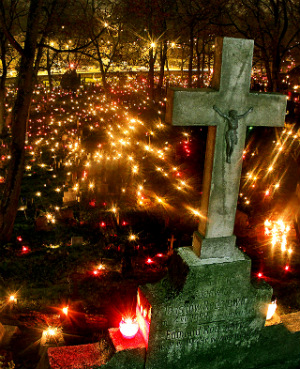
All Saints' Day, Halloween and All Souls' Day: What's the difference?
-
Should Christians Celebrate Halloween?
-
Since when did Halloween become a Christian holiday?
-
ADORABLE: A Little Boy's Heartfelt Lunchtime Prayer
-
Scientists Decode 3,000-Year-Old Babylonian Tablet, Revealing Potential Location of Noah's Ark
Daily Catholic
- Daily Readings for Friday, November 01, 2024
- St. Valentine Berrio-Ochoa: Saint of the Day for Friday, November 01, 2024
- Litany of the Saints: Prayer of the Day for Friday, November 01, 2024
- Daily Readings for Thursday, October 31, 2024
- St. Wolfgang: Saint of the Day for Thursday, October 31, 2024
- Memorare: Prayer of the Day for Thursday, October 31, 2024
 Daily Readings for Friday, November 01, 2024
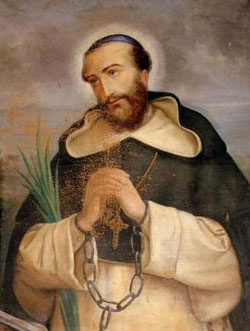 St. Valentine Berrio-Ochoa: Saint of the Day for Friday, November 01, 2024
 Litany of the Saints: Prayer of the Day for Friday, November 01, 2024


Copyright 2024 Catholic Online. All materials contained on this site, whether written, audible or visual are the exclusive property of Catholic Online and are protected under U.S. and International copyright laws, © Copyright 2024 Catholic Online. Any unauthorized use, without prior written consent of Catholic Online is strictly forbidden and prohibited.
Catholic Online is a Project of Your Catholic Voice Foundation, a Not-for-Profit Corporation. Your Catholic Voice Foundation has been granted a recognition of tax exemption under Section 501(c)(3) of the Internal Revenue Code. Federal Tax Identification Number: 81-0596847. Your gift is tax-deductible as allowed by law.