 Hi readers, it seems you use Catholic Online a lot; that's great! It's a little awkward to ask, but we need your help. If you have already donated, we sincerely thank you. We're not salespeople, but we depend on donations averaging $14.76 and fewer than 1% of readers give. If you donate just $5.00, the price of your coffee, Catholic Online School could keep thriving. Thank you. Help Now >
Diocese of Zante
FREE Catholic Classes
(ZACYNTHOS).
This Greek diocese, the only suffragan of the Archdiocese of Corfu , is permanently united with the Diocese of Cephalonia. The diocese includes the Islands of Cephalonia, Zante, Ithaca, Santa Maura or Leucas, and Cerigo or Cynthera. Among 170,000 inhabitants there are scarcely 1200 Catholics of the Latin Rite. The diocese contains 2 secular priests, 4 Capuchin Fathers, 1 brother, 3 main stations and 1 auxiliary station, 7 churches and chapels. As early as the fourth century the Island of Zante was the see of a Catholic bishop, whose successors fell away to the Greek Schism. About 1200 a Catholic Latin diocese was again established in Zante, and in 1222 this was united with the Diocese of Cephalonia, which is also mentioned in the fourth century and later became schismatic. In 1386 both dioceses wee made suffragans of the Archdiocese of Corfu. After the union of the Ionian Island with Greece in 1863, the Catholics were much oppressed by the schismatics. At the present time the diocese has no bishop of its own but is administered by the Archbishop of Corfu, and does not seem to increase in strength.

Join the Movement
When you sign up below, you don't just join an email list - you're joining an entire movement for Free world class Catholic education.


-

-
Mysteries of the Rosary
-
St. Faustina Kowalska
-
Litany of the Blessed Virgin Mary
-
Saint of the Day for Wednesday, Oct 4th, 2023
-
Popular Saints
-
St. Francis of Assisi
-
Bible
-
Female / Women Saints
-
7 Morning Prayers you need to get your day started with God
-
Litany of the Blessed Virgin Mary


Sacrifices of Faith: The Pro-Life Legacies of St. Gianna and Jessica Hanna
-
How to love God by caring for our bodies
-
Pope Francis calls for negotiations to End Russia-Ukraine War
-
Pope Francis Contemplates Return to U.S. for United Nations Assembly Address
-
Pope Francis Calls on Faithful to Embrace Faith, Hope, and Charity in New Teaching Series


Daily Catholic
- Daily Readings for Monday, April 29, 2024
- St. Catherine of Siena: Saint of the Day for Monday, April 29, 2024
- Prayer for the Dead # 3: Prayer of the Day for Monday, April 29, 2024
- Daily Readings for Sunday, April 28, 2024
- St. Peter Chanel: Saint of the Day for Sunday, April 28, 2024
- Prayer before a Crucifix: Prayer of the Day for Sunday, April 28, 2024
 Daily Readings for Monday, April 29, 2024
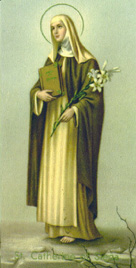 St. Catherine of Siena: Saint of the Day for Monday, April 29, 2024
 Prayer for the Dead # 3: Prayer of the Day for Monday, April 29, 2024


Copyright 2024 Catholic Online. All materials contained on this site, whether written, audible or visual are the exclusive property of Catholic Online and are protected under U.S. and International copyright laws, © Copyright 2024 Catholic Online. Any unauthorized use, without prior written consent of Catholic Online is strictly forbidden and prohibited.
Catholic Online is a Project of Your Catholic Voice Foundation, a Not-for-Profit Corporation. Your Catholic Voice Foundation has been granted a recognition of tax exemption under Section 501(c)(3) of the Internal Revenue Code. Federal Tax Identification Number: 81-0596847. Your gift is tax-deductible as allowed by law.