Bioethics battle is between contrary visions of the human person, says Rome professor
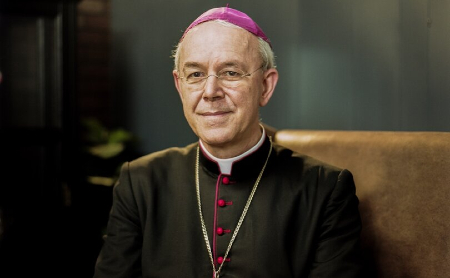
LEXINGTON, KY (Cross Roads) - In the field of bioethics, two contrary visions of the human person are engaged in a “fierce battle” with far-reaching implications for the human race, a professor of bioethics told a Lexington group Feb. 22 at the Catholic Center in Lexington.
Br. Than spoke in Lexington, during a two-week speaking tour of the U.S. and Canada.
“The inherent dignity is found metaphysically in (the) individual… The human person is an end in himself and never to be used as a means,” Br. Than said, adding that human beings are never to be treated as merchandise or degraded by classification as non- or less-than-human.
The truth about the human person, he said, exists at both the empirical and the philosophical levels.
By contrast, the liberal utilitarian view shuns any notion of inherent value and reduces the human person, by classification, to the individual’s capacity for thought, for independence or autonomy, for the ability to feel or relate to others, and freedom from suffering. In other instances, the utilitarian position coins new terms, such as “pre-embryo” and “activated egg,” to describe early life or assigns “arbitrary” timelines for life to begin, such as 14 days or implantation.
However, Br. Than said, bioethics requires a “right view of the human person…because anything else will have disastrous consequences.”
Communism, the source of cultural havoc
Br. Than traced utilitarian thinking back to the philosophies spawned by the Industrial Revolution (late 18th century) and the injustices of the then-newly industrialized world which influenced the thinking of Karl Marx, whose philosophy became the template for communism.
“Communism brought a lot of the havoc and miseries that we experience today,” Br. Than said, adding that ideas spark action and move the broader culture.
The bioethics professor also said cultural relativism and pluralism make no judgments about right or wrong and consider freedom an “absolute and everyone should do whatever they want.”
He offered several “snapshots” of how the utilitarian view is making inroads into the common culture: Chinese scientists have combined human and rabbit cells; a professor of bioethics in England has said that people should be able to sell their internal organs in order to rise above poverty; and a Sydney, Australia, hospital removed a woman from dialysis, because of her suffering and the burden of costs.
“Twenty years ago, these news (items) would make headlines…nowadays we’ve become desensitized to this kind of abuse,” Br. Than said.
Ideas, movements, and agendas are “not spontaneous,” he said. Rather, they are forwarded and financed by people who want to change the culture and are often abetted by the media.
At various times in the past 30 years, the abortion, euthanasia, and same-sex marriage movements have launched major propaganda offensives, in order to make acceptance of these movements part of the cultural landscape.
Br. Than said the notion of “privacy” introduced in the contraception case Griswold v. Connecticut (1965) and ensconced as a right in Roe v. Wade (1973) was cited in a 1994 assisted suicide case, an example of logic filtering down through culture.
He said this cultural osmosis is “very dangerous” and “geared toward changing families and changing culture.”
The attack of the clones
Br. Than, a self-described sci-fi buff, reacted to news earlier in the month that Korean scientists had successfully cloned human. When he was younger, he said, he thought cloning was “fantastic,” like the Harrison Ford movie “Blade Runner.”
“Is it sci-fi or reality? The line is not so clearly drawn these days,” Br. Than said.
These various attacks on human life, he said, “are not just theoretical… It’s going to affect your family. It’s going to affect your children, your grandchildren.”
To promote the Catholic Church’s vision of human life and dignity in the culture, what is needed is a “new generation of Catholic intellectuals,” Br. Than said.
He told the 38 people present that they can take practical steps as Catholics by praying, studying the issues and church teaching, political activism, serving the weak and the poor, and by “work in the world of ideas” to explain the church’s “correct vision” of the human person.
Rate This Article
Leave a Comment
More Diocese News
- Newman Centers are anchor of faith at public colleges
- A Pinprick to Revive Devotion
- Family celebration: Utah women travel to India to meet with sponsored children
- Deportation of Wis. eighth-grader reveals immigration policy's painful side to class
- Mandatory drug testing to be implemented in Oklahoma City Catholic high schools
- Catechesis of the Good Shepherd ‘hands-on’ religious education gets a look in Texas
- Food versus fuel: Is biofuel production to blame for our present food shortage?
- Spirituality key to the dying patient’s ‘quality of life,’ says Catholic doctor
- Bioethics battle is between contrary visions of the human person, says Rome professor
Featured News
- Fr. Paul Schenck: Finding Living Faith on Catechetical Sunday
- The Movie Yellow: Incest as 'Normal' and Cassavates's Slides Into the World of Woes
- The Chicago School Teachers Strike Reveals the Need For School Choice
- The Sexual Barbarians and the Dissolution of Culture
- The Happy Priest Challenges Us to Ask: Who is Jesus to Me?
- Michael Coren on Canadian Public Schools: Teachers, leave those kids alone
- We Cannot Ignore Our Consciences: Cardinal Dolan On Religious Liberty
- In the Face of Danger, Successor of Peter Travels to Lebanon as a Messenger of Peace
- Reflections on the Dignity and Vocation of Women: Who or What?
Most Popular
Editorial: Is the Scandal Ridden Obama Administration Becoming a House of Cards? Read More
Did God make junk? Scientists say 98 percent of human genome is junk Read More
Courageous Cardinal Seán Patrick O'Malley Will Not Attend Boston College Commencement Read More
Why Pope Francis Doesn't Give Communion Read More
Dr. Roy Spencer on Global Warming, 'No one knows' Read More
Daily Readings
Reading 1, Acts 25:13-21
Some days later King Agrippa and Bernice arrived in Caesarea ... Read More
Psalm, Psalms 103:1-2, 11-12, 19-20
[Of David] Bless Yahweh, my soul, from the depths of my being, ... Read More
Gospel, John 21:15-19
When they had eaten, Jesus said to Simon Peter, 'Simon son of ... Read More
Saint of the Day
St. Paschal Baylon
May 17: Franciscan lay brother and mystic. Born to a peasant family at ... Read More
Latest Videos
Pope to Pontifical Missionary Works: Your work is still relevant View Video
Pope rails against dictatorship of the economy View Video
May Crowning of the Virgin Mary - St Philip The Apostle Catholic Church View Video
St Thomas Aquinas Catholic School Visit to Ogwen Cottage May 2013 View Video
May 17 - Homily: St. Paschal, Profound Love For The Eucharist View Video
Marketplace
Renewing the Priestly Heart
Reflection and renewal for priests. Based on insights of Cardinal ... Read More
Personalized Gifts : Baptisms, First Communion, Confirmation, and Weddings Read More


0 Comments