We have one question for you.
Has Catholic Online given you $5 worth of value this year? Maybe you came here for a prayer. Maybe you read today's Mass readings. Maybe you researched a saint. Maybe you needed an answer about the Catholic Faith. Maybe your child used Catholic Online School. If the answer is no, you don't owe us anything. Keep using Catholic Online. But if the answer is yes, we're asking you to give $5 today.
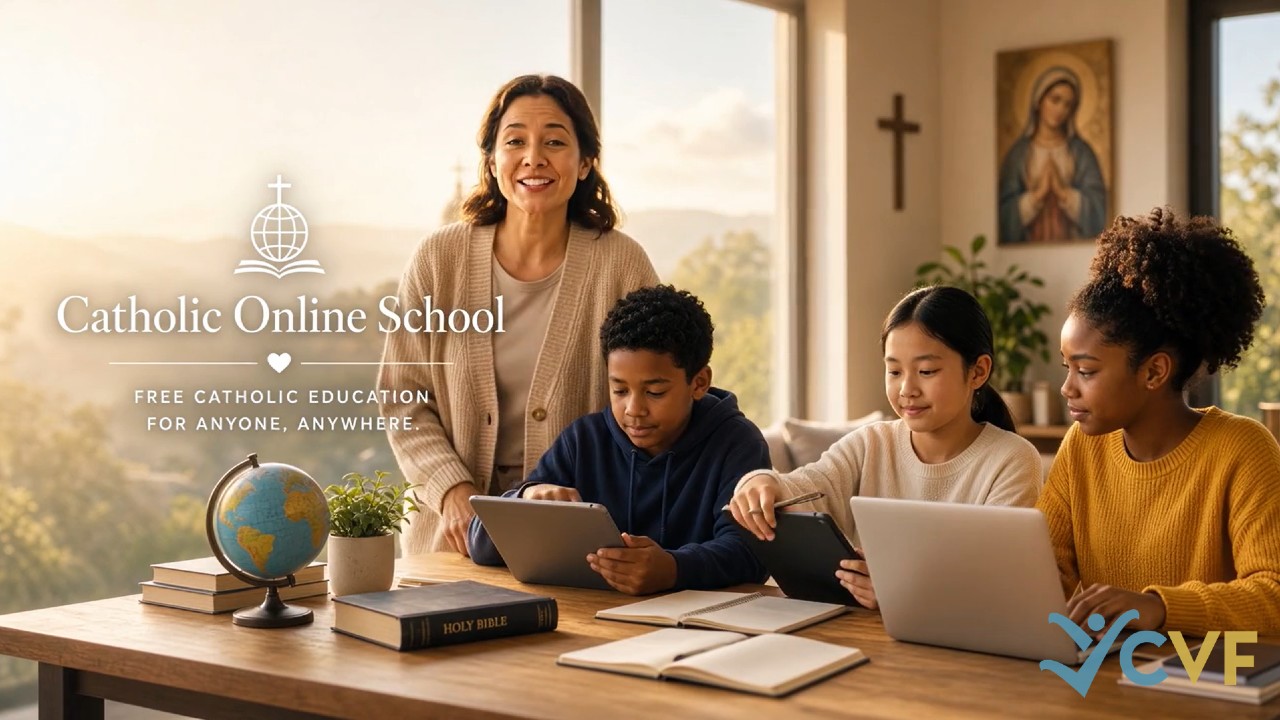
Catholic Online School has served 2.2 million student enrollments in 193 countries, and we continue working to make Catholic education available regardless of a family's financial circumstances. We don't need every reader to give. We need the readers who recognize the value of what they've received to stand behind it. Is Catholic Online worth $5 to you?
GIVE TODAY >>Christianity's Contribution
FREE Catholic Classes
Positive Effects of Religion Abound
By Father John Flynn, LC
ROME, NOV. 28, 2007 (Zenit) - The avalanche of books on the merits and demerits of God and religion continues. One of the latest works outlines many of the valuable contributions made by Christianity to society.
Dinesh D'Souza, a research scholar at the Hoover Institution at Stanford University, authored "What's So Great About Christianity" (Regnery Publishing). One of the biggest problems, he argued, is that many are ignorant about the role played for centuries by Christianity.
A common belief is that, after the high point of civilization during Greek and Roman times, the world was plunged into darkness during the Middle Ages, rescued only by the return to classical sources during the Renaissance. The next major advance was supposedly the Enlightenment, which opened up the doors to the modern age.
The destruction of the Roman Empire was not the work of Christianity, D'Souza pointed out. It was a combination of Roman decadence and the invasion of barbarians. It was Christianity, largely through the contribution of Catholic monks, who preserved learning and science, and also converted the barbarians.
Western art, literature and music also owe an enormous debt to Christianity. For many centuries, even artists who rejected Christianity produced work that was shaped by Christian themes, D'Souza added.
We also have a lot to thank Christianity for when it comes to the development of politics in Western civilization, the book continued. The teaching of Christ, in Matthew 22:21, to render to Caesar what belongs to Caesar and to God what belongs to God, is the origin of the separation of Church and state.
Limiting state power
Not only does this separation help prevent the excesses of a theocratic state, but it also gives origin to the concept of limited government, by advancing the concept that state power has a limit and must respect the conscience of each person.
Secularists, D'Souza warned, wish to empty the public square of religion and religious-based morality so they can monopolize society with their own views. This process brings with it the consequence of making religious believers into second-class citizens. The separation of Church and state should not be used as a weapon against Christianity, but in such a way that it is the source of social peace and religious freedom.
Human dignity is another prized contribution of Christianity examined by D'Souza. Not only does Christian teaching maintain the dignity of the sinner and those who fail, but it also calls for respect for those who are poor and lowly. "Christ produced the transformation of values in which the last became first, and values once scorned came to represent the loftiest human ideals," explained D'Souza.
Through its defense of human dignity Christianity also provided the inspiration for campaigns to end slavery, achieve democracy and promote self-government, as well as the first attempts to formulate a doctrine of human rights. Many modern formulations of human rights owe a lot to Christianity.
The Universal Declaration of Human Rights adopted by the United Nations in 1948, D'Souza pointed out, is based on the premise that all human lives have worth and that all lives count equally -- not a teaching to be found in all cultures and religions, but one derived from Christianity. If the West abandons Christianity, it may well put in danger the egalitarian values that Christian teaching brought into the world, he warned.
Turning back to the political realm, D'Souza added that the Christian notion of leaders who must consider themselves as servants of others provided the basis for political and social accountability. As a consequence, the political leader, the merchant, and the priest are called upon to serve people by attending to their needs.
Elevating society
Another vital contribution of Christianity is the high importance given to marriage and the family. The premises on which family life are based were introduced by Christianity into society, the book continued. No longer was family life subordinated to that of the state, but it was elevated through the sacrament of marriage. Christianity also introduced the concept of consent by both spouses as being a prerequisite of marriage, a vital instrument in preventing people being pressured into marriage against their will.
The Christian precepts of mutual love and charity were also behind the development of institutions such as hospitals and orphanages, taken for granted today by many who forget their origins.
Christianity also played a major role in the development of capitalism, according to D'Souza. Theologians in the Middle Ages were the first to develop the basic rules of economics, and the monasteries spread throughout Europe were flourishing centers of business activity.
Science too owes a lot to Christianity, in spite of the frequent portrayals of an opposition between them. D'Souza cited Benedict XVI's Regensburg address of Sept. 12, 2006, in which the Pope attributed the development of modern science to Christianity's emphasis on the importance of reason.
In fact, added D'Souza, modern science is based on the Christian contributions during medieval times, and the greatest breakthroughs in science were largely the work of Christians. In both the universities founded by the Church during the Middle Ages and in monasteries, scientific knowledge was preserved and developed.
Force for good
Religion's contribution to society is not limited to the past. Iam Buruma, writing on Sept. 29 in the opinion columns of the Los Angeles Times, observed that recent best-sellers would have us believe that religious faith is a sign of backwardness and the mark of primitives. "Religion, we are told, is responsible for violence, oppression, poverty and many other ills," noted Buruma.
Religion is not perfect, he admitted, but in many cases it is a force for good. He cited the recent example of Burmese monks, who defied the security forces of an oppressive regime.
Similarly, he added, Christians have stood up for democracy in countries such as the Philippines, South Korea and China.
"In a world of political oppression and moral corruption, religious values offer an alternative moral universe," argued Buruma.
When religion is greatly weakened, as in the Canadian province of Quebec, many social problems result, declared the archbishop of Quebec, Cardinal Marc Ouellet. "The real problem in Quebec is the spiritual void created by the religious and cultural rupture," he said during a presentation made to a government commission last Oct. 30.
According to a report of his comments, published by the Catholic Register on Nov. 2, the tensions between religions and cultures in Quebec are largely due to a loss of the traditional culture, combined with a crisis in the family and in education. Citizens, the cardinal continued, have been left "disoriented, unmotivated, subject to instability and leaning on transient, superficial values."
The Catholic leader also criticized anti-Catholic rhetoric in the news media that portrays the province's religious heritage as a source of shame and contempt. Such an attitude, he said, "destroys the soul of Quebec."
A similar alarm was sounded by Ireland's bishop of Limerick, Donal Murray, in a Nov. 6 speech on the relationship between the religious and secular spheres. "We have passed from a society where faith and public manifestations of faith were the norm, to a society which is, at best, embarrassed by any public visibility of faith," he commented.
We live in a time of conflict between faith and the ideology of secularism, Bishop Murray observed. Secularism would have us believe that "there is no answer to the fundamental questions about the meaning and destiny of human life." Faith, however, recognizes that we do not live on bread alone and places us "on solid ground, free to pursue what we are really seeking as individuals and as a society." Arguments that provide a healthy antidote to the often-superficial rants against religion being popularized today.
Contact
Catholic Online
https://www.catholic.org
CA, US
Catholic Online - Publisher, 661 869-1000
info@yourcatholicvoice.org
Keywords
Christian, Society, Life, Family, Religion, Flynn
More Catholic PRWire
Showing 1 - 50 of 4,716
A Recession Antidote
Randy Hain
Monaco & The Vatican: Monaco's Grace Kelly Exhibit to Rome--A Review of Monegasque-Holy See Diplomatic History
Dna. Maria St. Catherine Sharpe, t.o.s.m., T.O.SS.T.
The Why of Jesus' Death: A Pauline Perspective
Jerom Paul
A Royal Betrayal: Catholic Monaco Liberalizes Abortion
Dna. Maria St.Catherine De Grace Sharpe, t.o.s.m., T.O.SS.T.
Embrace every moment as sacred time
Mary Regina Morrell
My Dad
JoMarie Grinkiewicz
Letting go is simple wisdom with divine potential
Mary Regina Morrell
Father Lombardi's Address on Catholic Media
Catholic Online
Pope's Words to Pontifical Latin American College
Catholic Online
Prelate: Genetics Needs a Conscience
Catholic Online
State Aid for Catholic Schools: Help or Hindrance?
Catholic Online
Scorsese Planning Movie on Japanese Martyrs
Catholic Online
2 Nuns Kidnapped in Kenya Set Free
Catholic Online
Holy See-Israel Negotiation Moves Forward
Catholic Online
Franchising to Evangelize
Catholic Online
Catholics Decry Anti-Christianity in Israel
Catholic Online
Pope and Gordon Brown Meet About Development Aid
Catholic Online
Pontiff Backs Latin America's Continental Mission
Catholic Online
Cardinal Warns Against Anti-Catholic Education
Catholic Online
Full Circle
Robert Gieb
Three words to a deeper faith
Paul Sposite
Relections for Lent 2009
chris anthony
Wisdom lies beyond the surface of life
Mary Regina Morrell
World Food Program Director on Lent
Catholic Online
Moral Clarity
DAN SHEA
Pope's Lenten Message for 2009
Catholic Online
A Prayer for Monaco: Remembering the Faith Legacy of Prince Rainier III & Princess Grace and Contemplating the Moral Challenges of Prince Albert II
Dna. Maria St. Catherine Sharpe
Keeping a Lid on Permissiveness
Sally Connolly
Glimpse of Me
Sarah Reinhard
The 3 stages of life
Michele Szekely
Sex and the Married Woman
Cheryl Dickow
A Catholic Woman Returns to the Church
Cheryl Dickow
Modernity & Morality
Dan Shea
Just a Minute
Sarah Reinhard
Catholic identity ... triumphant reemergence!
Hugh McNichol
Edging God Out
Paul Sposite
Burying a St. Joseph Statue
Cheryl Dickow
George Bush Speaks on Papal Visit
Catholic Online
Sometimes moving forward means moving the canoe
Mary Regina Morrell
Action Changes Things: Teaching our Kids about Community Service
Lisa Hendey
Easter... A Way of Life
Paul Spoisite
Papal initiative...peace and harmony!
Hugh McNichol
Proclaim the mysteries of the Resurrection!
Hugh McNichol
Jerusalem Patriarch's Easter Message
Catholic Online
Good Friday Sermon of Father Cantalamessa
Catholic Online
Papal Address at the End of the Way of the Cross
Catholic Online
Cardinal Zen's Meditations for Via Crucis
Catholic Online
Interview With Vatican Aide on Jewish-Catholic Relations
Catholic Online
Pope Benedict XVI On the Easter Triduum
Catholic Online
Holy Saturday...anticipation!
Hugh McNichol
Come Grow With Us
Sign up and walk the Catholic journey with millions around the world.
Receive inspiring emails on saints, daily readings, and free faith-building resources—no cost, ever.
What if your child could learn the Catholic Faith for FREE?
Please Watch
- 7 Morning Prayers
- Mysteries of the Rosary
- Litany of the Bl. Virgin Mary
- Popular Saints
- Popular Prayers
- Female Saints
- Saint Feast Days by Month
- Stations of the Cross
- St. Francis of Assisi
- St. Michael the Archangel
- The Apostles' Creed
- Unfailing Prayer to St. Anthony
- Pray the Rosary







Copyright 2026 Catholic Online. All materials contained on this site, whether written, audible or visual are the exclusive property of Catholic Online and are protected under U.S. and International copyright laws, © Copyright 2026 Catholic Online. Any unauthorized use, without prior written consent of Catholic Online is strictly forbidden and prohibited.
Catholic Online is a Project of Your Catholic Voice Foundation, a Not-for-Profit Corporation. Your Catholic Voice Foundation has been granted a recognition of tax exemption under Section 501(c)(3) of the Internal Revenue Code. Federal Tax Identification Number: 81-0596847. Your gift is tax-deductible as allowed by law.