 Hi readers, it seems you use Catholic Online a lot; that's great! It's a little awkward to ask, but we need your help. If you have already donated, we sincerely thank you. We're not salespeople, but we depend on donations averaging $14.76 and fewer than 1% of readers give. If you donate just $5.00, the price of your coffee, Catholic Online School could keep thriving. Thank you. Help Now >
Wednesday's Audience - On St. Athanasius
FREE Catholic Classes
"God Is Accessible"
VATICAN CITY, JUNE 21, 2007 (Zenit) - Here is a translation of the address Benedict XVI delivered Wednesday at the general audience in Paul VI Hall. The reflection focused on St. Athanasius.
* * *
Dear Brothers and Sisters,
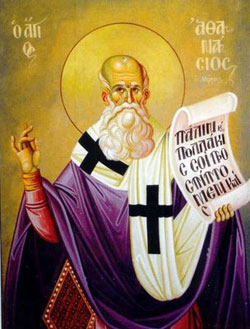
Continuing with our catechetical series on the great teachers of the ancient Church, today we turn our attention to St. Athanasius of Alexandria. This true protagonist of Christian tradition, just a few years after his death, was celebrated as a "pillar of the Church" by the great theologian and bishop of Constantinople, Gregory Nazianzen (Discourses 26:26). He has always been esteemed as a model of orthodoxy, in the East as well as in the West.
It was no mistake that Gian Lorenzo Bernini placed a statue of him among the four holy doctors of the Eastern and Western Church -- together with Ambrose, John Chrysostom and Augustine -- which surround the chair of Peter in the apse of the Vatican basilica.
Athanasius was, without a doubt, one of the most important and venerated Fathers of the ancient Church. But above all, this great saint is the passionate theologian of the incarnation of the "Logos," the Word of God, which -- as the prologue of the fourth Gospel says -- "was made flesh and lived among us" (John 1:14).
For this reason Athanasius was also the most important and tenacious adversary of the Arian heresy, which at that time was threatening faith in Christ by reducing him to a creature between God and man, following a recurring tendency in history that we still see in various forms today.
Athanasius was most likely born in Alexandria in Egypt, around the year 300, and received a good education before becoming a deacon and secretary of Bishop Alexander of Alexandria. The young cleric worked closely with his bishop, and accompanied him to, and took part in, the Council of Nicaea, the first such ecumenical council, called by the Emperor Constantine in May 325 to ensure the unity of the Church. The fathers of the Nicene Council dealt with many questions, foremost among them, the serious problems that had originated some years before with the preaching of the deacon Arius.
His theory threatened authentic faith in Christ, declaring that the "logos" was not true God, but a created God, a being not quite God and not quite man, but in the middle. And therefore the true God remained inaccessible to us. The bishops in Nicaea responded by emphasizing and establishing the "Symbol of Faith" that, later completed by the first Council of Constantinople, remained in the tradition of various Christian confessions and in the liturgy as the Nicene-Constantinopolitan Creed.
In this fundamental text -- which expresses the faith of the undivided Church, and which we still recite today, each Sunday in the Eucharistic celebration -- we see the Greek term "homooúsios," in Latin "consubstantialis," which means that the Son, the Logos, is "of the same substance" as the Father, is God from God, is his substance. Therefore the full divinity of the Son, which was negated by the Arians, is seen.
Upon the death of Bishop Alexander, Athanasius became, in 328, his successor as bishop of Alexandria. He immediately decided to fight against every compromise resulting from the Arian theories condemned by the Council of Nicaea. His resolve -- tenacious and at times very tough, even if necessary -- with those who were opposed to his election as bishop and above all against the adversaries of the Nicene Symbol, brought upon him the relentless hostility of the Arians and their supporters.
Despite the unequivocal outcome of the Council, which clearly affirmed that the Son was of the same substance as the Father, these erroneous ideas returned once more to dominate public thought -- so that even Arius himself regained popularity, and was supported for political motives by Emperor Constantine and then by his son Constantine II. The latter was not interested in theological truth but rather the unity of the empire and its political problems; he wanted to politicize the faith, making it more accessible -- in his view -- to all the subjects of the empire.
Hi readers, it seems you use Catholic Online a lot; that's great! It's a little awkward to ask, but we need your help. If you have already donated, we sincerely thank you. We're not salespeople, but we depend on donations averaging $14.76 and fewer than 1% of readers give. If you donate just $5.00, the price of your coffee, Catholic Online School could keep thriving. Thank you. Help Now >
The Arian crisis, which was thought to be resolved in Nicaea, continued in this way for decades, with difficult incidents and painful divisions in the Church. And five times -- during the 30 years between 336 and 366 -- Athanasius was forced to abandon the city, living 17 years in exile and suffering for the faith.
But during his forced absences from Alexandria, the bishop was able to sustain and spread -- in the West, first in Trier and then in Rome -- the faith of the Nicene Council and the ideals of monasticism, which were embraced in Egypt by the great hermit Anthony whose choice of life Athanasius followed closely. St. Anthony, with his spiritual strength, was the most important person in sustaining the faith of St. Athanasius.
After the definitive return to his see, the bishop of Alexandria was able to dedicate himself to religious pacification and the reorganization of the Christian community. He died on May 2, 373, the day in which we celebrate his liturgical feast.
The most famous work of the Alexandrian bishop is the treatise on the "Incarnation of the Word, " the divine "Logos" made flesh, like us, for our salvation.
In this work, Athanasius says, in a phrase that has become well known, that the Word of God "became man so that we might become God. He manifested himself by means of a body in order that we might perceive the unseen Father. He endured shame from men that we might inherit immortality" (54:3).
In fact, with his resurrection, the Lord made death disappear like "straw in the fire" (8:4). The fundamental idea of the entire theological battle of St. Athanasius was that God is accessible. He is not a secondary God, he is true God, and through our communion with Christ we can truly unite ourselves to God. He truly became "God with us."
Among the other works of this great Father of the Church -- which deal mainly with the events of the Arian crisis -- we recall the four letters that he addressed to his friend Serapion, bishop of Thmius, on the divine nature of the Holy Spirit, which was clearly affirmed.
And there are some 30 or so "festal" letters, written at the beginning of every year, to the Churches and monasteries of Egypt to indicate the date of Easter, but moreover to strengthen the ties among the faithful, reinforcing their faith and preparing them for that great solemnity.

Athanasius is also the author of meditative texts on the Psalms, which were vastly distributed, and a text that constituted a "best seller" of ancient Christian literature: the "Life of Anthony," the biography of St. Anthony the Abbot, written shortly after the death of this saint, while the bishop of Alexandria was in exile, living with the monks of the Egyptian desert. Athanasius was a friend of the great hermit, and even received one of the two sheepskins left by Anthony as his inheritance, together with the mantel that he himself had given him.
The biography of this beloved figure in Christian tradition contributed greatly to the spread of monasticism in the East and the West, as it became very popular and was soon translated twice in Latin and then in other Eastern languages.
The letter of this text, to Trier, is at the center of an emotional telling of the conversion of two ministers of the emperor, which Augustine mentions in the "Confessions" (VIII, 6:15) as a premise of his own conversion.
Athanasius showed that he had a clear awareness of the influence that the figure of Anthony could have on the Christian people.
In fact, he writes in the conclusion of this work: "And the fact that his fame has been blazoned everywhere; that all regard him with wonder, and that those who have never seen him long for him, is clear proof of his virtue and God's love of his soul. For not from writings, nor from worldly wisdom, nor through any art, was Anthony renowned, but solely from his piety toward God.
"That this was the gift of God no one will deny. For from whence into Spain and into Gaul, how into Rome and Africa, was the man heard of who dwelled hidden in a mountain, unless it was God who makes his own known everywhere, who also promised this to Anthony at the beginning? For even if they work secretly, even if they wish to remain in obscurity, yet the Lord shows them as lamps to lighten all, that those who hear may thus know that the precepts of God are able to make men prosper and thus be zealous in the path of virtue" ("Life of Anthony" 93, 5-6).
Yes, brothers and sisters! We have many reasons to thank St. Athanasius. His life, as that of Anthony and countless other saints, shows us that "those who draw near to God do not withdraw from men, but rather become truly close to them" ("Deus Caritas Est," 42).

[At the end of the audience, the Pope greeted the people in several languages. In English, he said:]
Dear Brothers and Sisters,
Continuing our catechesis on the great teachers of the ancient Church, we turn today to St. Athanasius of Alexandria. Athanasius is venerated in East and West alike as a pillar of Christian orthodoxy. Against the followers of the Arian heresy, he insisted on the full divinity and consubstantiality of the Son with the Father, and defended the faith of the Church as expressed in the Creed of the Council of Nicea. The Arian crisis did not end with the Council; indeed, for his resolute defense of the Nicene dogma, Athanasius was exiled from his see five times in thirty years. His many writings include the treatise On the Incarnation of the Word, which defends the full divinity of the Son, whose incarnation is the source of our salvation: "he became man so that we could become God." Athanasius also wrote a celebrated Life of Anthony, a spiritual biography of St. Anthony Abbot, whom he had known personally. This popular book had an immense influence in the spread of the monastic ideal in East and West. Like Anthony, Athanasius stands out as one of the great figures of the Church in Egypt, a "lamp" whose teaching and example even today light up the path of the entire Church.
I welcome the participants in the course organized by Foyer Unitas Lay Center. My greetings also go to the Brothers of the Poor of St. Francis Seraphicus. Upon all the English-speaking visitors present at today's Audience, especially those from England, Australia and the United States, I invoke God's abundant blessings.
© Copyright 2007 -- Libreria Editrice Vaticana
[The Pope then spoke in Italian:]
Today we celebrate the "World Day of the Refugee," promoted by the United Nations in order to promote attention for those who are forced to escape from their countries because they are in fear for their lives. Welcoming refugees and giving them hospitality is gesture of human solidarity, so that they will not feel isolated because of intolerance and disinterest. For Christians it is a concrete way to show evangelical love. I wish with all my heart that our brothers and sisters who suffer will be guaranteed exile and the recognition of their rights, and I invite the leaders of all nations to offer protection to those who find themselves in need.

I wish every good thing, to everyone. Thank you for your presence!
Contact
Catholic Online
https://www.catholic.org
CA, US
Catholic Online - Publisher, 661 869-1000
info@yourcatholicvoice.org
Keywords
St. Athanasius, Pope, Benedict, God, Alexandria, Constantinople
We ask you, humbly: don't scroll away.
Hi readers, it seems you use Catholic Online a lot; that's great! It's a little awkward to ask, but we need your help. If you have already donated, we sincerely thank you. We're not salespeople, but we depend on donations averaging $14.76 and fewer than 1% of readers give. If you donate just $5.00, the price of your coffee, Catholic Online School could keep thriving. Thank you.Help Now >
More Catholic PRWire
Showing 1 - 50 of 4,716
A Recession Antidote
Randy Hain
Monaco & The Vatican: Monaco's Grace Kelly Exhibit to Rome--A Review of Monegasque-Holy See Diplomatic History
Dna. Maria St. Catherine Sharpe, t.o.s.m., T.O.SS.T.
The Why of Jesus' Death: A Pauline Perspective
Jerom Paul
A Royal Betrayal: Catholic Monaco Liberalizes Abortion
Dna. Maria St.Catherine De Grace Sharpe, t.o.s.m., T.O.SS.T.
Embrace every moment as sacred time
Mary Regina Morrell
My Dad
JoMarie Grinkiewicz
Letting go is simple wisdom with divine potential
Mary Regina Morrell
Father Lombardi's Address on Catholic Media
Catholic Online
Pope's Words to Pontifical Latin American College
Catholic Online
Prelate: Genetics Needs a Conscience
Catholic Online
State Aid for Catholic Schools: Help or Hindrance?
Catholic Online
Scorsese Planning Movie on Japanese Martyrs
Catholic Online
2 Nuns Kidnapped in Kenya Set Free
Catholic Online
Holy See-Israel Negotiation Moves Forward
Catholic Online
Franchising to Evangelize
Catholic Online
Catholics Decry Anti-Christianity in Israel
Catholic Online
Pope and Gordon Brown Meet About Development Aid
Catholic Online
Pontiff Backs Latin America's Continental Mission
Catholic Online
Cardinal Warns Against Anti-Catholic Education
Catholic Online
Full Circle
Robert Gieb
Three words to a deeper faith
Paul Sposite
Relections for Lent 2009
chris anthony
Wisdom lies beyond the surface of life
Mary Regina Morrell
World Food Program Director on Lent
Catholic Online
Moral Clarity
DAN SHEA
Pope's Lenten Message for 2009
Catholic Online
A Prayer for Monaco: Remembering the Faith Legacy of Prince Rainier III & Princess Grace and Contemplating the Moral Challenges of Prince Albert II
Dna. Maria St. Catherine Sharpe
Keeping a Lid on Permissiveness
Sally Connolly
Glimpse of Me
Sarah Reinhard
The 3 stages of life
Michele Szekely
Sex and the Married Woman
Cheryl Dickow
A Catholic Woman Returns to the Church
Cheryl Dickow
Modernity & Morality
Dan Shea
Just a Minute
Sarah Reinhard
Catholic identity ... triumphant reemergence!
Hugh McNichol
Edging God Out
Paul Sposite
Burying a St. Joseph Statue
Cheryl Dickow
George Bush Speaks on Papal Visit
Catholic Online
Sometimes moving forward means moving the canoe
Mary Regina Morrell
Action Changes Things: Teaching our Kids about Community Service
Lisa Hendey
We ask you, humbly: don't scroll away.
Hi readers, it seems you use Catholic Online a lot; that's great! It's a little awkward to ask, but we need your help. If you have already donated, we sincerely thank you. We're not salespeople, but we depend on donations averaging $14.76 and fewer than 1% of readers give. If you donate just $5.00, the price of your coffee, Catholic Online School could keep thriving. Thank you.Help Now >
Easter... A Way of Life
Paul Spoisite
Papal initiative...peace and harmony!
Hugh McNichol
Proclaim the mysteries of the Resurrection!
Hugh McNichol
Jerusalem Patriarch's Easter Message
Catholic Online
Good Friday Sermon of Father Cantalamessa
Catholic Online
Papal Address at the End of the Way of the Cross
Catholic Online
Cardinal Zen's Meditations for Via Crucis
Catholic Online
Interview With Vatican Aide on Jewish-Catholic Relations
Catholic Online
Pope Benedict XVI On the Easter Triduum
Catholic Online
Holy Saturday...anticipation!
Hugh McNichol
Join the Movement
When you sign up below, you don't just join an email list - you're joining an entire movement for Free world class Catholic education.


-

-
Mysteries of the Rosary
-
St. Faustina Kowalska
-
Litany of the Blessed Virgin Mary
-
Saint of the Day for Wednesday, Oct 4th, 2023
-
Popular Saints
-
St. Francis of Assisi
-
Bible
-
Female / Women Saints
-
7 Morning Prayers you need to get your day started with God
-
Litany of the Blessed Virgin Mary


Daily Catholic
- Daily Readings for Thursday, May 02, 2024
- St. Athanasius: Saint of the Day for Thursday, May 02, 2024
- The Our Father: Prayer of the Day for Thursday, May 02, 2024
- Daily Readings for Wednesday, May 01, 2024
- St. Marculf: Saint of the Day for Wednesday, May 01, 2024
- To Saint Peregrine: Prayer of the Day for Wednesday, May 01, 2024
 Daily Readings for Thursday, May 02, 2024
 St. Athanasius: Saint of the Day for Thursday, May 02, 2024
 The Our Father: Prayer of the Day for Thursday, May 02, 2024

Copyright 2024 Catholic Online. All materials contained on this site, whether written, audible or visual are the exclusive property of Catholic Online and are protected under U.S. and International copyright laws, © Copyright 2024 Catholic Online. Any unauthorized use, without prior written consent of Catholic Online is strictly forbidden and prohibited.
Catholic Online is a Project of Your Catholic Voice Foundation, a Not-for-Profit Corporation. Your Catholic Voice Foundation has been granted a recognition of tax exemption under Section 501(c)(3) of the Internal Revenue Code. Federal Tax Identification Number: 81-0596847. Your gift is tax-deductible as allowed by law.